


Microsoft's (MSFT) Azure cloud business is facing fresh scrutiny as the company reportedly considers ways to reduce costs by as much as 20%, even as demand for its cloud and AI services remains strong. According to reports, Azure President Girish Bablani asked senior leaders in his roughly 11,500-person unit to identify potential cost reductions of at least 20%. Microsoft has pushed back on the report, saying Azure leadership has not directed teams to develop cost-cutting plans.
The reported cost-cutting discussions come at a time when Microsoft is seeing surging artificial intelligence (AI) infrastructure spending that puts pressure on margins. Meanwhile, Microsoft is ramping up its own AI-chip deployments and expects capital expenditures to remain elevated, highlighting the challenge of balancing rapid AI growth with profitability.
More Top Stocks Daily: Go behind Wall Street’s hottest headlines with Barchart’s Active Investor newsletter.
While a successful reduction in Azure expenses could improve operating leverage and help offset the massive costs of expanding AI capacity, the aggressive cuts could also raise questions about whether Microsoft is sacrificing investment to protect margins.
About Microsoft Stock
Microsoft Corporation is a global technology company headquartered in Redmond, Washington, with a broad portfolio spanning software, cloud computing, artificial intelligence, gaming, and productivity services. Its key businesses include Microsoft 365, Windows, LinkedIn, Xbox, and Azure, its cloud-computing platform. Microsoft has increasingly focused on AI, integrating AI capabilities across its products and expanding its cloud infrastructure to support growing demand and boasting a market cap of $3.9 trillion.
Microsoft's stock has delivered a 10% gain year-to-date (YTD), although its 4% advance over the past year reflects a more measured longer-term performance. The stock’s recent momentum has been stronger, with shares rising 8% over the past month as investors regained confidence in Microsoft’s AI and cloud growth outlook.
More recently, Microsoft’s announcement of its Maia 300 custom AI chip, which is designed to improve computing efficiency and reduce reliance on third-party accelerators, has provided another potential catalyst as investors focus increasingly on the profitability of AI infrastructure spending.
However, concerns about elevated capital expenditures, AI-related infrastructure costs, and broader volatility in technology stocks have limited MSFT stock’s longer-term gains. With Microsoft reportedly considering significant cost reductions within Azure, it will be worth watching closely for evidence that Microsoft can improve cloud economics while sustaining rapid AI-driven growth.
MSFT stock is currently trading at 27.46 times forward earnings and 12.07 times sales, a premium to industry peers.
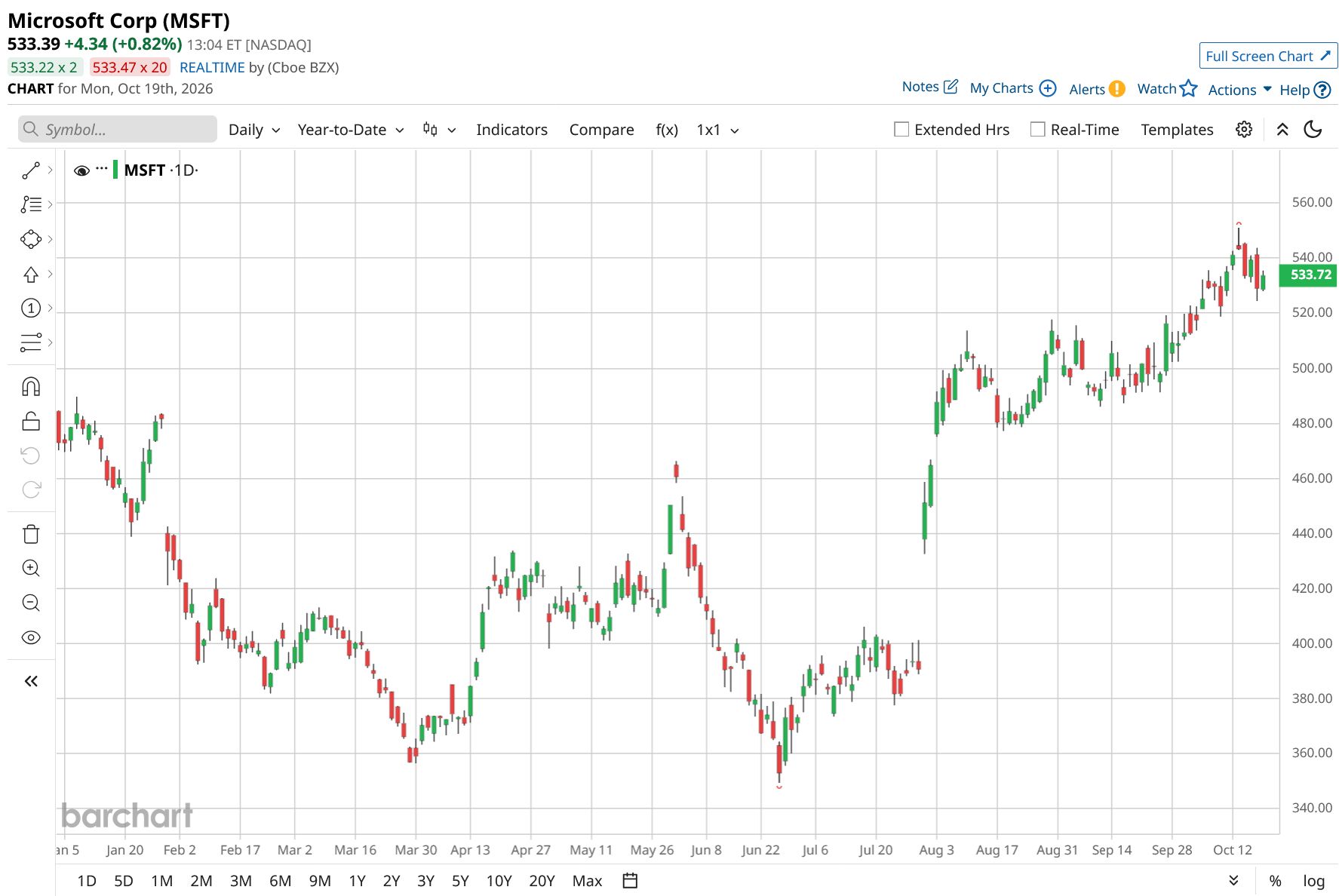 www.barchart.com
Q4 Results Demonstrate Continued Growth
Microsoft reported its fiscal fourth-quarter and full-year 2026 results on July 29, delivering strong growth as Azure and AI demand continued to drive the business.
For Q4 FY2026, revenue increased 18% year-over-year (YoY) to $90 billion. Operating income rose 18% to $40.6 billion, while net income jumped 31% to $35.8 billion. On a non-GAAP basis, net income increased 22% to $35.3 billion and EPS rose 23% to $4.74.
The strongest growth came from the cloud business. Intelligent Cloud revenue climbed 32% to $39.3 billion, with Azure and other cloud services revenue accelerating 43% YoY. Microsoft Cloud revenue rose 27% to $59.3 billion, while commercial remaining performance obligations surged 84% to $678 billion, providing significant visibility into future cloud revenue. Microsoft 365 Commercial cloud revenue increased 14%, LinkedIn revenue rose 12%, and Dynamics 365 revenue grew 13%. In contrast, More Personal Computing revenue declined 4% to $12.9 billion.
For full-year FY2026, Microsoft generated $331.8 billion in revenue, up 18%. On a non-GAAP basis, net income increased 22% to $128.8 billion and EPS rose 22% to $17.28.
Additionally, the company forecasted total revenue at a midpoint of approximately $90.4 billion and projected Azure growth of 45%. Microsoft also projected about $50 billion in capital expenditures for Q1 FY2027 and roughly $175 billion for calendar 2026, underscoring that the company intends to maintain substantial AI infrastructure spending despite ongoing investor concerns over the cost and profitability of its AI buildout.
Overall, the results reinforced that Azure growth is accelerating and AI adoption is expanding. However, the enormous AI-related capital spending highlights why investors are increasingly focused on whether Microsoft can convert its AI and cloud growth into sustainable margin expansion.
Meanwhile, analysts remain upbeat, projecting EPS of $19.65 for fiscal 2027, up 13.7% YoY, and anticipating a further 18.3% annual increase to $23.25 in fiscal 2028.
What Do Analysts Expect for MSFT Stock?
This month, UBS analyst Karl Keirstead raised MSFT stock’s price target to $675 from $525, while maintaining a “Buy” rating. The upgrade reflects UBS’ increased confidence in Azure and Microsoft 365 as Microsoft heads into its fiscal first-quarter results.
Plus, Jefferies analyst Brent Thill raised his price target on Microsoft to $650 from $575, while maintaining a “Buy” rating.
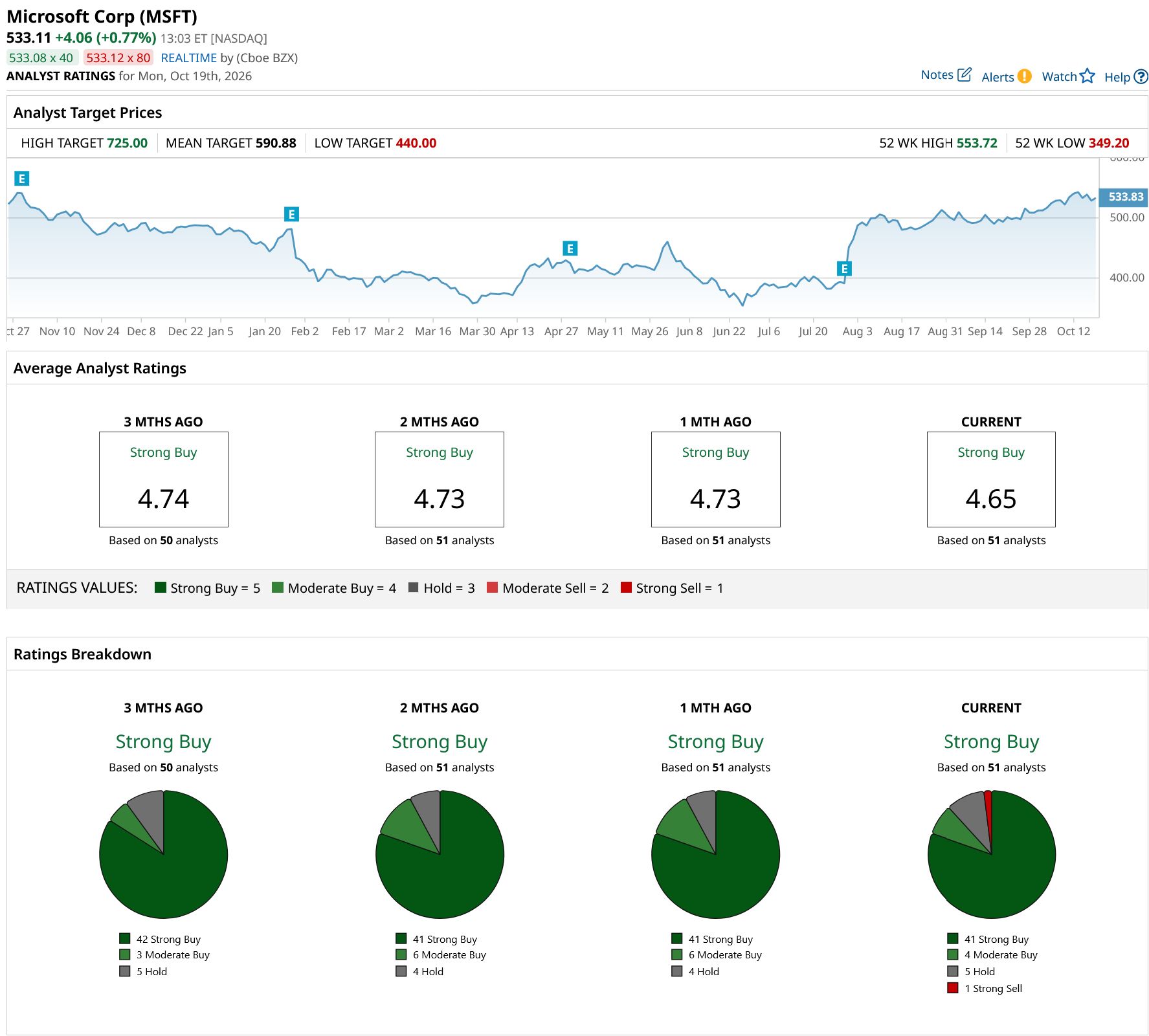
Overall, MSFT stock has a consensus “Strong Buy” rating. Of the 51 analysts covering the stock, 41 advise a “Strong Buy,” four suggest a “Moderate Buy,” five analysts recommend a “Hold” rating, and one offers a “Strong Sell.”
The average analyst price target for MSFT is $590.88, indicating a potential upside of 11%. The Street-high target price of $725 suggests that the stock could rally as much as 36%.
 www.barchart.com
On the date of publication, Subhasree Kar did not have (either directly or indirectly) positions in any of the securities mentioned in this article. All information and data in this article is solely for informational purposes. For more information please view the Barchart Disclosure Policy here.
More news from Barchart
Microsoft Cost Cuts: What a 20% Reduction at Azure Could Mean for MSFT Stock Microsoft’s New AI Model Adds to Its Bull Case, but Investors Should Wait for a Pullback Cathie Wood Just Sold $9.4M of SpaceX. Here’s Why Now May Not Be the Time to Buy Freshworks Stock Has Strong Momentum at New 52-Week Highs, But There’s 1 Reason for Caution