

Today’s investor population is divided into three types:
Investors who understand bonds from experience many years ago. Investors who think they understand bonds but don’t know what they don’t know. Investors who don’t know anything about bonds and don’t care.The fact is, bonds are not what most investors and traders think they are. And the era of treating them like they don’t matter is over. So you might as well learn how to make money in bonds – even if you do so kicking and screaming.
Join 200K+ Subscribers: Find out why the midday Barchart Brief newsletter is a must-read for thousands daily.
Don’t worry, bonds can be cool like stocks. Unless you are averse to making money when most of your friends aren’t.
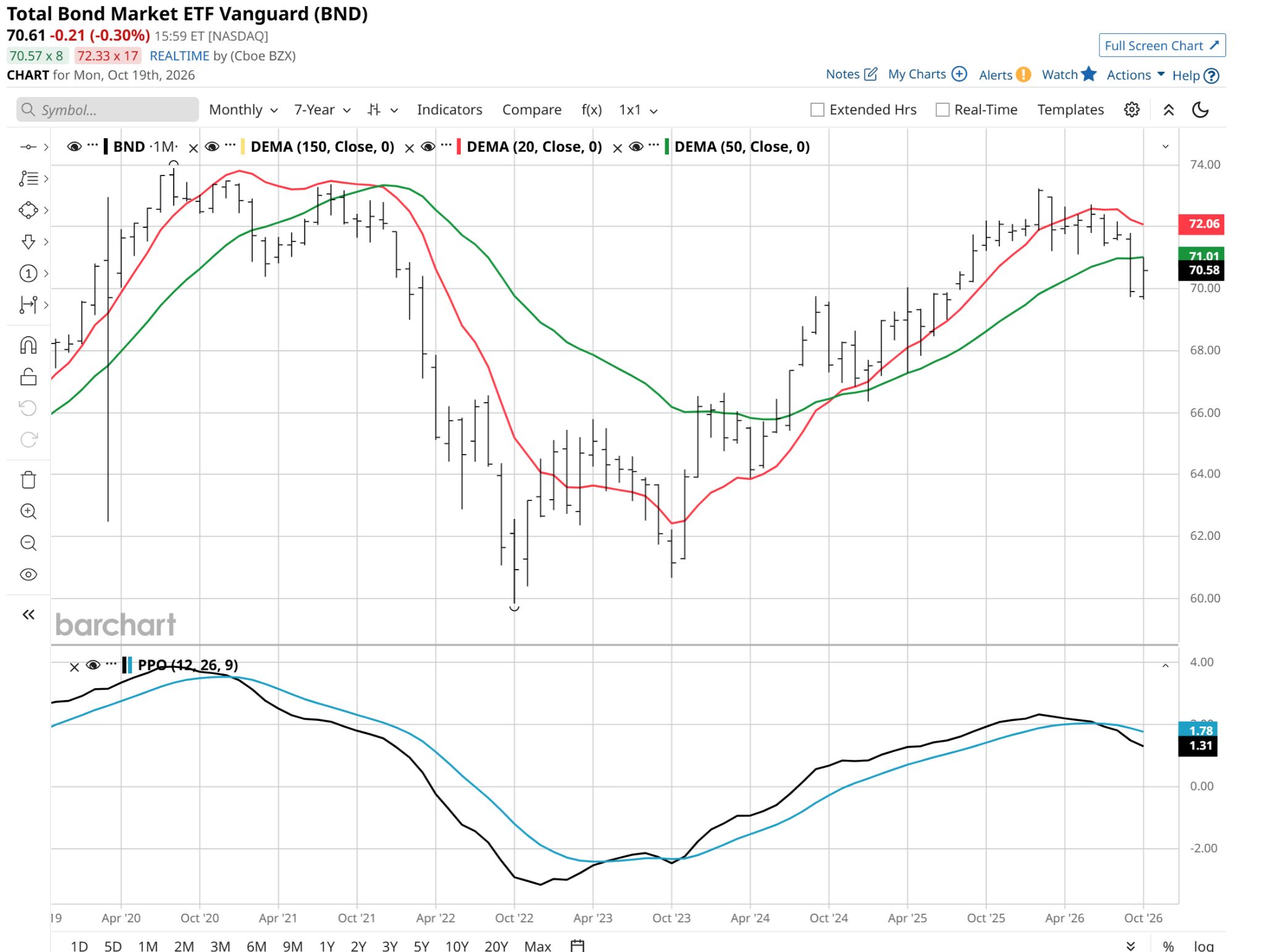
The typical wealth manager approach to bonds is to buy a generic bond index like the Vanguard Total Bond Market ETF (BND). However, bond ETFs left to fend for themselves can result in something like this:
 www.barchart.com
BND has gone this entire decade with only a very modest gain. For the past seven years, it is indeed up by about 4% total. Not per year, total! And this long-term chart does not scream “buy me aggressively.”
Is there a way to own a portfolio of bonds or bond ETFs, secure today’s 5%-ish rates, and not have to constantly look over your shoulder to make sure the principal doesn’t erode?
If you own certain bond ETFs or bonds directly, you’ll get money back when they mature. However, inflation might have made it so that maturity value buys a lot less than it did when you bought the bond exposure.
Welcome to the world of bond hedging. Here’s how it works.
I treat my bond portfolio like a sports team roster. I don’t bet everything on one outcome. I assign specific players to specific jobs depending on market conditions. Portfolio management is a team sport.
My “offense” in my bond ETF model portfolio is made up of ETFs that differ primarily by the years to maturity they track. I’m a Treasuries guy for now, as I do not trust the credit bond markets. There’s not enough extra return in it to justify the risk.
Now, let’s meet the defense
Let’s introduce the real stars of my hedged bond portfolio. The defense. These are just some of the rostered ETF “players” I move in and out of the lineup, to support the more staid and lower-turnover “offense.”
1. Simplify Interest Rate Hedge ETF (PFIX)
PFIX holds a foundation of safe, short-term T-bills (70%-80%) paired with payer swaptions on 20-year rates. Because it uses options, it offers “convexity” which is the formal name for investing small amounts to potentially make a lot more.
If it doesn’t do well, the smaller investment is a modest drag on returns. Even a tiny 1% to 2% position can deliver an outsized pop if long-term yields surge, shielding the rest of the bond ETF portfolio. Note that options suffer from time decay. PFIX is a tactical 3- to 18-month tool for rising-rate periods, not a permanent buy-and-hold asset.
2. ProShares Short 20+ Year Treasury ETF (TBF)
TBF offers a clean, straightforward hedge against falling bond prices.
It delivers the inverse (-1x) daily return of long-term Treasuries. If long bond prices drop 1%, TBF gains 1%. It avoids the severe compounding decay of leveraged inverse funds, although I use those in small sizes from time to time.
3. iShares Treasury Floating Rate Bond ETF (TFLO)
TFLO holds short-term Treasuries (typically 2-year maturities) whose coupon payments reset higher alongside prevailing market rates. You get price stability similar to short-term paper, but your payout automatically climbs if the rate environment heats up.
The Takeaway
Getting 5%+ on government-backed paper is the best income gift investors have received this century. That’s really my belief. The entire challenge is making sure you don’t give that 5% return right back in bond price losses.
By pairing that core foundation of defined-maturity bonds ETF or other ETFs to patrol the yield curve, with these and other hedging strategies, you don’t have to fear rising yields. You can lock in your income floor, keep your capital safe, and let macro interest rate and stock market volatility work for you instead of against you.
Rob Isbitts is a semi-retired CIO, former fiduciary investment advisor, Barchart columnist, and straight-talker. Download his new free e-book on hedged bond investing for retirement at ETFYourself.com. His research and model portfolios are at ROAR.PiTrade.com.
On the date of publication, Rob Isbitts did not have (either directly or indirectly) positions in any of the securities mentioned in this article. All information and data in this article is solely for informational purposes. For more information please view the Barchart Disclosure Policy here.
More news from Barchart
How Low Can Lumber Prices Fall This Winter? Stop Sleeping on Bonds: 3 ETFs to Buy So You Can Profit When Rates Rise What US Traders Need to Know About the Disastrous Day 1 Trading in the 'Korean CoreWeave,' Elice Group How Kevin Warsh Just Created a Buying Opportunity in T-Bond Futures