

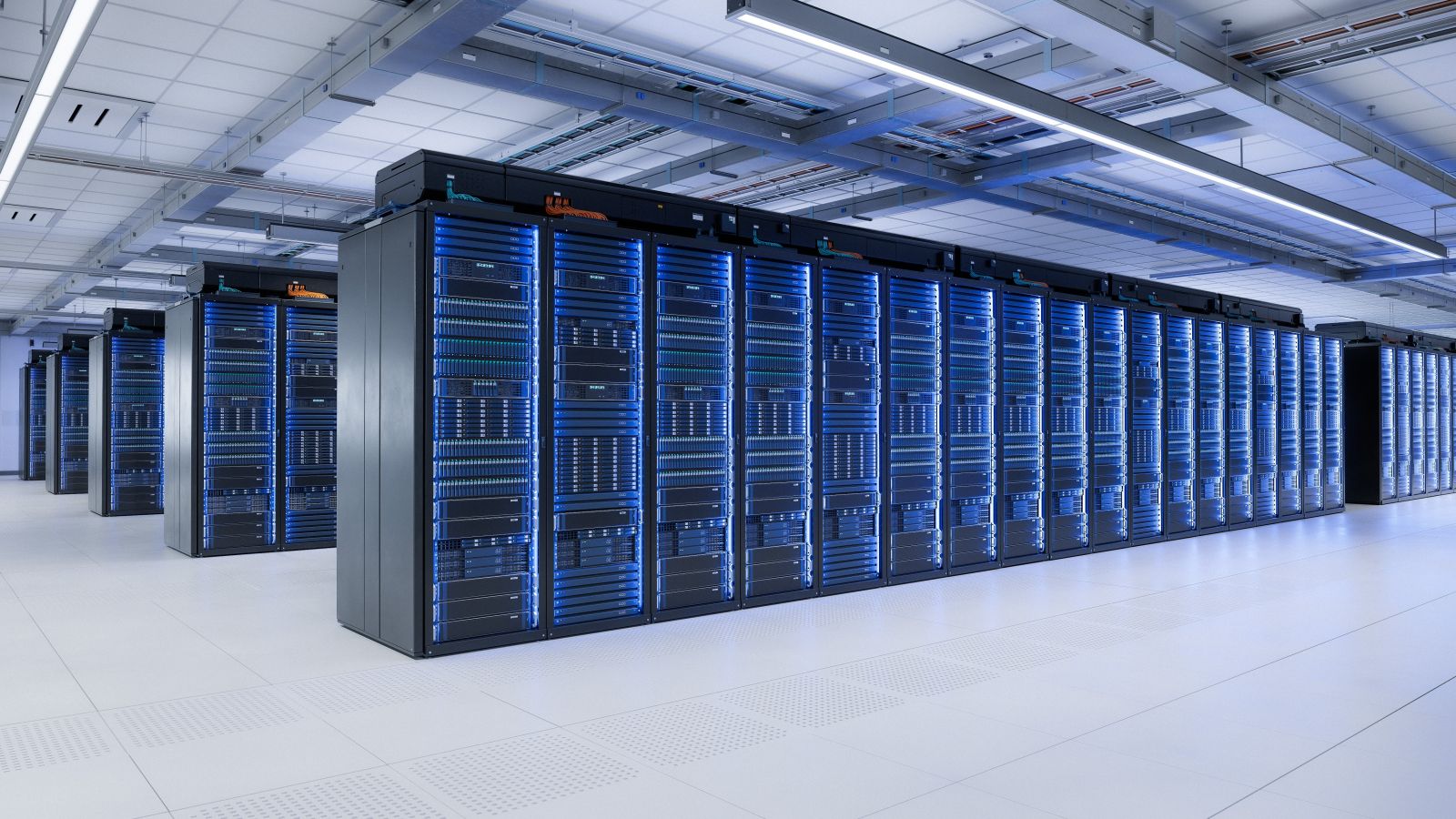
AI server maker Super Micro Computer (SMCI) has had quite a ride in the market in recent years. Once celebrated as a key player in the AI infrastructure market and one of the primary beneficiaries of the same, faulty accounting and audit issues, along with accusations of chip smuggling to China, have derailed its progress.
However, the clouds may have started clearing after the company's preliminary results for Q1 FY2027 were cheered by investors in Wednesday's trading session. This has also led to leading Wall Street firm Wedbush deeming it a “clear positive.” Elaborating on it further in a note to clients, analyst Matt Bryson of the firm said, “SMCI announced preliminary FQ1'27 results highlighted by revenue that looks to exceed prior guidance by ~$4B, with GMs also coming in above the guided range.”
More Top Stocks Daily: Go behind Wall Street’s hottest headlines with Barchart’s Active Investor newsletter.
About Super Micro Computer
Founded in 1993, Super Micro Computer is an important supplier in the AI infrastructure supply chain. Rather than designing the GPUs that train and run AI models, it builds the surrounding systems, including servers that house GPUs, connecting them to memory and networking equipment, managing power and cooling, and integrating them into data centers. Today, Super Micro's operations span the United States, Taiwan, the Netherlands, and Malaysia, while claiming that a significant portion of its systems are designed, developed, and manufactured in-house, distinguishing its model from competitors that outsource more of their system assembly.
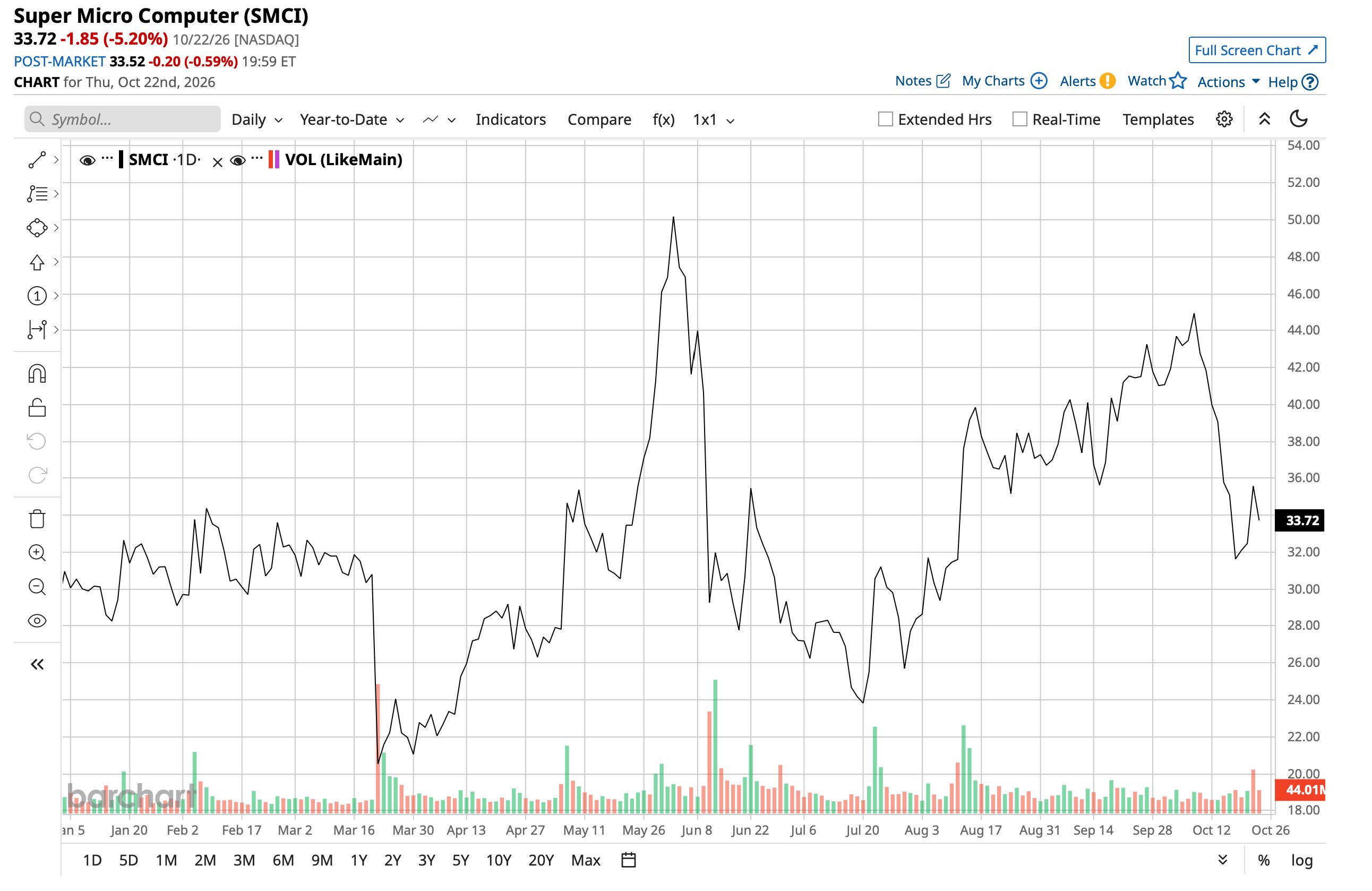
Valued at a market cap of $23.4 billion, SMCI stock is up 14% on a year-to-date (YTD) basis, only slightly outperforming the S&P 500 ($SPX). However, is this a false dawn? Let's find out.
 www.barchart.com
Preliminary Q1 Results Are a Start
The full Q1 results are slated to be released on Nov. 3, with the company having posted preliminary results several times before. Having said that, Super Micro expects revenues for Q1 to range between $18.5 billion and $19.5 billion, higher than the previous guidance of $14.5 billion to $15.5 billion. Encouragingly, the company expects higher gross margins too, expecting them to be between 12% and 12.5%, compared to 10.4% to 10.8%, earlier.
In Q4 2026, the company's latest full results were mixed, with an earnings beat but a revenue miss. Net sales grew by 91.4% from the previous year to $11.1 billion, along with improved gross margins of 17.6% versus 9.6% in the year-ago period. Yet, the sales figure missed the Street estimates by close to $450 million.
Earnings, however, jumped to $1.70 per share from $0.41 per share in the prior year, comfortably outpacing the consensus estimate of $0.92 per share. Notably, this was the third consecutive quarter of earnings beats from the company. Management forecasts Q1 2027 EPS to be between $1.01 and $1.10 per share, which is lower than the consensus estimate of $1.25 per share. However, the midpoint of the range would denote another impressive YoY growth rate of 201.4%.
Yet, for the full fiscal year ended June 30, 2026, net cash from operating activities turned negative, at -$6.8 billion from an inflow of $1.6 billion in 2025. A substantial increase in inventories and accounts receivable were the contributing factors. Overall, Super Micro ended the year with a cash balance of $7.5 billion, higher than its short-term debt levels of about $2 billion.
Meanwhile, SMCI's muted price performance over the past year is making it trade at undervalued levels currently. Its forward P/E, P/S, and P/B at 7.62, 0.33, and 1.51 are all below the sector medians of 22.02, 3.36, and 4.75, respectively.
Super Micro's Superpowers and Super Worries
Detached from its financials and corporate governance issues, Super Micro's products do have quite a few takers in the AI infrastructure market, primarily due to its specialization in cooling and Data Center Building Block Solutions (DCBBS) offering. While cooling addresses the physical limit on how much computing a room can support, DCBBS addresses the integration work that can delay a deployment even after the chips arrive.
Starting with cooling, Super Micro’s direct liquid cooling places cold plates on hot components, then moves heat through coolant, manifolds, and distribution units rather than relying entirely on room air. Its stated heat capture reaches up to 98% for critical electronics, essentially meaning heat is removed at the equipment-level. Notably, Super Micro also offers alternatives for buildings that were not designed around liquid cooling. Its rear door heat exchangers remove heat from server exhaust, with models rated from 10 to 120 kilowatts. They can work alongside direct liquid cooling or provide a route into denser computing with less disruption to an existing facility.
Meanwhile, DCBBS brings all of Super Micro's capabilities in one place, with customizable offerings. A customer can specify compute, storage, networking, rack power, cooling, management software, and deployment services as one validated design. For its Vera Rubin blueprint, Super Micro describes a scalable unit with 1,152 GPUs spread across 16 compute racks, supported by networking, storage, and cooling sized to the available power. In fact, in July, it said it had capacity to deliver up to 3,000 advanced racks a month, including 2,000 liquid-cooled racks. Thus, with DCBBS, a customer may therefore be buying a shorter path from ordered chips to usable computing, rather than a uniquely capable GPU. This is being reflected in the company's order backlog, which has reached record levels of $60 billion.
On the other hand, competitors Dell (DELL) and HPE (HPE) are not sitting idle. Market leader Dell is the clearest challenge to any claim that Super Micro alone can deliver a complete AI factory. Dell offers liquid-cooled Vera Rubin systems, rack power and cooling integration, storage, networking, software, and deployment services. Notably, in March, Dell said more than 4,000 customers were deploying its AI Factory with Nvidia (NVDA). This strength was reflected in its fiscal second quarter 2027 results, reported in September, where it showed $16.4 billion of AI server revenue, $60.9 billion of quarterly AI server orders, and a $95 billion AI backlog.
Analyst Opinion on SMCI Stock
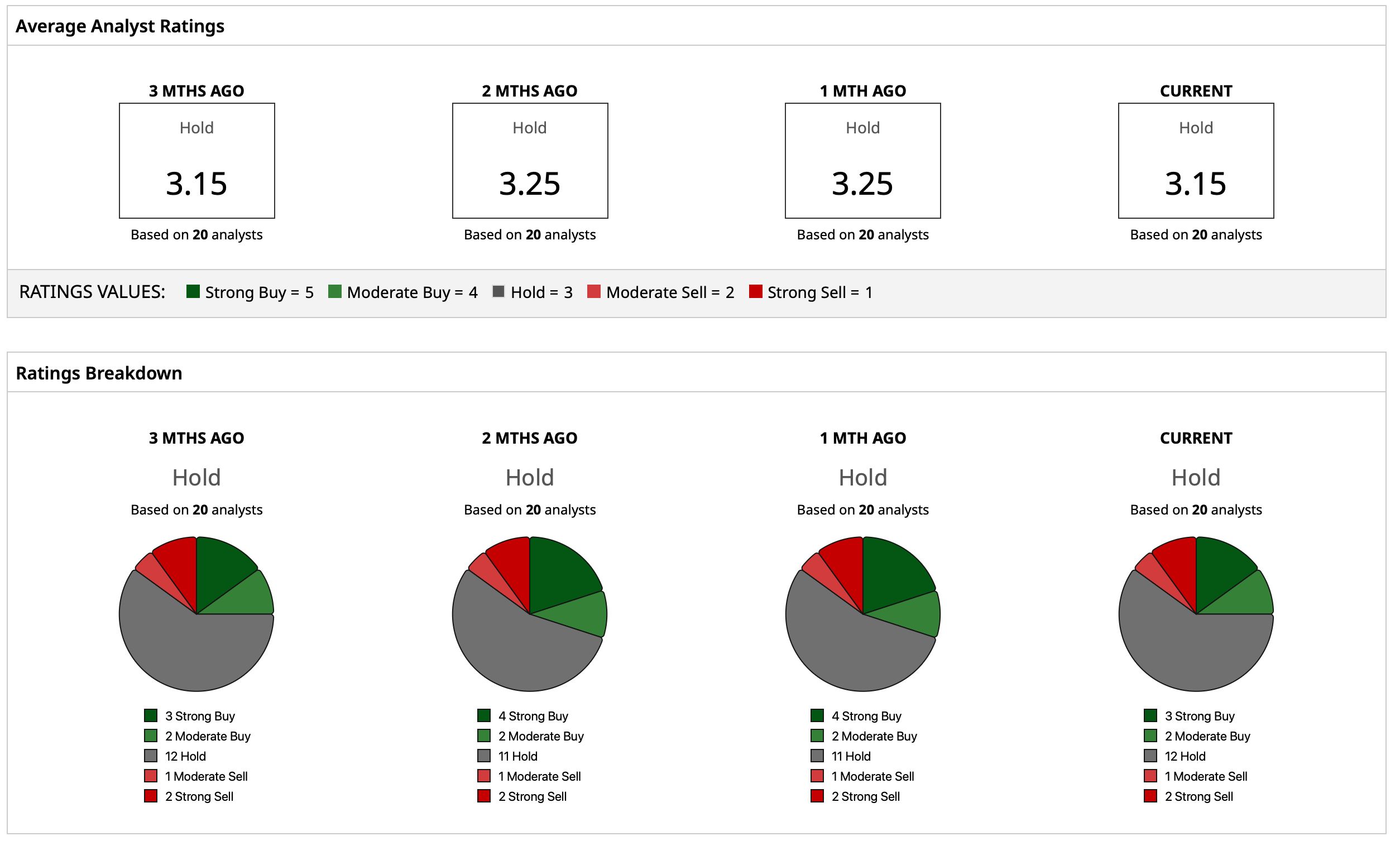
Considering all this, analysts attributed an overall consensus rating of “Hold” for SMCI stock. The mean target price of $43.19 denotes a potential upside of 28.1% from current levels. Out of 20 analysts covering the stock, three have a “Strong Buy” rating, two have a “Moderate Buy” rating, 12 have a “Hold” rating, one has a “Moderate Sell” rating, and two have a “Strong Sell” rating.
 www.barchart.com
On the date of publication, Pathikrit Bose did not have (either directly or indirectly) positions in any of the securities mentioned in this article. All information and data in this article is solely for informational purposes. For more information please view the Barchart Disclosure Policy here.
More news from Barchart
Wedbush Gives a Thumbs Up to Super Micro’s Preliminary Q1 Results. Troubles for SMCI Stock Could Finally Be in the Rear-View. Comcast Q3 Results Show Peacock and Wireless Gains Amid Widening Broadband Losses Nvidia Teams Up With 6 Supply Chain Partners to Expand Its Global AI Manufacturing Capacity Morgan Stanley Sees Amazon Stock Surging 100% with AWS Hitting $1 Trillion in Revenue Sooner Than People Think