

A laptop partnership might not sound like a turning point for a semiconductor giant. But with Qualcomm (QCOM) planning workforce cuts, its push into a new market gives shareholders something fresh to weigh alongside the tougher news.
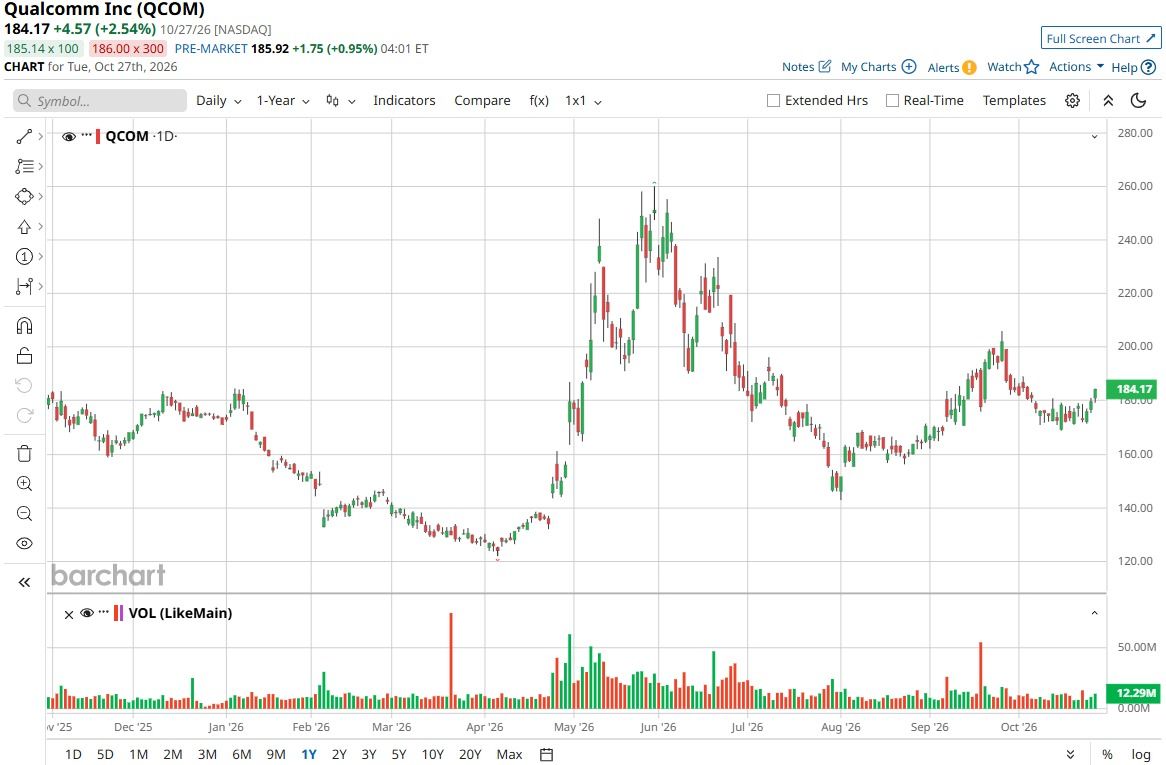
Qualcomm’s planned collaboration with Anduril to produce U.S. laptops does just that, raising questions about how much room the chipmaker has to grow beyond smartphones. The announcement also comes after a mixed stretch for QCOM stock. Shares closed at $164.79 on Oct. 30, with Qualcomm stock down almost 4% so far this year and down 7% over the past 52 weeks.
More Top Stocks Daily: Go behind Wall Street’s hottest headlines with Barchart’s Active Investor newsletter.
 www.barchart.com
Could this partnership become a meaningful step forward for Qualcomm stock? Let’s take a closer look.
What the Anduril Deal Really Means
Headquartered in San Diego, California, Qualcomm designs chips and develops wireless technologies for smartphones, vehicles, computers, and connected devices. It also licenses mobile communications patents worldwide. The company has a market capitalization of roughly $197.9 billion.
On Oct. 27, Qualcomm and Anduril unveiled BlueChip, a computer product line aimed at government, defense, first responders, and public safety organizations. Functional laptop prototypes already exist, with orders expected to open in 2027.
The partnership combines Qualcomm’s Snapdragon X Series processors with Anduril’s hardware development and domestic manufacturing capabilities. Qualcomm supplies the computing platform, including graphics and on-device artificial intelligence (AI), while Anduril plans to assemble circuit boards at its Arsenal 1 facility in Ohio. Its engineering work also involves adapting enclosures, batteries, and display glass to available U.S. materials and production methods.
That domestic focus comes with an important qualification. Suppliers in the United States and allied countries “account for more than 90% of the BlueChip prototypes’ component procurement cost.” A fully domestic supply chain remains a longer-term ambition rather than a commitment for the initial products.
The investment opportunity, therefore, rests on more than where the laptops are assembled. BlueChip could extend Snapdragon’s reach into specialized computing markets and establish a platform for additional products. However, the announcement includes no shipment targets, customer commitments, or revenue projections. That makes the partnership a potentially meaningful strategic step, but not yet a demonstrated earnings catalyst for Qualcomm stock.
How Qualcomm’s Core Business Stacks Up
Qualcomm’s third-quarter fiscal 2026 earnings report painted a mixed picture. Revenue totaled $9.94 billion, down 4% year-over-year (YOY), while net income fell to $2 billion.
Handsets remained a source of pressure, with revenue falling 20% to approximately $5.1 billion. Qualcomm attributed the weakness to elevated memory prices, higher manufacturing and input costs, and supply shortages. Adjusted EPS came in at $2.21 versus the $2.22 consensus estimate, while adjusted operating income reached $2.78 billion.
Operating cash flow reached $8.4 billion, while net cash flow widened to -$3.31 billion. That net outflow does not mean operations generated less cash, since operating cash flow and net cash flow measure different things.
Looking forward, Qualcomm forecast Q4 revenue of $10.1 billion at the midpoint and adjusted EPS outlook of $2.15 at the midpoint.
Qualcomm is also working to preserve its licensing revenue. Apple (AAPL) recently renewed its global patent license agreement with Qualcomm, effective April 1, 2027. The agreement covers the use of Qualcomm’s patented technology.
Qualcomm's planned acquisition of PickNik Robotics would add motion planning software to Qualcomm’s robotics offering. Qualcomm's industrial networking and robotics design win pipeline exceeds $7 billion, including more than $3.5 billion secured this year. These wins represent potential future business rather than booked revenue, making conversion into sales the next test.
Wall Street’s Expectations
Wall Street expects earnings to fall sharply when Qualcomm reports its September-quarter results on Nov. 4, after the market closes. Earnings are expected to fall 43% YOY to $1.46 per share, compared with $2.56 a year earlier.
While earnings are expected to decline, Bernstein analyst Stacy Rasgon has a “Hold” rating and a $165 price target for QCOM stock. That target is almost exactly in-line with current levels.
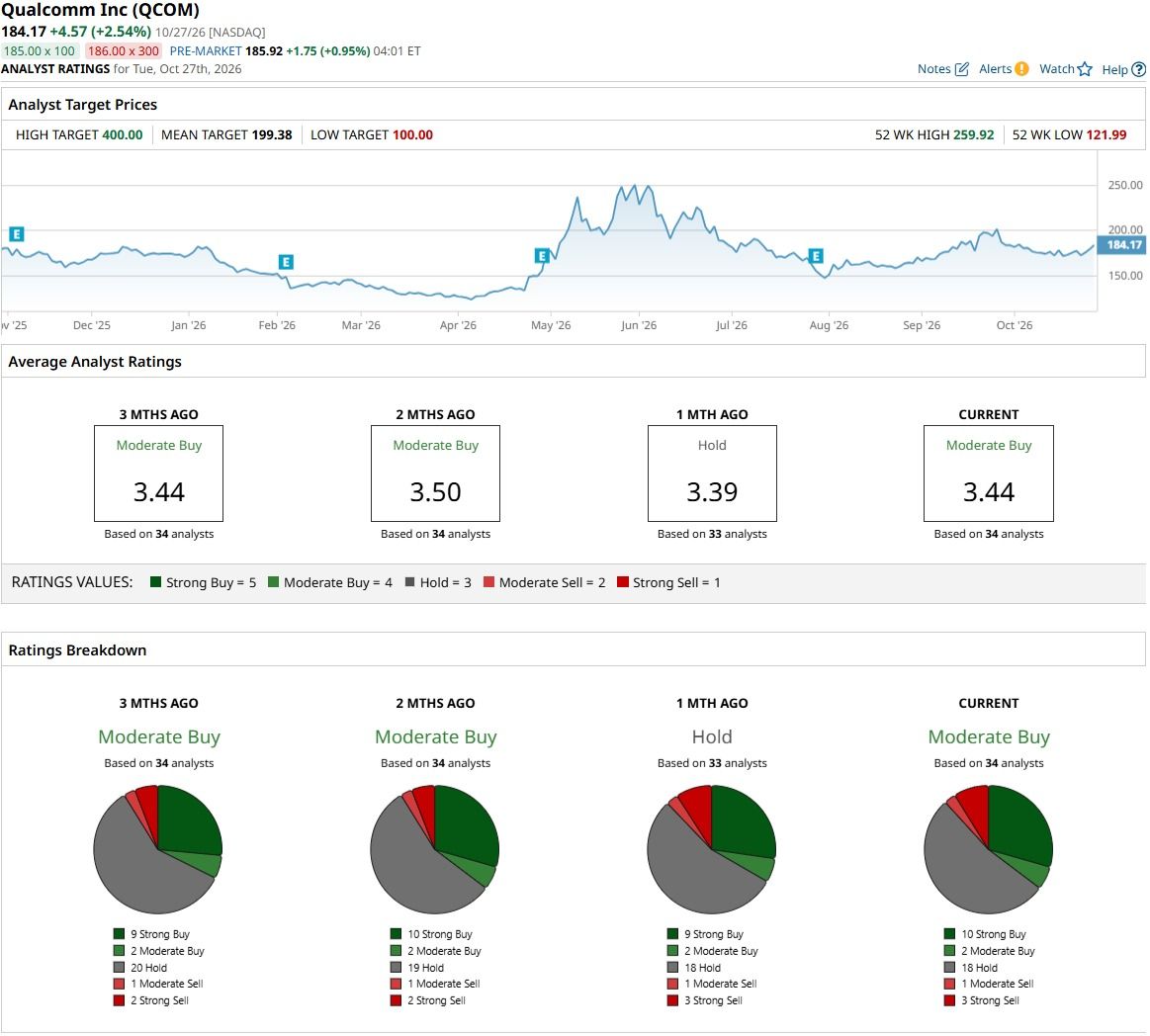
The caution is not shared across Wall Street, however. Overall, Qualcomm has a consensus “Moderate Buy” rating based on 34 analysts with coverage. The average price target of $199.38 implies potential upside of roughly 21% from here. That suggests the broader analyst group sees room for gains, although its outlook is measured rather than overwhelmingly bullish.
 www.barchart.com
Conclusion
Qualcomm’s deal with Anduril is a positive step, but it probably will not change QCOM stock’s direction anytime soon. Selling chips into another market helps, though the partnership still needs orders before its financial value becomes clear. Until then, handset demand and earnings will likely matter much more. A steady climb looks more likely than a big rally, especially with Wall Street projecting modest upside. The Anduril deal adds promise, but Qualcomm still has to turn that promise into real business.
On the date of publication, Ebube Jones did not directly have a position in any of the securities mentioned in this article. All information and data in this article is solely for informational purposes. For more information please view the Barchart Disclosure Policy here.
More news from Barchart
Qualcomm Is Teaming Up With Anduril to Produce U.S.-Made Laptops. Don’t Expect It to Move the Needle for QCOM Stock. Why Did Friday's Session Remind Me of The Red Wedding? Your Tech Stock Is Down 30%. Here’s When I’d Sell, Hold or Buy More Intel Agreed to Buy Israeli Startup Classiq Technologies. How Investors Should View the Deal.