

Artificial intelligence (AI) has given investors plenty of growth to celebrate. Paying for that growth is becoming the harder part. The same technology that creates new cloud customers can also change how existing businesses earn their money. For shareholders, that means watching both sides of the ledger: What AI adds and what it puts at risk.
The industry's spending race already threatens returns across the AI supply chain. Google's latest quarter adds a more uncomfortable possibility, as building a better product could weaken the economics of the business financing it.
More Top Stocks Daily: Go behind Wall Street’s hottest headlines with Barchart’s Active Investor newsletter.
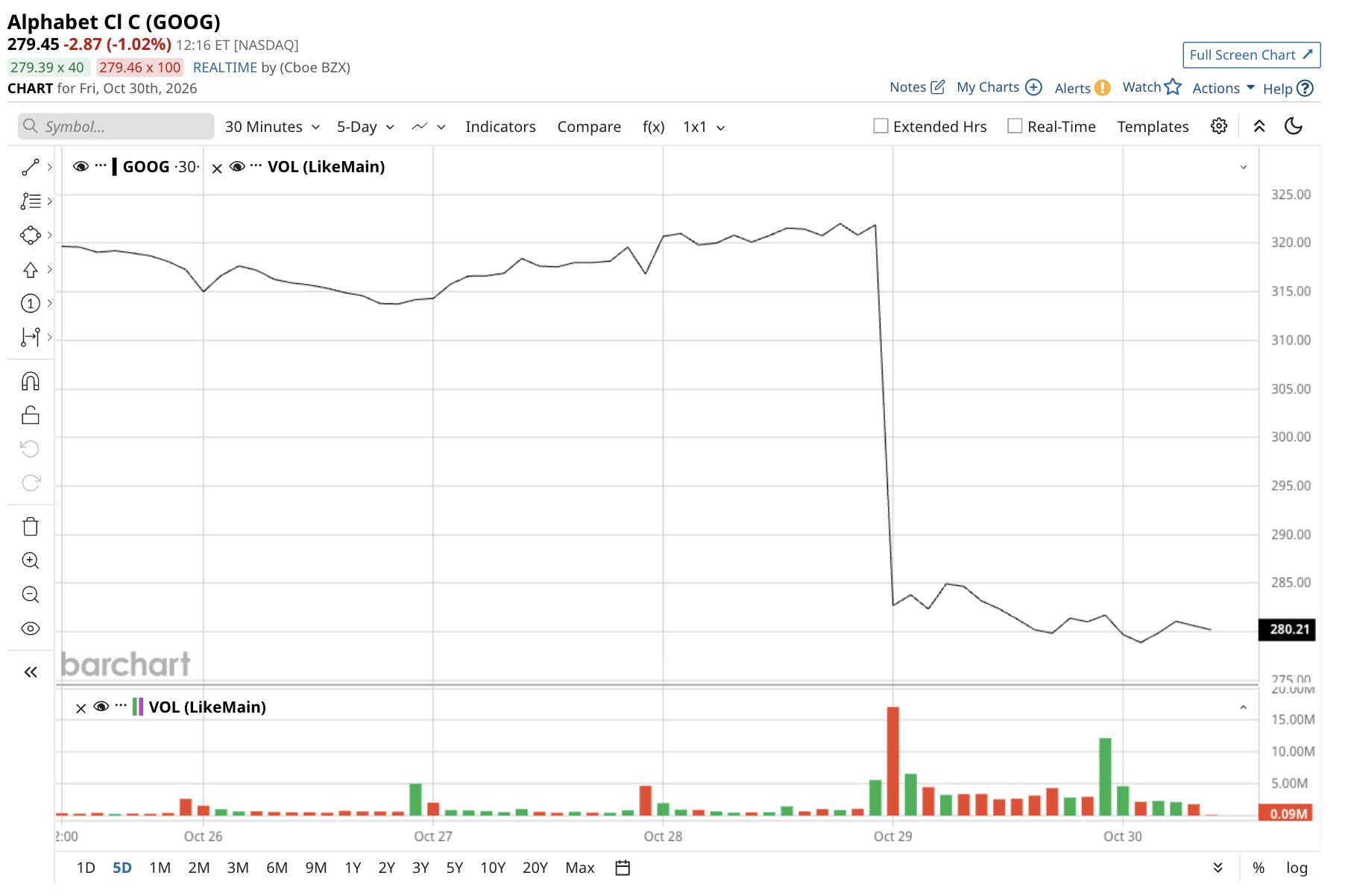
Google parent Alphabet (GOOGL) lost roughly $500 billion in market value on Oct. 29 as GOOGL stock fell more than 12% to record its worst day ever. That wasn't cash disappearing from Google's bank account. It was investors slashing what they would pay for its future.
 www.barchart.com
Google's AI Search Has a Revenue Problem
In Alphabet's third-quarter earnings release, Google Search and other revenue rose 12% to $63.35 billion. Search Engine Journal's comparison of its quarterly disclosures puts that growth below 17% in Q2 and 19% in Q1. Yet CEO Sundar Pichai said search-query growth reached its fastest pace in five years. So, people are searching more, but Search is experiencing slower revenue growth. That's the friction investors need to understand.
On the Oct. 28 earnings call, Chief Business Officer Philipp Schindler acknowledged that AI Mode's lower monetization contributed to the slowdown. In other words, Google's expanding AI search experience hasn't yet developed the same advertising earning power investors expect from the Search business.
Granted, Schindler identified currency as the largest contributor to the deceleration, alongside advertising-category changes, so AI wasn't the whole explanation. His statement also doesn't quite prove that AI Overviews — the summaries feature above regular results — is causing paid clicks to collapse. AI Mode is a separate conversational experience. Management's acknowledgment supports a monetization concern; it hasn't proven yet that advertisers are seeing a decline in clicks because of AI.
Earlier research suggests fewer website visits need not hurt Google. SparkToro’s analysis of Similarweb’s January–April panel found 68% of searches generated no click, yet its comparison with earlier research showed a larger share of clicks going to ads. Different panels limit that comparison, but the implication is important: Publishers can lose traffic while Google keeps earning.
The latest earnings call raises a separate concern about whether rapidly growing AI Mode usage can generate enough advertising revenue.
The Spending Bill Keeps Growing
The timing makes that concern harder to shrug off. Alphabet's earnings release filed with the U.S. Securities and Exchange Commission (SEC) shows $42.3 billion in Q3 operating cash flow against $51.4 billion in capital spending. Free cash flow was -$9.1 billion.
That spending sits alongside Google's expanding infrastructure financing commitments. Shareholders need advertising cash generation to remain dependable while those investments mature.
The cash squeeze extends beyond Google. In Q3, Amazon (AMZN) reported -$42.4 billion in trailing-12-month (TTM) free cash flow, attributing the deterioration primarily to increased AI investment.
But Google faces an additional challenge: Improving AI search economics while paying for the infrastructure supporting it.
Cloud Gives Bulls a Real Counterargument
Alphabet's AI gamble is also producing revenue, so it's not in danger of collapsing. Google Cloud revenue doubled in Q3, rising 103% year-over-year (YOY) to $30.7 billion. Cloud operating income reached $11.1 billion versus $3.6 billion a year earlier.
For comparison, Amazon's earnings release showed AWS revenue up 39% YOY to $46 billion. Google is growing faster from a smaller base, although its cloud growth also benefited from hardware sales.
Pichai described Google's strategy as developing the user experience before monetization. If advertising catches up, today's gap could prove temporary.
Still, AI infrastructure investments must eventually produce durable cash flow. Usage alone won't settle the investment case. The next few quarters need to show that Google's AI users can become profitable advertising customers without requiring ever-larger infrastructure checks. That's the test behind the headline loss.
 www.barchart.com
Wall Street Remains Optimistic
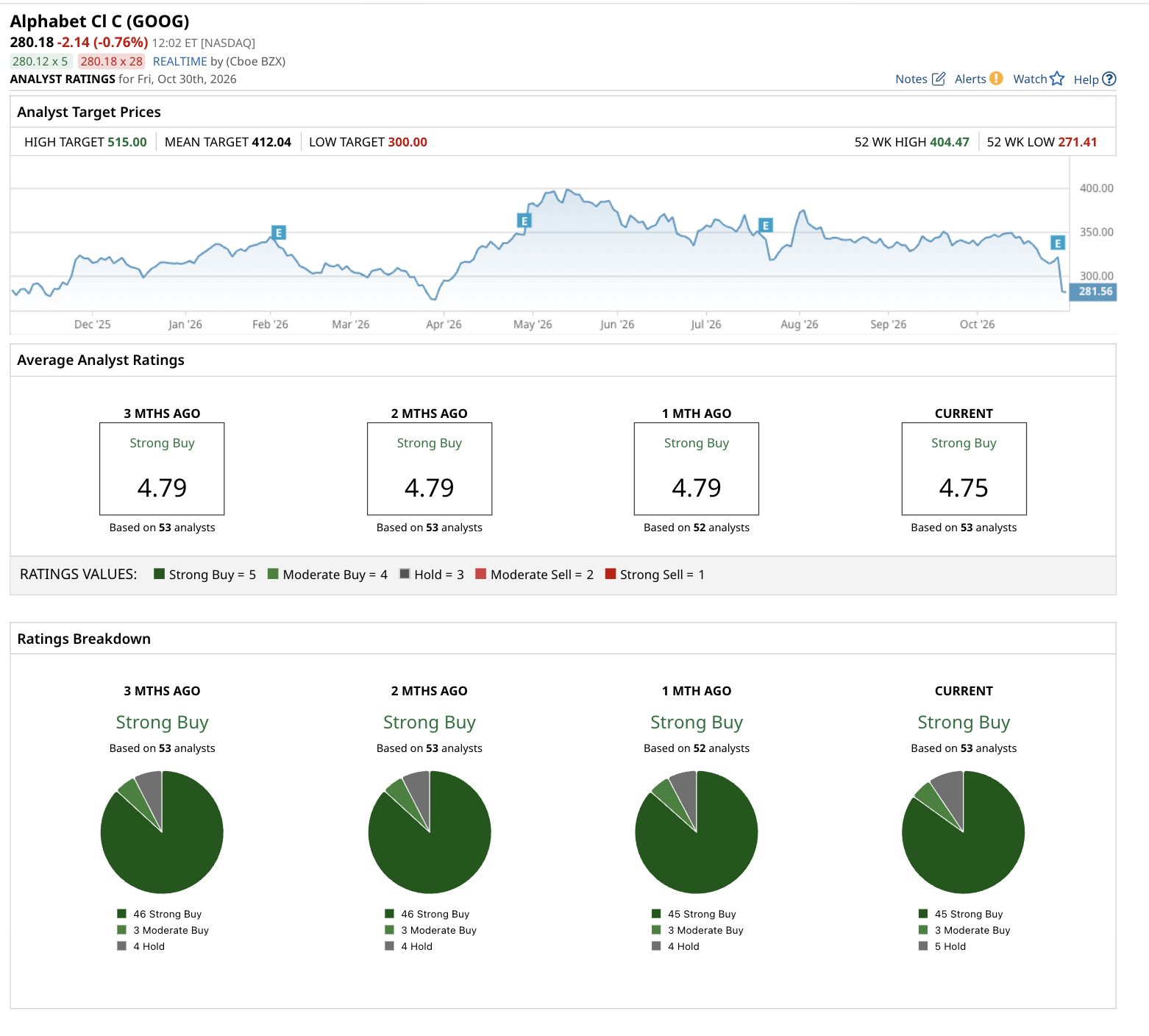
While the stock decline didn't shake analyst sentiment in Alphabet's future — with the vast majority of the 53 analysts covering the company reiterating their "Buy" ratings — analysts at Citigroup and Citizens JMP both downgraded GOOG stock to a “Market Perform” rating from "Market Outperfom." Meanwhile, JPMorgan Chase analyst Douglas Anmuth lowered his price target from $425 to $375 while keeping an “Overweight” rating. UBS analyst Stephen Ju also reiterated a reduce recommendation.
Key Takeaway
Google's AI gamble hasn't failed, but its search monetization problem is real. Existing shareholders have reason to hold while cloud profits grow. Prospective buyers should demand improving search revenue growth and free cash flow before treating the selloff as a bargain.
The impact of AI on monetization is still evolving. Investors would do well to see whether this quarter was a one-off, or if this will be a recurring theme. That's not just for Alphabet, either. With tech stock valuations trading at premium levels, investors can't afford for the biscuit wheels on AI's gravy train to suddenly derail.
On the date of publication, Rich Duprey did not directly have a position in any of the securities mentioned in this article. All information and data in this article is solely for informational purposes. For more information please view the Barchart Disclosure Policy here.
More news from Barchart
Google Just Lost Half a Trillion Dollars. It Has a Real Problem With Search Monetization. Dear ON Semiconductor Stock Fans, Mark Your Calendars for November 2 Why It's Time to Buy the Pullback in Alphabet Stock Dear Roku Stock Fans, Mark Your Calendars for November 2