

Wall Street’s artificial intelligence (AI) trade is losing its footing. On November 5, the Nasdaq 100 ($IUXX) plunged 6.36%, while the S&P 500 ($SPX) fell 4.36% as investors rushed out of chipmakers and other artificial intelligence stocks.
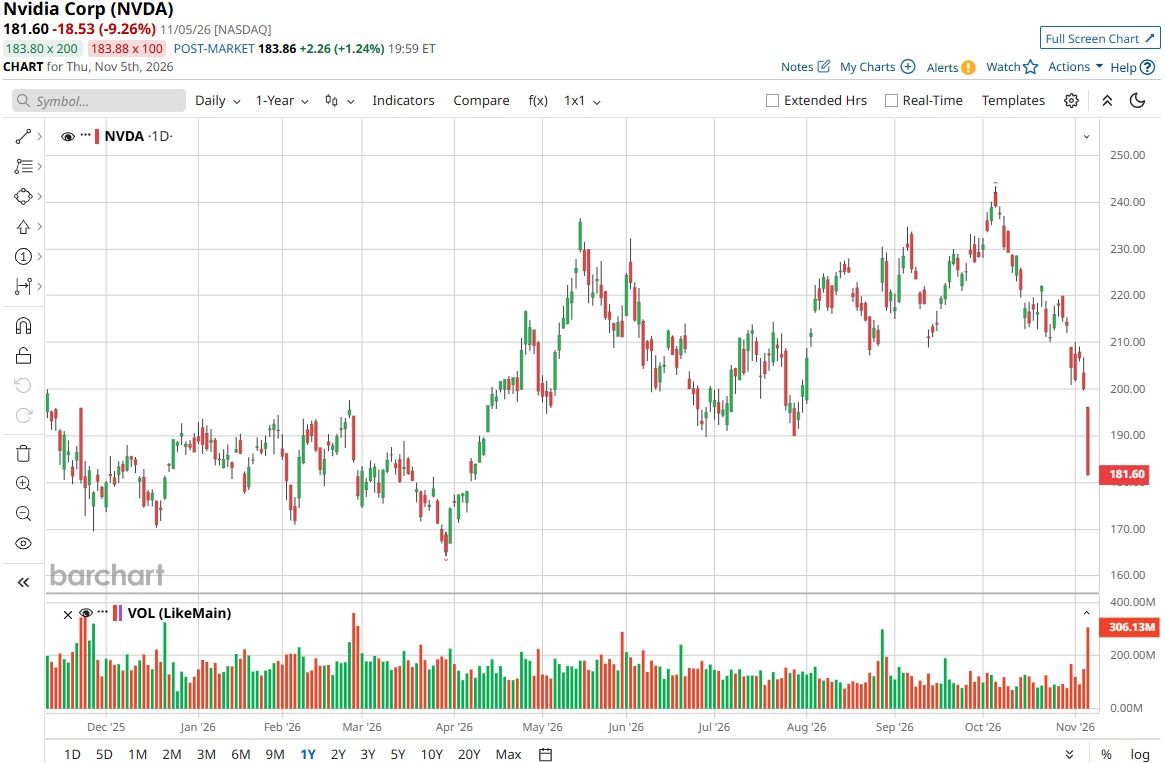
The sharp retreat has put the companies driving the AI spending boom under renewed scrutiny. Nvidia (NVDA), a central player in that boom, fell 9.26%, shedding $18.53 per share in a single session and wiping out its gains for 2026.
More Top Stocks Daily: Go behind Wall Street’s hottest headlines with Barchart’s Active Investor newsletter.
Yet the stock’s reversal comes against a striking earnings backdrop. Nvidia’s latest reported quarterly revenue climbed 106% from a year earlier to $96.2 billion, powered by a 117% increase in Data Center revenue to $89 billion.
These numbers make the selloff more than a story about fading enthusiasm. How should investors view Nvidia after this sudden reset? Let’s find out.
What Nvidia’s Numbers Say About Its Value
Nvidia designs graphics processors and supplies networking equipment and software for artificial intelligence, gaming, and accelerated computing. Headquartered in Santa Clara, California, this $4.82 trillion company sells chips and complete computing systems to cloud providers, businesses, and governments.
NVDA ended November 5 at $181.60 with a 2.63% year-to-date decline and a 6.97% loss over 52 weeks.
 www.barchart.com
Its 22.23x forward earnings multiple trails the sector’s 27.45x median, but a 1.59x PEG exceeds the 1.00x median and complicates the discount. NVDA pays an annual dividend of $1.00 per share, yielding 0.48%.
Nvidia released fiscal second-quarter 2027 results on August 26 and reported revenue of $96.22 billion, up 106% from a year earlier. This exceeded the $92.37 billion consensus by 4.2%, while GAAP earnings reached $2.46 per share compared with $1.08 in the same quarter last year.
Their adjusted operating income increased 124% to $63.96 billion and delivered a 66.5% margin, while GAAP operating margin expanded to 66.2% from 60.8%. The stronger profitability accompanied continued Data Center growth as segment revenue reached $89 billion, up 18% sequentially across hyperscale and other customer groups.
NVDA attributed that expansion to AI adoption, with CEO Jensen Huang highlighting complete infrastructure systems and CFO Colette Kress identifying enterprise, sovereign, and startup demand. It projected next quarter’s revenue at $108 billion against the $104.6 billion consensus, placing guidance 3.3% above expectations despite constraints on available supply.
That supply limitation involves memory availability and data center capacity, which management said restrict deliveries even as customer forecasts indicate stronger potential growth.
What Could Sustain Nvidia’s Growth
Nvidia’s expanded Meta Platforms' (META) partnership includes a $3 billion equity investment and collaboration on Muse models and AI agents. Meta plans additional deployments of Nvidia’s Vera Rubin GPUs and Vera CPUs alongside Spectrum-X networking and BlueField-4 technology. These deployments extend Nvidia’s sales opportunity beyond GPUs into networking and supporting infrastructure, although its equity investment also increases financial exposure to a customer.
Oracle (ORCL) is also expanding its use of Nvidia’s technology through plans to deploy Vera Rubin NVL72 systems at multiple gigawatts of scale. Each NVL72 rack connects 72 GPUs, while Nvidia’s Vera CPUs will support workloads including code execution and data retrieval on Oracle Cloud Infrastructure. The expansion gives Nvidia another channel for supplying its processors to cloud customers.
SpaceX’s (SPCX) approximately $40 billion binding financing commitment through an Apollo Global Management (APO) entity could fund further purchases of Nvidia’s Vera Rubin chips and related equipment. The commitment supports Nvidia’s prospective order pipeline, but financing approval and equipment deliveries remain separate from recognized revenue.
Together, these agreements strengthen Nvidia’s demand outlook after the selloff. Their investment value ultimately depends on deployments translating into revenue and sustained customer spending.
How Wall Street Views Nvidia’s Prospects
Nvidia reports earnings after markets close on November 17. Wall Street expects earnings of $2.49 per share for the October quarter, up 100.81% from $1.24 a year earlier.
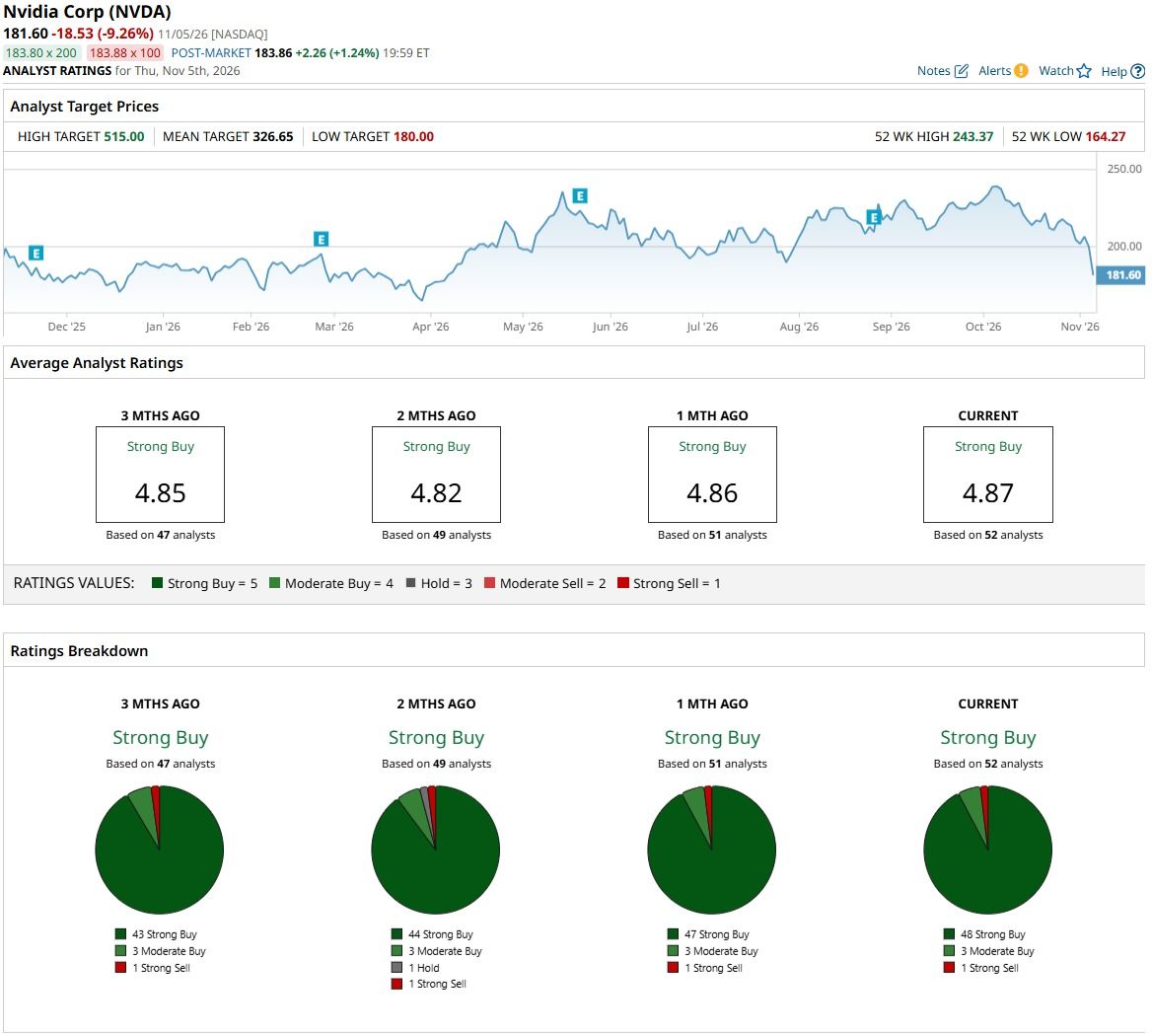
That earnings outlook helps explain Wall Street’s optimism. Barclays analyst Thomas O’Malley maintained a “Buy” rating and a $275 price target on October 27, implying 51.43% upside.
Seaport Research analyst Jay Goldberg takes the opposite view. He reiterated a “Sell” rating with a $180 target, implying about 0.88% downside, and warned that competitive pressures were “mounting.” His concerns also include Nvidia’s growing financial obligations and cyclical risks tied to data center expansion and financing activities.
Nevertheless, the consensus across 52 analysts remains a “Strong Buy,” rather than a unanimous recommendation. Their $326.65 average target implies 79.87% upside from November 5’s $181.60 close.
 www.barchart.com
Conclusion
Nvidia looks more like a buying opportunity than a stock to abandon, though buying gradually makes more sense than rushing in. Strong earnings growth and customer commitments support the business, while supply limits, competition, and financing risks warrant caution. The stock looks more likely to recover over time if demand continues turning into revenue, though further declines remain possible and November 17 earnings will help test that view. This pullback makes Nvidia worth considering, provided the focus stays on earnings rather than momentum.
On the date of publication, Ebube Jones did not directly have a position in any of the securities mentioned in this article. All information and data in this article is solely for informational purposes. For more information please view the Barchart Disclosure Policy here.
More news from Barchart
Oracle Just Walked Away From a $7 Billion Tencent Deal. Here’s What It Means for ORCL Stock. Nvidia Is Now Down for the Year After a Sharp Selloff. You Can Buy NVDA Stock Gradually, but Don’t Rush In. Meta Stock Dips Towards $600 But Don’t Load Up Just Yet Airbnb Soars Over 11% After Strong FCF Results - What's the Best ABNB Play Now?