

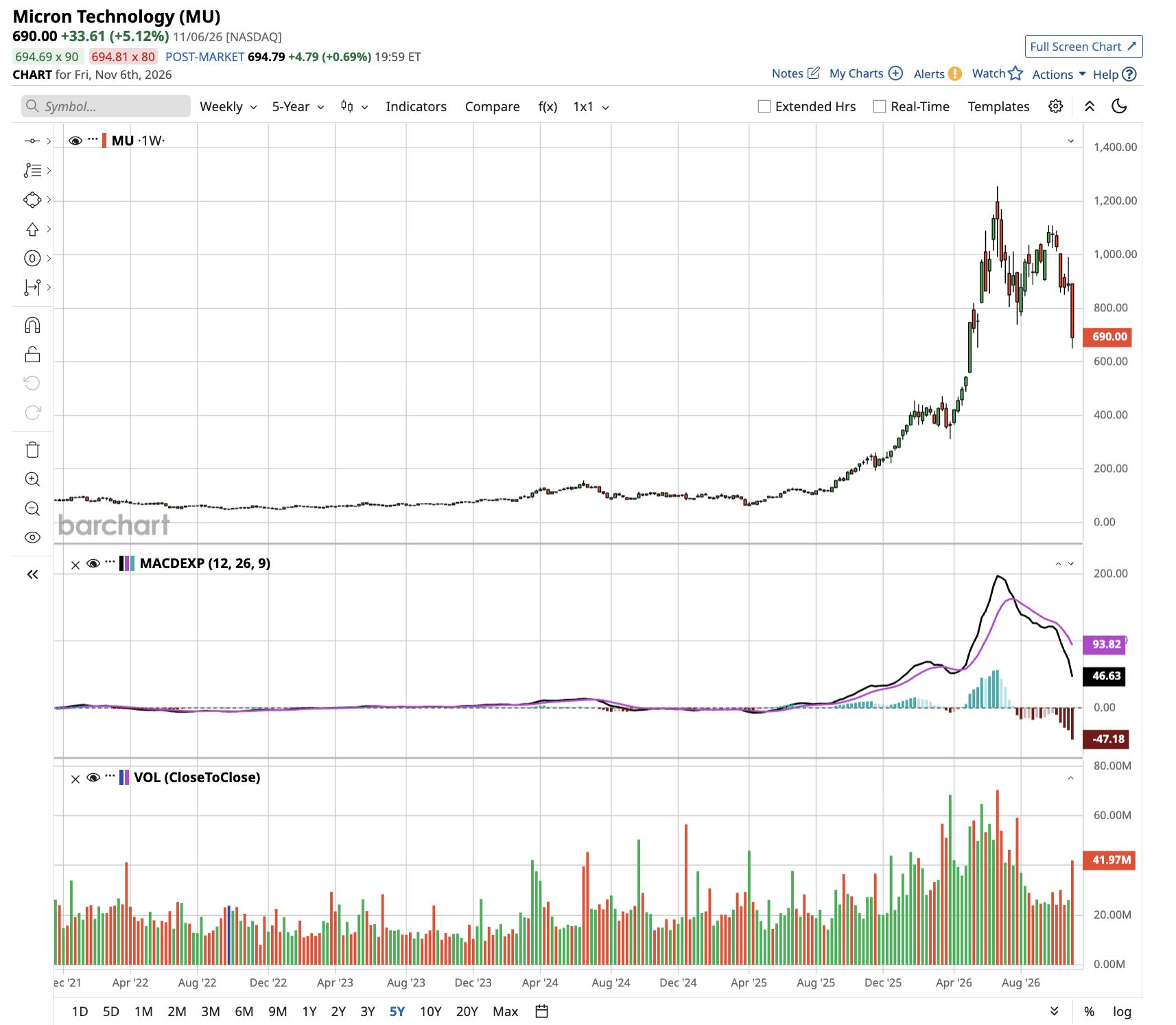
Micron Technology (MU) is among the most popular tech stocks in 2026. Valued at a market cap of $780 billion, MU stock has almost tripled over the past year. However, despite its outsized returns, the chip giant is down 44% from all-time highs.
Let’s see if you should buy the dip in Micron stock right now.
More Top Stocks Daily: Go behind Wall Street’s hottest headlines with Barchart’s Active Investor newsletter.
 www.barchart.com
Micron's Record Year Set a High Bar
On its Sept. 30 earnings call, Micron reported revenue of $133.2 billion in fiscal 2026 (ended in August), an increase of 256% year over year. CEO Sanjay Mehrotra added that DRAM revenue topped $100 billion. DRAM is the common memory inside computers and phones.
Gross margin rose to 81.1%, a jump of 40 percentage points, while earnings per share (EPS) climbed 811% to $75.52. Revenue in Q4 rose 379% year over year to $54.2 billion, gross margin stood at 87%, while adjusted earnings per share rose to $33.42.
Micron generated $44 billion of operating cash flow and $33.2 billion of free cash flow in the quarter. CFO Mark Murphy said DRAM prices rose in the high teens during the quarter and NAND, the memory behind storage drives, rose about 30%.
Why the Memory Shortage May Last
Management does not expect supply chain headwinds to ease in the near term, as Mehrotra said conditions should be much tighter in calendar 2027 and 2028 than in 2026.
Notably, more than 75% of Micron’s 2027 output is already committed. The company has also signed 26 strategic customer agreements (SCAs). Mehrotra estimates they cover over 35% of revenue through 2030, and customers have backed them with $32 billion in financial commitments.
Murphy said remaining performance obligations total about $150 billion, and called that figure conservative because it uses minimum prices. Even at these minimum prices, he expects margins above any prior cycle peak.
High bandwidth memory (HBM) adds to the bull case, and Mehrotra said Micron has agreed the vast majority of its 2027 HBM supply at much higher prices. Bloomberg notes that HBM is tied closely to Nvidia (NVDA) accelerators.
For the fiscal first quarter (ending in November), Murphy guided to $61.5 billion in revenue, plus or minus $1.5 billion. He expects gross margin near 86.25% and EPS of $38.15, plus or minus $1.
Murphy expects record revenue every quarter next year. Higher bonuses and startup costs add roughly $1 billion in costs in the first quarter, Murphy said. Operating expenses should also rise about $2.5 billion in fiscal 2027, while capital spending (CapEx) is forecast to reach about $25 billion in the first half.
Taiwan Plant Freeze Rattles Investors
According to a Bloomberg report:
Micron has halted construction of a memory plant in Taoyuan, Taiwan, due to a long labor dispute. The site, called Fab 11E, had a budget of $3 billion to $4.5 billion and was due online in 2028. Taiwan makes 60% of Micron's DRAM output and employs 15,000 people, about a quarter of the company. The Taoyuan union demanded that 15% of operating profit go to employees. Taiwan's Ministry of Economic Affairs said the October deal would lift junior engineers' pay more than twofold, to about NT$4 million ($121,450).On the Sept. 30 call, Micron said its Tongluo facility in Taiwan is on track for meaningful shipments in mid 2027, which is a different site. Still, Bloomberg says the pause could lead Micron to rethink its wider Taiwan plans.
What Next for MU Stock Investors?
Micron ended the quarter with $73.5 billion in cash and investments against $5.2 billion of debt. Murphy said Micron will step up capital returns from Dec. 9, 2026, mainly through share buybacks, while the current authorization stands at $2.2 billion.
On the earnings call, Bank of America analyst Vivek Arya said memory stock valuations look depressed. Investors are worried that demand could peak next year and labor union issues in Taiwan add to ongoing uncertainty.
Wall Street projects Micron’s free cash flow to expand from $1.67 billion in fiscal 2025 to $179 billion in 2029. If MU stock is priced at 10 times forward FCF, the stock could more than double over the next two years.
 www.barchart.com
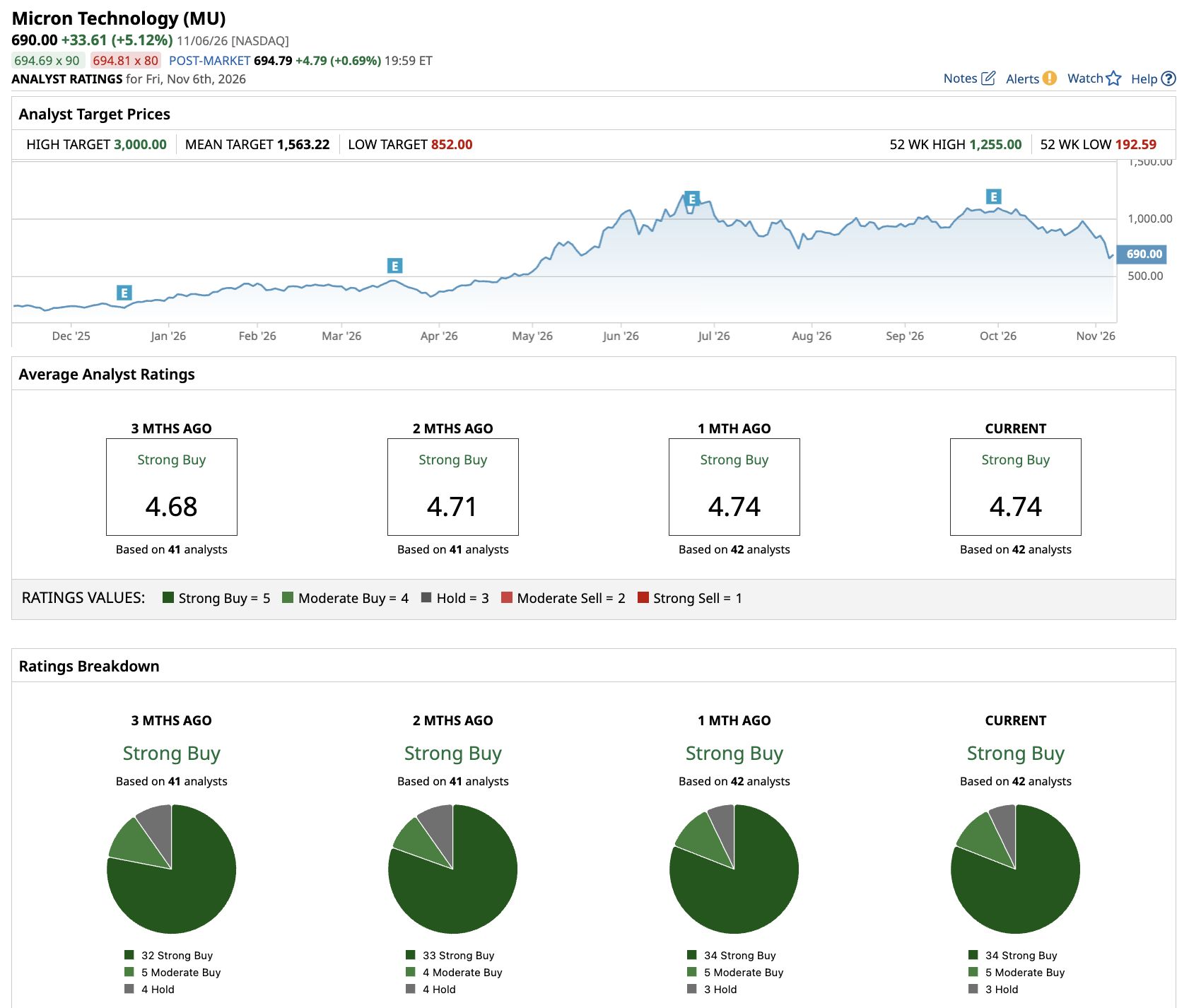
Out of the 42 analysts covering Micron stock, 34 recommend “Strong Buy,” five recommend “Moderate Buy,” and three recommend “Hold.” The average MU stock price target is $1,563, above the current price of $690.
On the date of publication, Aditya Raghunath did not directly have a position in any of the securities mentioned in this article. All information and data in this article is solely for informational purposes. For more information please view the Barchart Disclosure Policy here.
More news from Barchart
Want to Get Paid $1,000 a Year for 10 Years? Just Live Right Next to a Data Center. Cybertruck Production Is Set to End as Elon Musk Finally Closes the Coffin on a Multi-Year Executional Nightmare Down 44% From All-Time Highs, Here’s Why You Should Consider Buying the Micron Stock Dip Palantir vs. AMD: Both Stocks Have Pulled Back More Than 20%, But 1 Is a Better Value Buy Here