

In the race to build bigger and more powerful artificial intelligence (AI) infrastructure, the spotlight is no longer limited to the companies making GPUs. The processors that keep these systems running smoothly are becoming just as important. That’s where Advanced Micro Devices (AMD) comes in. The chipmaker designs high-performance CPUs, GPUs, and adaptive computing solutions, serving everything from PCs and gaming consoles to data centers and AI workloads. Lately, AMD has also been giving investors another reason to pay attention.
Shares jumped 13% on Nov. 9 after the company announced that its fifth-generation EPYC server processors will power Google Cloud’s next-generation TPU 8tx system. The partnership with Alphabet's (GOOGL) Google brings AMD’s CPUs and security technology together with Google’s eighth-generation AI accelerators to support confidential AI computing, keeping sensitive customer data and AI models protected even while they are being processed.
More Top Stocks Daily: Go behind Wall Street’s hottest headlines with Barchart’s Active Investor newsletter.
The deal also highlights AMD’s growing role in the AI infrastructure market, where demand extends beyond GPUs to the CPUs that handle data preparation, inference, fine-tuning, and increasingly complex agentic AI workloads. AMD also noted that more than 10 leading hyperscalers and AI labs already use its EPYC processors, including systems powered by Nvidia (NVDA) GPUs and custom AI chips.
With Google deepening its relationship with AMD, investors have another development to consider as they assess the chipmaker’s AI opportunity. AMD already has plenty of excitement behind it, and Google’s latest deal adds to that. But with the stock already up 173% in 2026, what’s the smart way to play AMD? Let’s take a closer look.
About Advanced Micro Devices Stock
Based in Santa Clara, California, Advanced Micro Devices is one of the world’s leading semiconductor companies. It makes the processors and graphics chips that power everything from personal computers and gaming consoles to cloud computing and AI data centers.
In recent years, AMD has been making bigger inroads into the AI market with its EPYC server processors and Instinct AI accelerators. Its products are increasingly finding a place among major cloud providers and enterprise customers. With a portfolio spanning CPUs, GPUs, networking, and software, AMD is looking to capitalize on the growing demand for AI computing and high-performance chips. The company has a market capitalization of about $906 billion.
Investors have certainly taken notice. AMD stock has been on an impressive run over the past year, gaining 126% over the past 52 weeks and comfortably outperforming the broader market. The rally picked up steam as investors grew more confident in AMD’s AI ambitions and its ability to challenge established players in the semiconductor industry. Even Wall Street analysts joined the excitement, with Citi analyst Atif Malik raising his price target on AMD stock, pointing to another opportunity investors may be overlooking: CPUs.
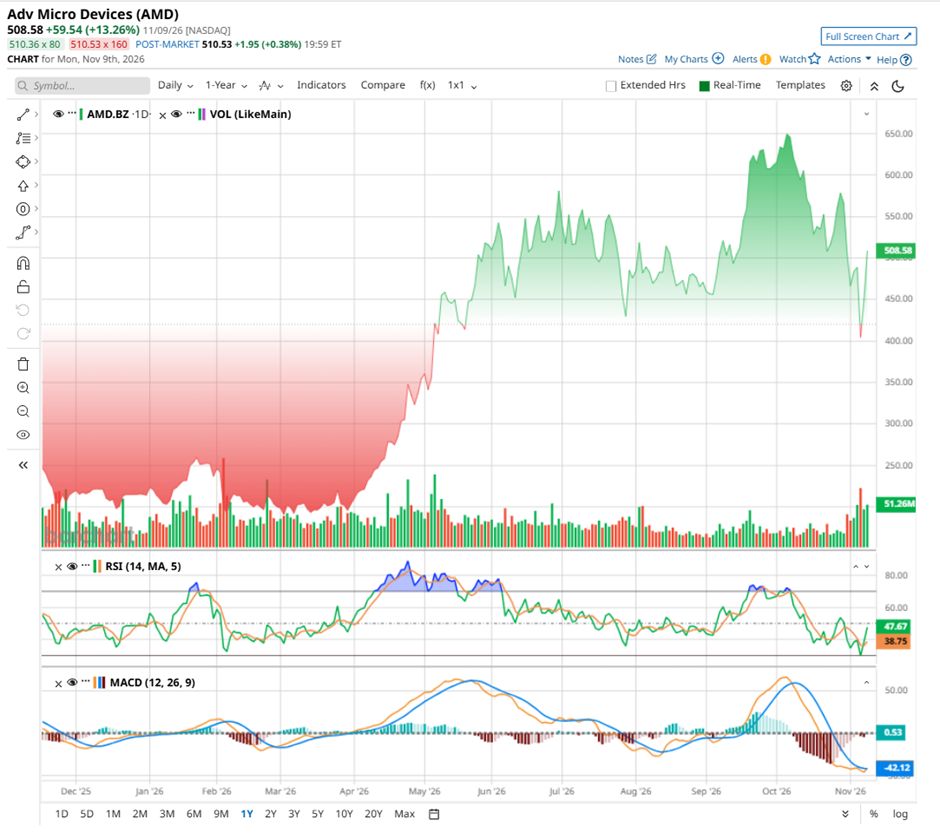
The AI business is not just about powerful GPUs anymore. As agentic AI gains traction, CPUs are becoming increasingly important for handling reasoning, data processing, and security tasks that allow autonomous AI agents to operate. Citi believes AMD could be a major beneficiary of this shift, along with a broader recovery in CPU demand. That optimism helped push AMD's shares to an all-time high of $658.52 on Oct. 6.
But as the stock market likes to remind investors, the road up is rarely a straight line. On Nov. 5, shares took a 17% hit amid a broader chip selloff, despite the company reporting record third-quarter results just two days earlier. Concerns about the political environment following midterms — particularly the possibility of restrictions on data-center construction in key states like Texas, Ohio, and Georgia — added to the pressure. Investors are worried that any slowdown in AI infrastructure spending could eventually hurt chipmakers.
Thankfully for AMD shareholders, the selling did not last long. AMD stock bounced back 11% on Nov. 6 and climbed another 13% on Nov. 9. The recovery was thanks to a broader rebound in chip stocks, Google’s decision to use AMD’s EPYC processors, and an Oppenheimer upgrade.
Technically, AMD stock seems to be taking a breather rather than losing its momentum, with its 14-day RSI cooling after flashing overbought signals in October.
 www.barchart.com
Of course, AMD’s impressive comeback and growing AI ambitions have not gone unnoticed on Wall Street, and investors are now paying a pretty steep price to own a piece of the story. AMD stock currently trades at 74.3 times forward earnings and 24.3 times sales, putting it at a premium to many semiconductor peers as well as its own historical averages.
AMD Beats Q3 Projections
AMD has given investors plenty to chew on with its latest quarterly results, released on Nov. 3. The chipmaker beat expectations and delivered stronger margins, record data-center sales, and a much more ambitious outlook.
For Q3, revenue jumped 45% year over year (YOY) to nearly $13.4 billion. Growth came from across the business, with record sales of EPYC server processors and Instinct GPUs leading the charge, alongside stronger demand for Ryzen and Embedded products. Aerospace, defense, automotive, and industrial markets all contributed to Embedded growth.
Data-center segment revenue surged 97% YOY to $8.5 billion, accounting for roughly 64% of AMD’s total revenue. Hyperscalers continued expanding their EPYC server capacity to support cloud services and agentic AI workloads, while AMD also began initial shipments of its Instinct MI450 Series GPUs. Server sales more than doubled from a year ago as demand for computing infrastructure picked up.
AMD is also moving beyond simply shipping chips. Its Helios rack-scale systems and MI455X GPUs entered volume production, while sixth-generation EPYC Venice processors began revenue shipments. Five major customers are already running models and workloads on Helios, including Meta Platforms (META), Microsoft (MSFT), Oracle (ORCL), OpenAI, and Anthropic (ANT). Expanded partnerships with Meta and Anthropic further underline the scale of customer commitments.
There was some softness elsewhere. Gaming revenue fell 40% YOY to $773 million. Client revenue increased 7% YOY to $2.9 billion, supported by demand for Ryzen processors and edge AI adoption. Embedded also continued to show growth across its end markets.
The stronger product mix helped AMD widen its margins. Non-GAAP gross margin improved to 56%, while operating margin expanded to 29%. Adjusted operating income climbed 75% YOY, and adjusted net income increased 77% YOY. Adjusted EPS jumped 74% YOY to $2.09.
AMD ended the quarter with $15.8 billion in cash, cash equivalents, and short-term investments. Total debt increased to $7.08 billion, partly reflecting a $4.75 billion senior notes offering completed in August. The company generated $1.2 billion in operating cash flow from continuing operations and $554 million in free cash flow. Meanwhile, inventories climbed to $11.5 billion as AMD secured components and production capacity to meet growing data-center demand.
Looking at the guidance, management expects Q4 revenue of about $17 billion, plus or minus 3%. At the midpoint, that would represent roughly 66% YOY growth and a 27% sequential increase. Data-center revenue is expected to rise 50% sequentially, although Client and Gaming revenue could decline by more than 20%.
Looking further ahead, management expects growth to accelerate in 2027, with total revenue projected to increase more than 80%. Server revenue is expected to double, while data-center AI growth is also projected to accelerate. Management expects the data-center segment to contribute more than 80% of total revenue in 2027, with operating margins continuing to expand. Importantly, operating expenses are expected to grow at less than half the pace of revenue, pointing to further operating leverage. Stronger MI450 and Helios deployments, along with management’s confidence in its supply chain, underpin this outlook.
However, AMD has warned of softer demand for its PC components, echoing concerns raised by rival Intel (INTC) in its recent earnings report. The AI boom is putting pressure on supply chains and pushing up PC component prices, making consumers more reluctant to upgrade their existing machines. So, while the data-center segment is growing, the traditional PC business could face some near-term headwinds.
Analysts tracking AMD expect Q4 EPS to be around $2.59, up 109% YOY, while revenue is projected to be around $17.1 billion. Looking to fiscal 2026, EPS is anticipated to jump 112% YOY to $6.93, then surge by another 131% YOY to $16.04 in fiscal 2027.
What Do Analysts Expect for AMD Stock?
Oppenheimer analyst Rick Schafer recently upgraded AMD to “Outperform” from “Perform” with a $600 price target. Following AMD's latest earnings call, Schafer raised his estimates, describing the company as a “durable supplier of AI compute.” While AMD management expects overall revenue to grow more than 80% in 2027, Oppenheimer sees data-center revenue leading the charge with projected growth of 135%.
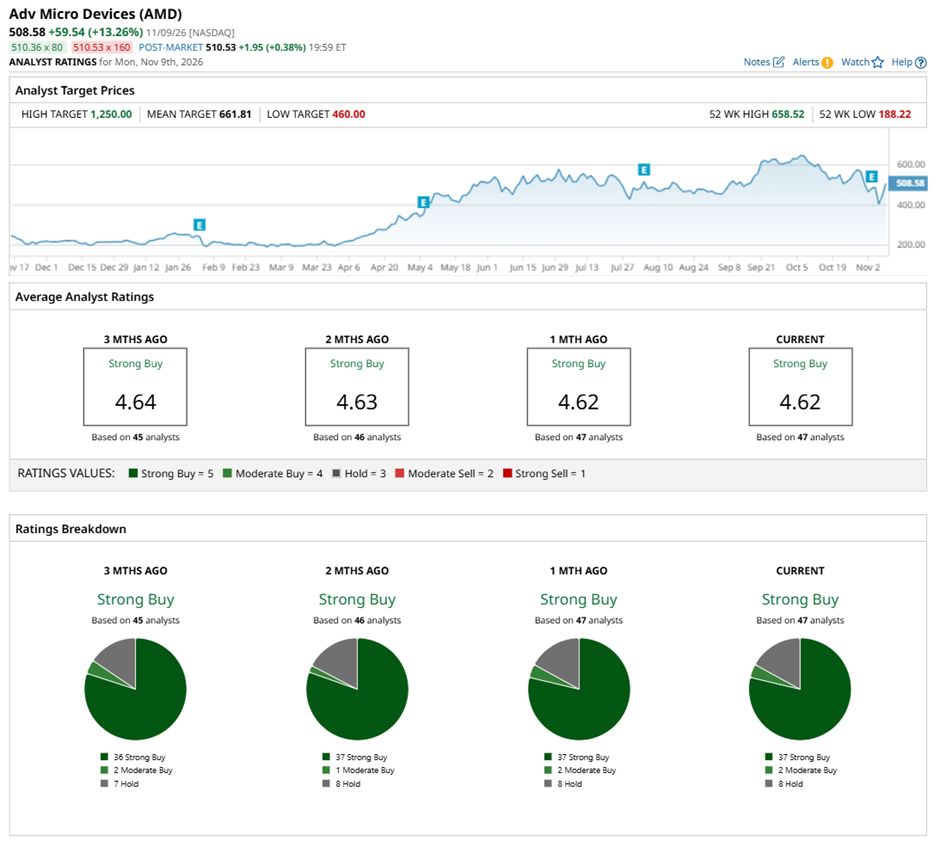
Overall, AMD stock carries a consensus “Strong Buy” rating. Among the 47 analysts tracking the stock, 38 have a “Strong Buy,” two have a “Moderate Buy,” and seven advise a “Hold” rating. The average price target of $661.81 suggests potential upside of 13% from current levels. However, the Street-high target of $1,250 suggests shares could climb 114% from here.
 www.barchart.com
On the date of publication, Sristi Suman Jayaswal did not directly have a position in any of the securities mentioned in this article. All information and data in this article is solely for informational purposes. For more information please view the Barchart Disclosure Policy here.
More news from Barchart
How to Play AMD Stock as Google Picks EPYC for Its Next-Gen TPUs ‘SaaSpocalypse’ Fears Hit Microsoft Stock Again. Don’t Rush to Buy the Dip. S&P 500 Futures Gain With Focus on U.S. PPI Data and Fed Speak Dear Costco Stock Fans, Mark Your Calendars for December 4