


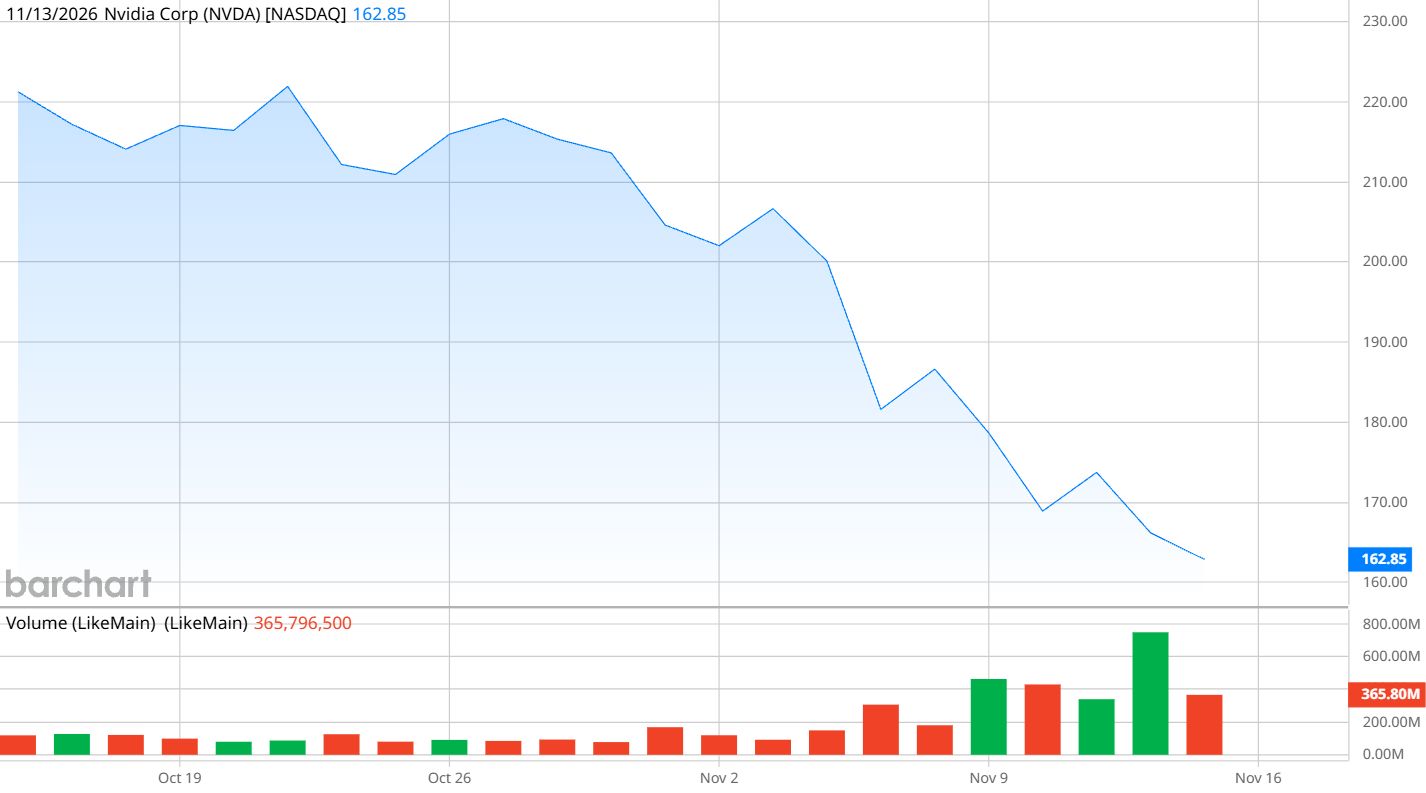
Michael Burry made his reputation betting against the U.S. housing market before the 2008 financial crisis. Now the investor made famous by “The Big Short” is making another aggressive wager against Nvidia (NVDA) and the technology stocks that have powered the artificial intelligence (AI) boom.
Burry disclosed on Thursday, Nov. 12, that he doubled his put options position against the Nasdaq-100 Index ($IUXX), with contracts expiring in early 2027 at a strike price approximately 20% below the index's current level. He also increased his bearish position in the VanEck Semiconductor ETF (SMH), which has Nvidia among its largest holdings.
Can’t Get Enough Options?: Join the list for Barchart’s daily unusual options report, delivered free.
The strategy comes as Nvidia faces serious questions following a scandal that forced the resignation of Jensen Huang as CEO. But I’m not following Burry’s lead, and unless you’re an experienced investor, I recommend that you stay away as well.
 www.barchart.com
Why Burry Is Betting Against Nvidia
Burry's latest trades come as Nvidia faces an unusual combination of problems. Huang resigned on Nov. 12, four days after Nvidia's board of directors opened an independent investigation into reports that a foreign intelligence operation had targeted the CEO. U.S. intelligence officials suspect that Huang had a relationship with Alice Huang, a Chinese businesswoman and former executive at Singapore-based Megaspeed, who was allegedly recruited to gather information for Beijing.
In addition, Huang reported relationships with other Nvidia employees, and he acknowledged being unfaithful in his marriage. Congressional probes are sure to follow as well.
Burry believes Nvidia's troubles could have consequences well beyond the chipmaker itself. In a Nov. 12 Substack post, he identified CoreWeave (CRWV), Nebius Group (NBIS), Taiwan Semiconductor Manufacturing (TSM), and ASML Holding (ASML) as companies benefiting from Nvidia's business. If Nvidia falters, Burry believes these companies could suffer as well.
Burry also expects semiconductor valuations to decline further and industry earnings to weaken over the next couple of years. That's where SMH comes into the picture. The exchange-traded fund (ETF) provides exposure to semiconductor companies, including Nvidia and Taiwan Semiconductor.
Notably, Burry believes Advanced Micro Devices (AMD) and Broadcom (AVGO) are potential beneficiaries of Nvidia's diminished influence, so he recommends betting against SMH rather than the iShares Semiconductor ETF (SOXX), partly because of the latter fund's exposure to AMD and Broadcom.
How Burry's Options Strategy Works
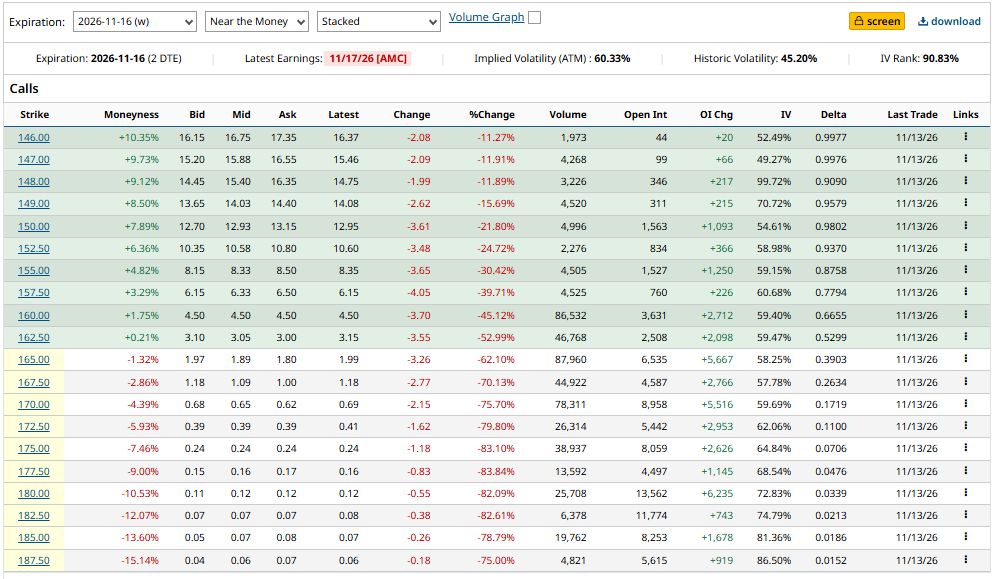
Burry isn't simply selling Nvidia shares and waiting for the price to decline. He's using put options, which give buyers the right to sell an underlying security at a predetermined price before expiration.
These contracts can become more valuable when the underlying security declines. So, if an ETF or stock trades at $100 per share and an investor buys a put option with an $80 strike price and a $5 premium, the investor is betting that the ETF or stock will drop by at least $25. The further the price falls below $75, the more profitable the options trade becomes.
If the price falls between $75 and $80, the investor recovers some of the premium but loses money overall. And if the price remains above $80 when the option expires, the contract expires worthless. The investor loses the entire premium. That's the risk Burry is accepting with his Nasdaq-100 puts, which are approximately 20% out of the money. He needs a substantial decline to make those contracts profitable at expiration, although they could increase in value before then even without a full 20% drop.
Burry also bought back 25% of an SMH put position he had previously reduced. Those contracts expire in June 2027.
 www.barchart.com
Why I'd Rather Play the Long Game
There's nothing inherently wrong with options. But they're not something I'd recommend to inexperienced investors. Options buyers can lose their entire investment, while certain strategies involving selling uncovered options can expose investors to much larger losses.
Burry has the experience and resources to make these kinds of trades. Most individual investors aren't operating under the same circumstances.
I'm also not convinced that a potential 20% decline in semiconductor stocks would justify abandoning the sector. Even with that kind of drop, I view that as an opportunity to build positions through dollar-cost averaging — buying shares at regular intervals over a period of time. That means you don’t need to try to predict exactly when the market will bottom — because timing the market is virtually impossible.
Burry may be right about the next several months. He has certainly made successful bearish calls before. But I'd rather own strong semiconductor businesses for the next several years than wager that their stock prices will fall by a particular amount before an options contract expires.
On the date of publication, Patrick Sanders had a position in: NVDA , NBIS . All information and data in this article is solely for informational purposes. For more information please view the Barchart Disclosure Policy here.
More news from Barchart
Michael Burry Is Betting on an AI Stock Selloff. I’d Rather Buy the Dip. Shorting ConocoPhillips Puts and Put Credit Spreads Are Attractive Income Plays Wells Fargo: Get Paid to Wait: or Buy at a Discount Don’t Buy the Dip in Nvidia Without This Safety Net. How I’m Playing NVDA Stock After the Jensen Huang Fiasco