

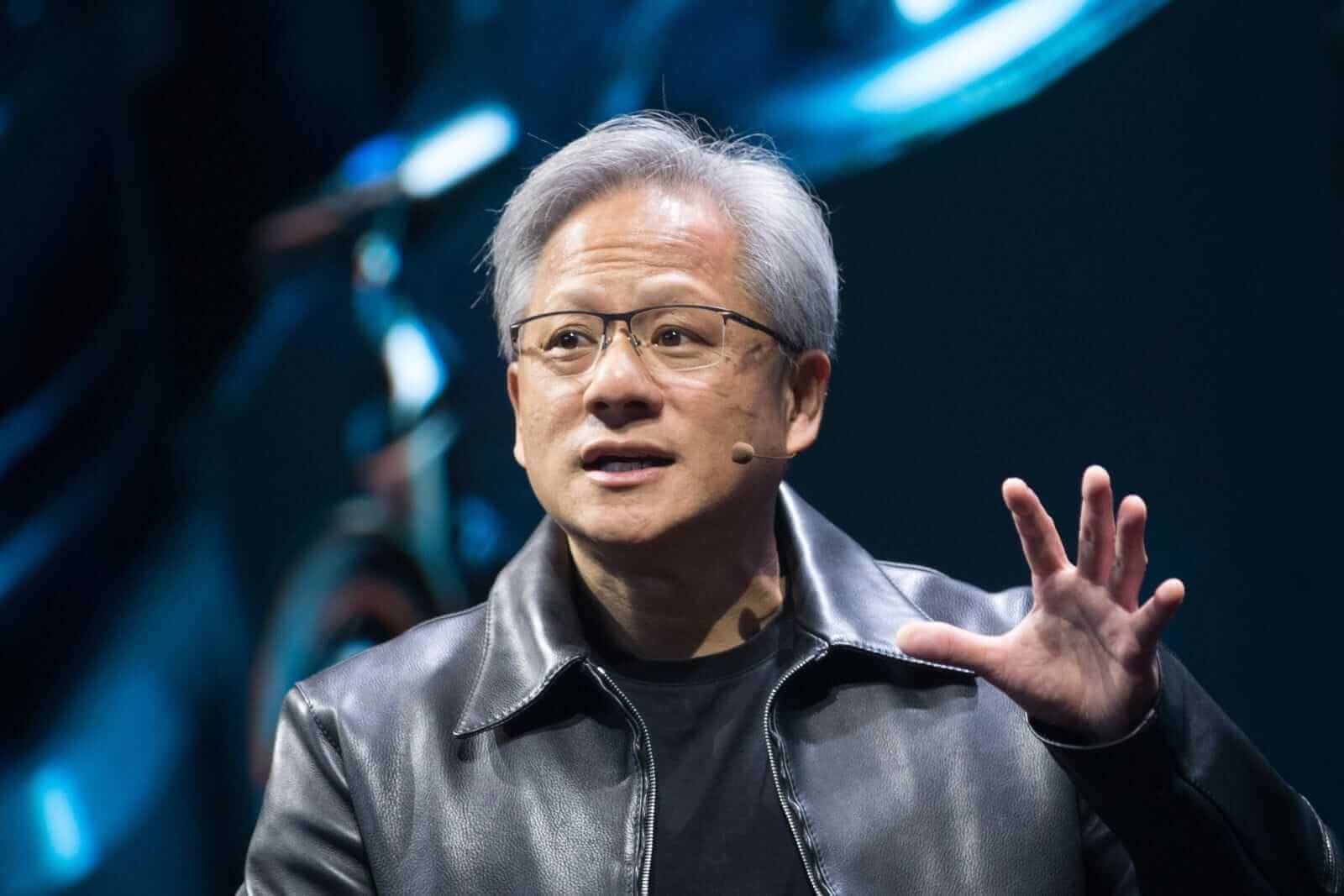
NVIDIA (NVDA) is facing one of the most consequential leadership transitions in its history after co-founder and CEO Jensen Huang resigned on Nov. 12 amid reports of extramarital affairs and a broader governance controversy. The abrupt departure has raised questions about whether Nvidia can maintain the pace of innovation and execution that made Huang central to its rise as an artificial intelligence (AI) powerhouse.
Yet Goldman Sachs sees the recent selloff as a potential buying opportunity. Analyst James Schneider reiterated a “Buy” rating on NVDA, while lowering the price target to $220 from $300, arguing that the leadership shock is likely to have a limited direct impact on Nvidia’s earnings over the next 12 to 18 months. The firm points to Nvidia’s 12- to 24-month backlog and two- to three-year product roadmap as cushions against the abrupt leadership change.
More Top Stocks Daily: Go behind Wall Street’s hottest headlines with Barchart’s Active Investor newsletter.
Goldman is also looking to Apple’s (AAPL) experience following Steve Jobs’ extended medical leave in January 2011 and his death later that year. While Apple’s valuation multiple compressed as investors reassessed the company without its visionary founder, the underlying business continued to execute and eventually regained investor confidence. Goldman believes Nvidia could follow a similar path, making the current uncertainty and the resulting pressure on the stock’s valuation a potentially attractive entry point for investors willing to look beyond the leadership turmoil.
About Nvidia Stock
NVIDIA is a global leader in accelerated computing and AI, renowned for pioneering the GPU that revolutionized gaming, data centers, and AI-driven computing. Headquartered in Santa Clara, California, Nvidia’s technology now powers everything from high-performance gaming and cloud computing to autonomous vehicles and generative AI applications. With a market cap of $3.8 trillion, Nvidia stands among the world’s most valuable companies, driven by its dominance in AI infrastructure and continued innovation in next-generation chip design.
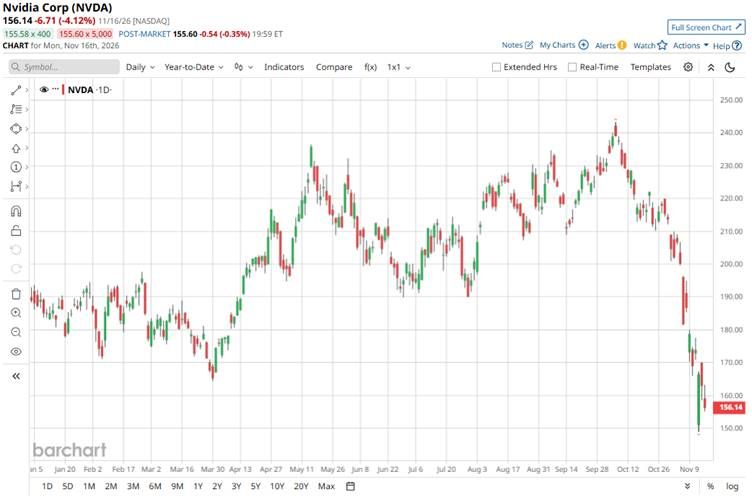
NVDA has come under significant selling pressure, with the stock now down 17.9% over the past year and 16.3% year-to-date (YTD). The decline has accelerated sharply in the near term, with shares slumping 12.6% over the past five trading days and closing at $156.14 on Nov. 16. NVDA is now about 35.8% below its 52-week high of $243.37.
The recent weakness reflects a combination of company-specific and broader AI-market concerns. The resignation of Huang has introduced an unexpected leadership overhang just as investors were preparing for Nvidia’s fiscal third-quarter results. The company is also facing increased scrutiny over its China exposure and U.S. restrictions on advanced-chip access, while the broader semiconductor sector has been under pressure as investors reassess the pace, valuation and returns of AI infrastructure spending. Nvidia fell another 4.1% on Nov. 16 as those concerns intensified ahead of its earnings report.
On the other hand, the sharp decline has created a more compelling valuation backdrop for investors who remain bullish on Nvidia’s underlying AI opportunity, according to Goldman Sachs.
 www.barchart.com
NVIDIA trades at 17.89 times forward earnings, which is a discount to industry peers, while 18.55 times sales is a premium.
Q2 Earnings Exceeded Expectations
NVIDIA delivered another stellar quarter yesterday, reporting its fiscal third-quarter 2027. Revenue reached a record $115.8 billion, up 103% year-over-year (YOY) from $57 billion, and increased 20% sequentially. The result also comfortably exceeded consensus estimates of $109 billion.
The company’s profitability continues to rapidly expand. On a non-GAAP basis, net income climbed 109% to $64.9 billion, versus $31 billion in Q3 fiscal 2026, while adjusted EPS jumped 111% to $2.68, exceeding expectations. Non-GAAP gross margin rose to 74.9% from 73.5%. Operating income surged 116% YOY to $77.9 billion.
Nvidia’s Data Center segment remained the primary growth engine, generating $107.6 billion in revenue, up 110% YOY from the prior-year quarter and representing the majority of total company revenue. The performance reflects continued demand for Nvidia’s accelerated-computing platforms as hyperscalers and AI companies expand infrastructure.
Furthermore, Nvidia issued an even stronger outlook. For Q4 fiscal 2027, the company expects revenue of $130 billion, plus or minus 3%. Importantly, the forecast assumes no Data Center compute revenue from China. Nvidia expects GAAP and non-GAAP gross margins of approximately 71-72%%.
It’s worth noting that Nvidia is not merely maintaining its AI growth trajectory; it is accelerating it, with management pointing to full production of its next-generation Vera Rubin platform and continued strength across AI infrastructure.
Street expects Nvidia’s momentum to continue, with analysts forecasting EPS growth of 103.1% YOY to $9.286in fiscal 2027, followed by another 67.9% increase to $15.55 in fiscal 2028. The consensus EPS estimate of $3.16 for the fourth quarter indicates growth of 69% YOY.
Wall Street Remains Bullish About Nvidia
The latest analyst actions show a clear split on Nvidia following the leadership turmoil surrounding CEO Jensen Huang, although most firms have cut price targets rather than abandoned their bullish ratings, while some took a more cautious stance.
In addition to Goldman Sachs, Morgan Stanley analyst Joseph Moore also maintained an “Overweight” rating on Nvidia but cut the price target to $267 from $300, reflecting increased uncertainty following Jensen Huang’s departure and heightened China-related risks. Despite the target reduction, Moore remains bullish on Nvidia’s underlying business.
Also, UBS analyst Timothy Arcuri maintained a “Buy” rating on Nvidia but lowered the price target to $240 from $300. However, Arcuri remains bullish on Nvidia’s near-term fundamentals and argued that concerns about Nvidia’s product roadmap following the management shake-up are overblown, with the company’s ecosystem and upcoming Rubin platform supporting continued growth.
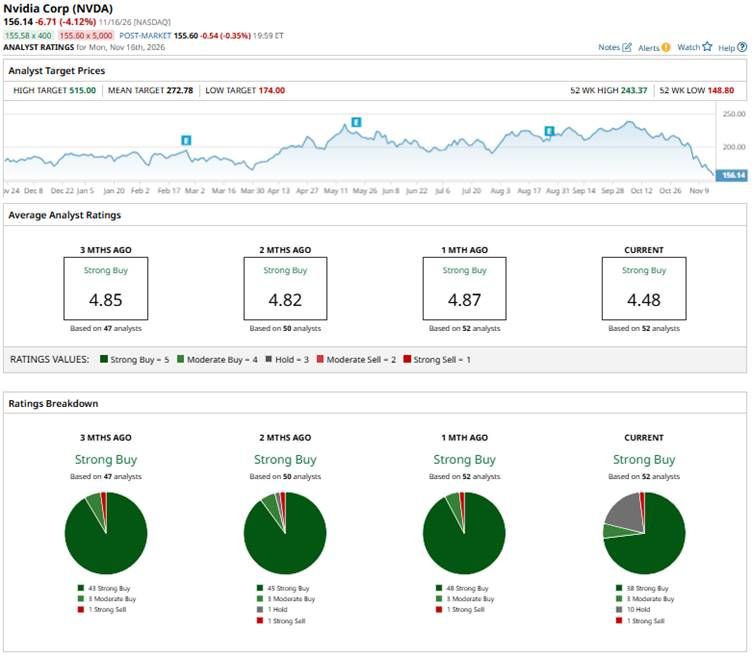
Overall, NVDA has a consensus “Moderate Buy” rating. Of the 53 analysts covering the stock, 36 advise a “Strong Buy,” four suggest a “Moderate Buy,” 12 recommend a “Hold,” and one offers a “Strong Sell” rating.
The average analyst price target for NVDA is $258.03, indicating a potential upside of 67%. Also, the Street-high target price of $515 suggests that the stock could rally as much as 233%.
 www.barchart.com
On the date of publication, Subhasree Kar did not directly have a position in any of the securities mentioned in this article. All information and data in this article is solely for informational purposes. For more information please view the Barchart Disclosure Policy here.
More news from Barchart
‘I Would Be Honored to Answer These Calls and Return as CEO,’ Jensen Huang Says as Employees, Fellow Tech Leaders Rally Behind the Nvidia Founder Billionaire Charlie Munger Called Robinhood ‘A Gambling Parlor Masquerading As a Respectable Business’ and Now They Hold 70 Million Trump Accounts A Strong Q3 Puts Nvidia (NVDA) Stock on Track for a Quick 194% Options Payout As Netflix Stock Hovers Near Its 52-Week Low, Analyst Sentiment Remains Mixed. Here's Why.