


While I don’t predict the future, I do gauge the odds.
And with each passing week, the odds of the broad stock market digging out of this current downturn any time soon become more remote. So instead of trying pointlessly to identify stocks to buy with any level of confidence, this risk manager will drop down a level.
More Yield, Less Trap: Sign up free to get Barchart’s daily Dividend Investor newsletter straight to your inbox.
Take a look at the Xtrackers S&P 100 Ex Top 20 ETF (XOEX) and the iShares S&P 500 Ex S&P 100 ETF (XOEF), a pair of fairly new ETFs which debuted not too long ago. What’s the appeal for investors? They exclude the biggest risk in the U.S. stock market right now: mega-caps carrying too much of the weight in the S&P 500 index to be healthy.
If you own an S&P 500 index fund like (SPY) or (VOO), you do not own a diversified basket of 500 American businesses. You own a top-heavy momentum bet where a small cluster of trillion-dollar giants drives an outsized share of your returns.
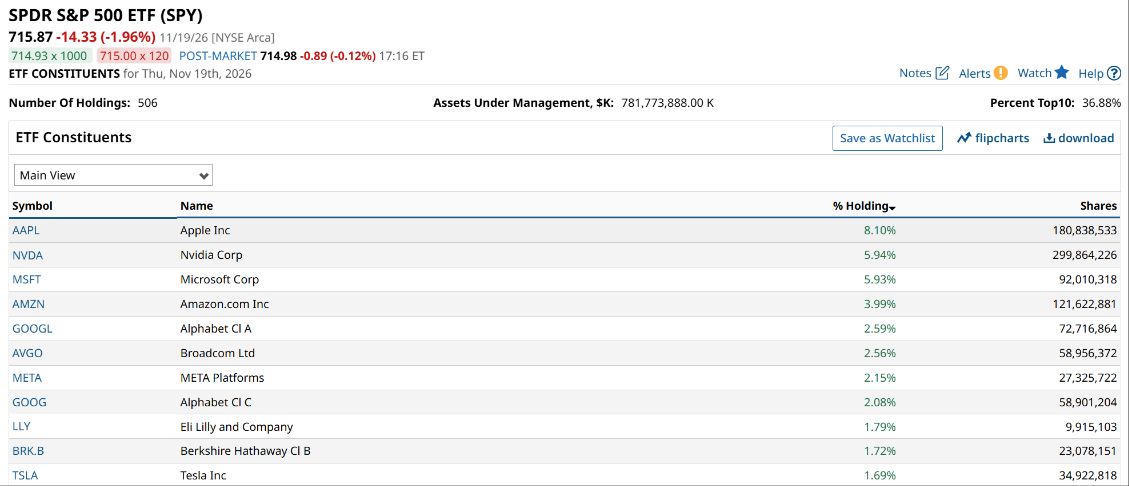
For example, here are SPY’s top 10 stocks (including 2 Alphabet (GOOG) (GOOGL) tickers, for a list of 11 names total). These occupy 39% of the index’s total weight, leaving about 490 stocks to account for the other 61%.
 www.barchart.com
Think about that for a moment. One group averages about a 3.6% position, and the other about 0.8%. Like an army of ants, the latter crew can only do so much individually to alter the damage that the ones on top can do. Like now, for instance.
XOEF excludes not only the top 10, but the top 100. The remaining 400 stocks are not shrimps. But only one stock — CrowdStrike (CRWD) — has a market cap that exceeds $200 billion. No trillionaires here!
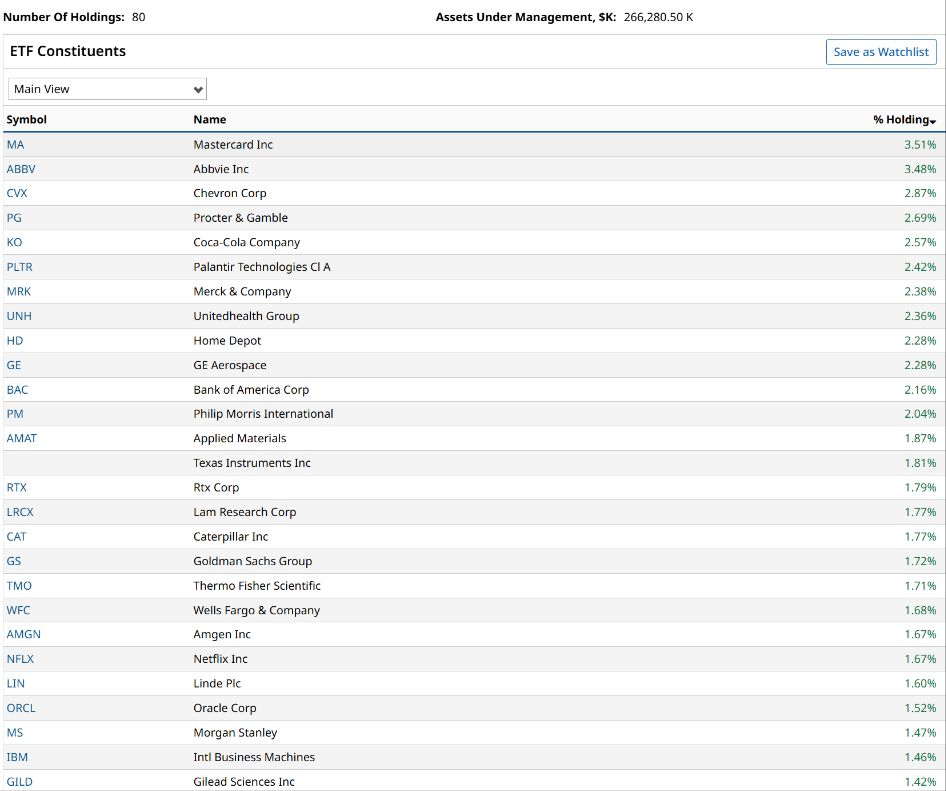
But wait, there’s more. XOEX does similar math, but one step further. Whereas XOEF takes its portfolio from the 500 S&P stocks down to 400 by removing the top 100, XOEX takes the top 100 S&P 500 stocks and excludes the top 20 by market capitalization. That nets out to an 80-stock portfolio, whose biggest holdings are shown here.
 www.barchart.com
Frankly, in a rough market like this, I consider an ETF like this relatively attractive, since there’s a good chance nearly all stocks could plummet from here.
However, this is exactly the time for investors to identify ETFs that can serve one purpose now, and a related one later, in a calmer market climate.
Specifically, I see XOEX as a great pairing with the Short S&P500 -1X ETF (SH), an inverse ETF that shorts the S&P 500. Or, one of the leveraged versions of that concept, (SDS) or (SPXL), for example.
The idea is that if I short S&P 500 stocks 21-100 by size through XOEX and short the full S&P 500 index via SH, to the extent that the mega caps underperform the rest of the market, that’s a win.
In fact, pairing them roughly equally creates an “arbitrage” in just a two-ETF package. Here’s what that looks like over the very volatile past six months for SPY.
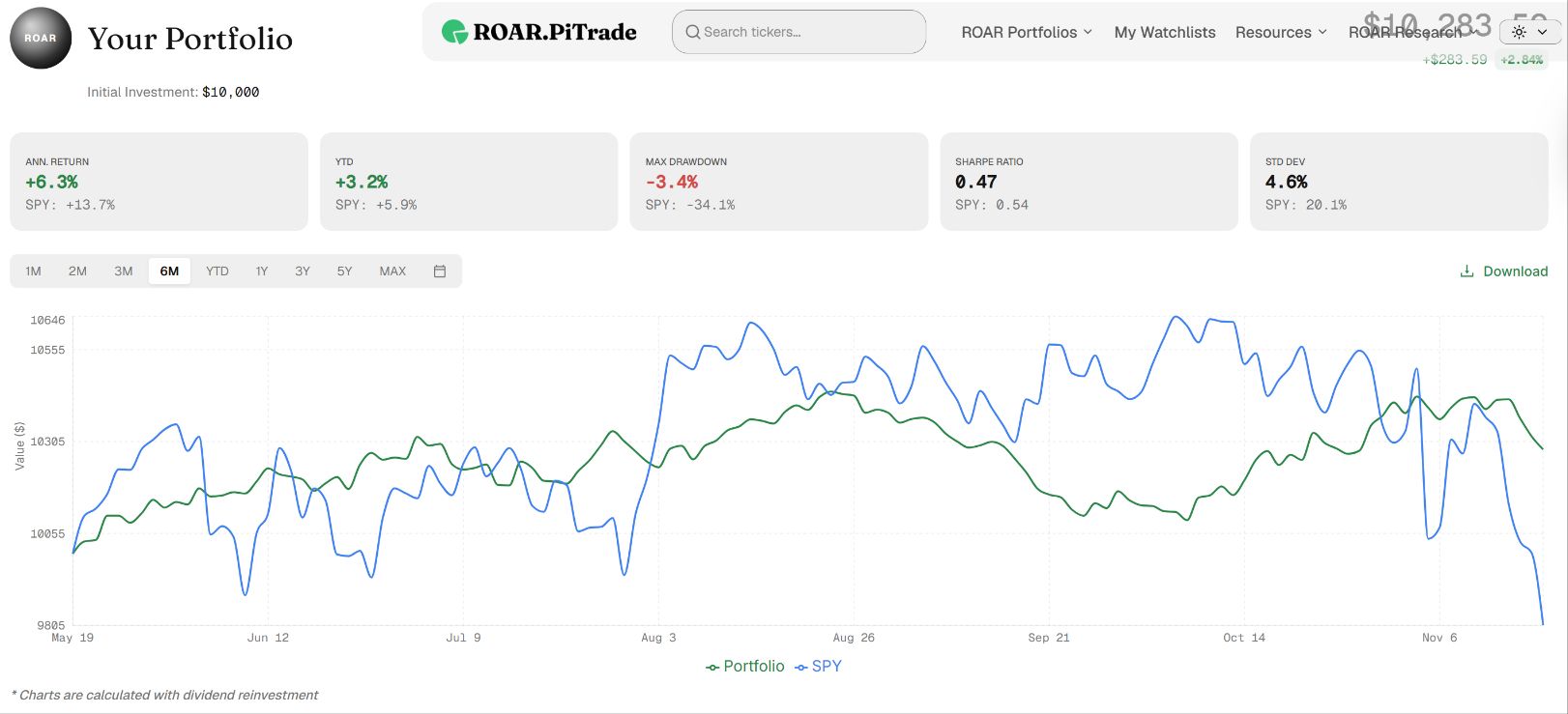 Chart courtesy of Rob Isbitts.
I used the portfolio-builder from ROAR.PiTrade.com, the site built off of my charting experience, in partnership with PiTrade.com, as that’s what it is built to do. Rather than add the typical extra dimension of my ROAR Score risk metric, I simply backtested a 60% XOEX, 40% SH model portfolio. Super simple, and super effective during this time frame.
That static allocation, 2-ETF XOEX-SH model, actually made a profit over that time, in a down period for SPY. You can see on the right side that when SPY tailed off, this combination, led by XOEX, did not. It preserved capital, something that a stock portfolio alone is unlikely to do in a bear market cycle.
What really caught my attention when I glanced at the analytics was the R-Squared and the Beta. In plain English, an R-Squared of 0.01 to the S&P 500 essentially means that the performance of that two-ETF model is not at all determined by what the stock market is doing. Which, right now, could be what a lot of people would love!
The R-Squared of most equity ETFs tends to be 0.90 or more, which means that they are 90% reliant on the S&P 500 going up to make money.
For decades, I’ve tried to be a thought leader and “champion” of investing in the stock market, but not RELYING on stocks.
That’s a big difference, and during times like this, it can be measured in an extra zero or two in the size of your portfolio. The beta of 0.03 similarly means that the 2-ETF mix has only been 1/33 as volatile as SPY during this period.
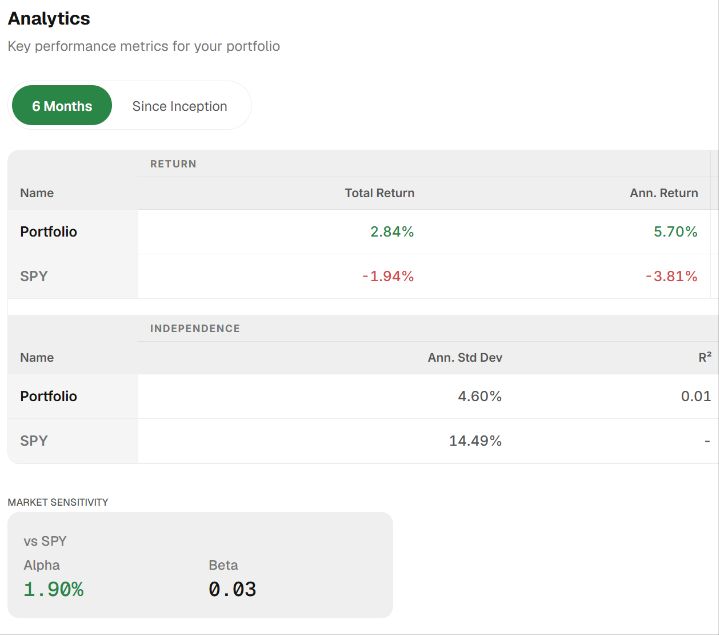 Chart courtesy of Rob Isbitts.
Now, in a straight-up bull market cycle, a mix like this will blunt the upside. But that’s due to the hedge (SH) I applied for, not the XOEX ETF itself.
The point of showing this structure is to present one of many examples of how playing offense and defense at the same time can start with pairing different types of ETFs into a simple portfolio. However, if we add one step, which is to re-evaluate the mix on a periodic basis (monthly, weekly, etc.), we can do a lot with just one pair of ETFs.
For years, investors ignored that concentration risk because the biggest stocks only seemed to go up. Now that AI-stock valuations are facing scrutiny and market leadership is wobbling, self-directed investors are looking for the exit ramp.
If you want to surgically remove the top-heavy giants without diving into unprofitable small-cap junk, two under-the-radar ETFs are built specifically for the job: XOEX and XOEF.
Rob Isbitts created the ROAR Score, based on his 40+ years of technical analysis experience. ROAR helps DIY investors manage risk and create their own portfolios. For Rob's written research, check out ETFYourself.com.
On the date of publication, Rob Isbitts did not directly have a position in any of the securities mentioned in this article. All information and data in this article is solely for informational purposes. For more information please view the Barchart Disclosure Policy here.
More news from Barchart
2 ETFs to Consider in a Market Where Nearly All Stocks Look Dangerous ‘Jensen Huang is a Nation-State’: Why the Nvidia CEO’s Ouster is a Cross-Border Gray Swan The Biggest Winners from the Anthropic IPO Could Be Everyday SPY Investors 12 Influencer-Touted ETFs That Have Fallen Out of Favor: Don't Discount the Risks of Acting on Social Media Investing Advice