

At ObesityWeek on Nov. 14 and 15, Eli Lilly (LLY) presented new results for its next wave of weight-loss drugs. EloraTZP, which combines tirzepatide, the active ingredient in Zepbound and Mounjaro, with eloralintide, a newer drug Lilly is developing, was tested on patients who had obesity and Type 2 diabetes. It delivered weight loss of up to an average of 54.1 lbs at 48 weeks. The drug also helped up to 77% of participants reach normal blood sugar levels. This was a Phase 2 trial, which is an early stage, and EloraTZP is not approved for use yet.
Beyond weight loss, the company is working on treating other conditions too, which means more potential patients. In later-stage Phase 3 trials, its other next-generation drug, retatrutide, helped with health problems often linked to obesity. For people with sleep apnea, it reduced breathing disruptions during sleep by up to 60.6% at 80 weeks. It also reduced knee arthritis pain by up to 75.8% at 68 weeks. And Lilly is building this pipeline from a position of strength. As I covered earlier, it is already winning about 7 in 10 new Medicare patients starting weight-loss drugs, and it held about 61% of the U.S. market in the second quarter, well ahead of Novo (NVO).
More Top Stocks Daily: Go behind Wall Street’s hottest headlines with Barchart’s Active Investor newsletter.
About Eli Lilly Stock
Eli Lilly is a pharmaceutical company best known these days for its weight-loss and diabetes drugs, and it's working on the next generation of them. Its product portfolio includes Mounjaro, Zepbound, and its weight-loss pill, Foundayo, along with treatments for cancer, immune conditions, and Alzheimer's disease. Founded in 1876, the company is headquartered in Indianapolis, Indiana, and is led by CEO Dave Ricks.
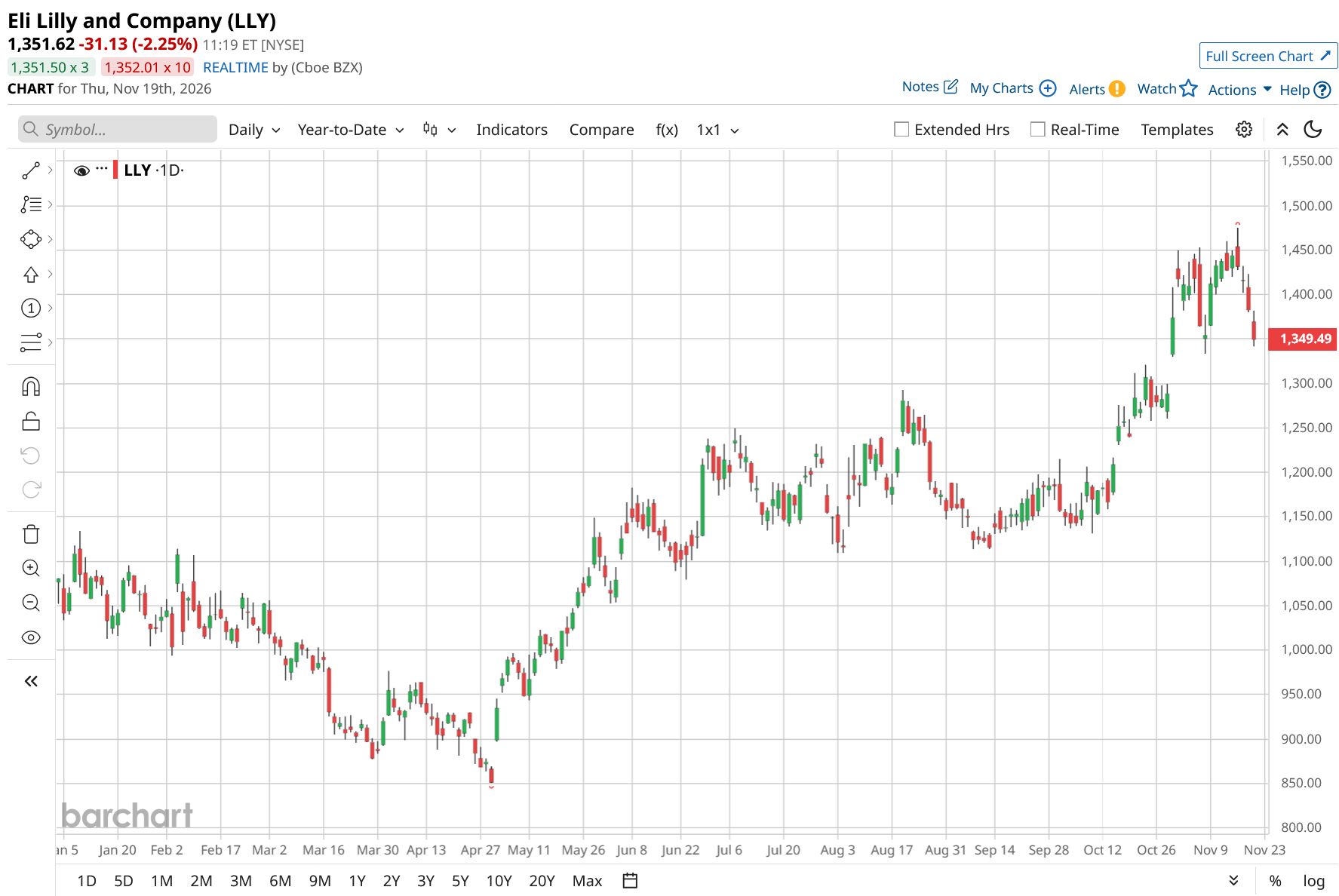
Eli Lilly’s stock has grown 25% this year, outperforming the Health Care Select Sector SPDR Fund's (XLV) 19% gain during the same period. In the past month alone, the stock has surged 9% and currently sits just 8.6% below its all-time high of $1,475.25.
 www.barchart.com
Lilly's valuation looks reasonable to me right now. The forward non-GAAP price-to-earnings (P/E) of 40.36x sits nearly 12% below its 5-year average of 45.73x. The forward price-to-sales (P/S) ratio of 13.91x is about 8% above its 5-year average of 12.87x, a modest premium. The EPS outlook is strong in the near term. Analysts expect earnings to grow around 47% in 2026 and 43% in 2027, then slow to about 14% in 2028 and 2029. That's why the new pipeline is so crucial for Lilly, because drugs like EloraTZP and retatrutide could help keep growth going once the current boom slows down. The balance sheet shows $49.50 billion in debt against $4.89 billion in cash, which is manageable for a company worth about $1.28 trillion.
Why the FDA Warning Didn't Hurt Eli Lilly All That Much
On Nov. 9, the FDA required all GLP-1 drugs, including Lilly's Mounjaro and Zepbound, to carry a new warning about a rare eye condition that can cause sudden vision loss. The FDA's review of 126 clinical trials found about six cases a year for every 100,000 patients on GLP-1 drugs, compared with about four for patients not taking them. But LLY stock still stayed near its record highs. One likely reason is that the FDA hasn't yet proven the drugs are what caused the issue. Furthermore, the warning applied to every drug in this class, so it didn't favor Novo over Lilly.
Mounjaro and Zepbound Drive Another Comfortable Beat
Eli Lilly reported its third-quarter 2026 earnings on Oct. 29, beating analyst estimates on both key metrics. Revenue jumped 39% year-on-year (YoY) to $24.4 billion, roughly $2 billion above estimates. Non-GAAP EPS of $7.48 rose 7% and beat the $6.26 consensus, even with one-time charges tied to recent acquisitions. Mounjaro sales surged 65%, and Zepbound grew 49%, while its newer drugs for cancer, immune conditions, and neuroscience doubled in revenue.
Looking forward, Lilly raised its full-year revenue guidance to $91 billion to $92 billion, up from $85 billion to $87 billion. However, it trimmed its EPS outlook slightly to $35 to $36 because of those acquisition charges.
What Do Analysts Expect for LLY Stock?
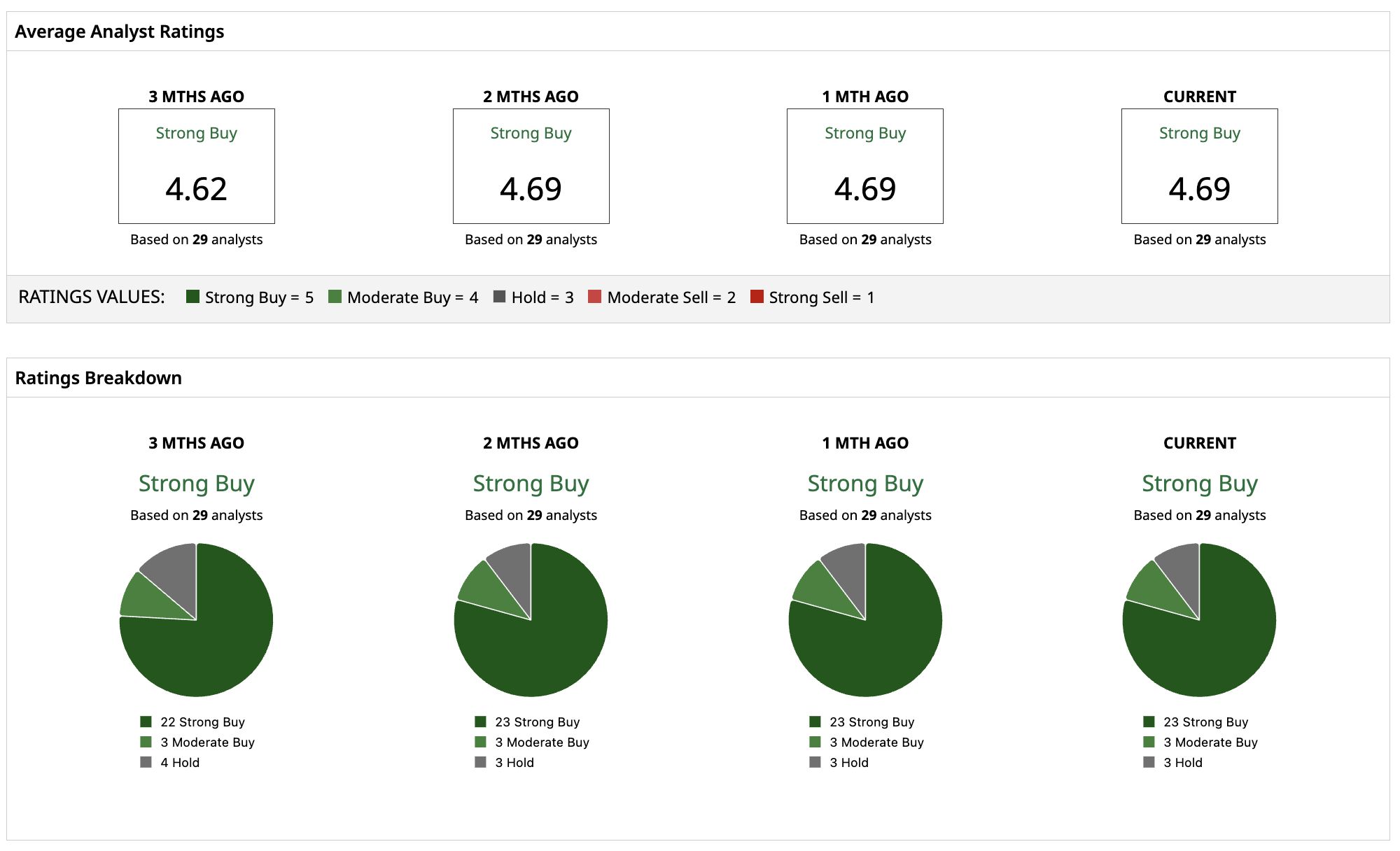
Based on 29 Wall Street analysts, LLY stock holds a “Strong Buy” consensus rating with a mean price target of $1,517.64, indicating 13% upside. I think the main reason for the modest upside is that the stock is already sitting close to its record high price.
 www.barchart.com
On the date of publication, Jabran Kundi did not directly have a position in any of the securities mentioned in this article. All information and data in this article is solely for informational purposes. For more information please view the Barchart Disclosure Policy here.
More news from Barchart
Eli Lilly’s Next Weight-Loss Drug Helped Patients Lose Up to 54 Pounds. Why the FDA’s New Warning Didn’t Hurt LLY Stock. Coatue Management Bets on SK hynix Stock as Demand for HBM Chips Accelerates TD Cowen Just Upgraded UnitedHealth Stock. Here’s Why. Apple Is Now Worth Over $5 Trillion Without Betting Big on AI Data Centers. AAPL Stock Now Trades Near Wall Street’s Targets.