

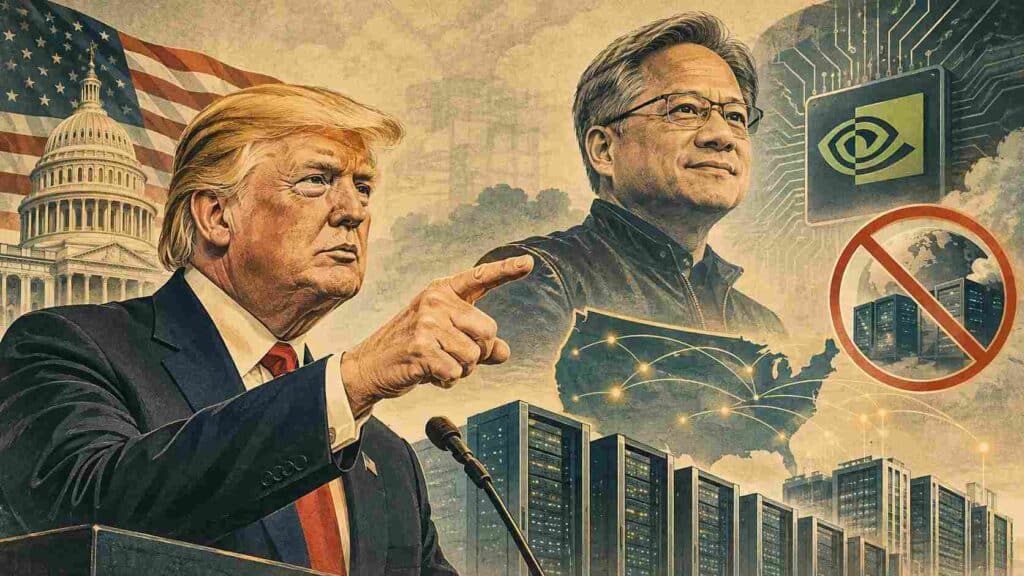
The comments , made during a White House press conference on November 20, highlight two priorities for the administration: keeping artificial intelligence infrastructure within the United States and maintaining its competitive position against China.
Trump Proposes Tax on Overseas AI Data Centers
Trump said his administration would prevent American companies from establishing data centers outside the country or impose a substantial financial penalty on those that proceed. Referring to the proposed measure, he warned that companies building facilities abroad would face a “tremendous tax.”
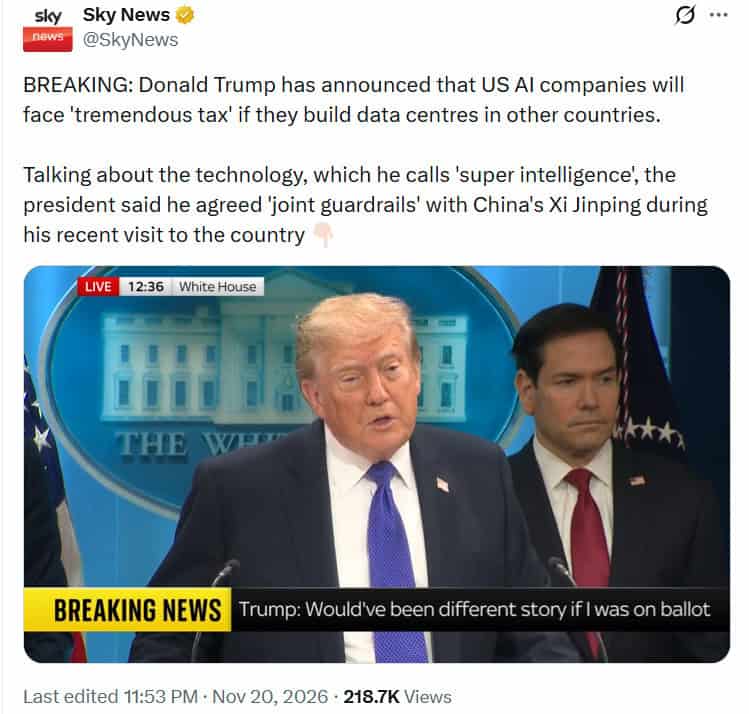
President Trump proposed a hefty tax on US AI firms building data centers overseas to protect domestic infrastructure and jobs amid growing competition with China. Source: @SkyNews/X
“We're not going to allow our companies to build data centers outside of our country,” Trump said during the press conference.
The president argued that allowing critical technology infrastructure and manufacturing operations to move overseas could weaken America's position in the global AI race. He pointed to the semiconductor industry as an example, suggesting that the United States had fallen behind after allowing chip production to expand abroad.
The proposal reflects Trump's broader effort to attract investment, infrastructure development, and technology-related employment to the domestic market. However, he did not provide a proposed tax rate, implementation schedule, or details about which companies and projects would fall under the measure.
The announcement also came with questions about its legal and administrative feasibility. According to Axios, Trump acknowledged that he had not discussed the proposal with his officials before making the announcement. The president also did not explain whether he would seek congressional approval or attempt to use existing executive powers.
The US Constitution grants Congress authority to impose federal taxes, leaving the precise legal route for Trump's proposed measure unresolved. No formal legislative framework or implementing regulations were outlined during the announcement.
Domestic Data Center Expansion Faces Public Opposition
Trump's proposal comes as the rapid expansion of AI infrastructure faces growing resistance in several US communities. Although the administration wants companies to build more facilities domestically, the projects have generated concerns about electricity consumption, water requirements, and their potential impact on household utility costs.
Data centers require substantial computing capacity to train and operate increasingly sophisticated AI models. Their electricity demand can place additional pressure on local power networks, while cooling systems can require significant water resources. These issues have become prominent subjects in local planning discussions and election campaigns.
The backlas h also became a political issue during the 2026 midterm election cycle, with voters considering measures to restrict or impose additional conditions on data center development. Consequently, Trump's effort to discourage overseas construction comes at a time when some American communities are questioning the costs of hosting these facilities.
There is also an economic consideration. Data center operators frequently establish facilities close to customers to reduce processing delays and the expense of transmitting large volumes of information. For companies serving international clients, maintaining infrastructure across different countries can therefore remain important.
A policy that increases the cost of overseas construction could influence future investment decisions by US technology firms. However, its ultimate impact would depend on the scope of the proposed tax and whether companies receive any exemptions.
Trump Highlights AI Competition With China
Trump linked his data center proposal to the wider competition between Washington and Beijing over artificial intelligence. During the same press conference, he discussed his recent Asia trip and his conversations with Chinese President Xi Jinping.
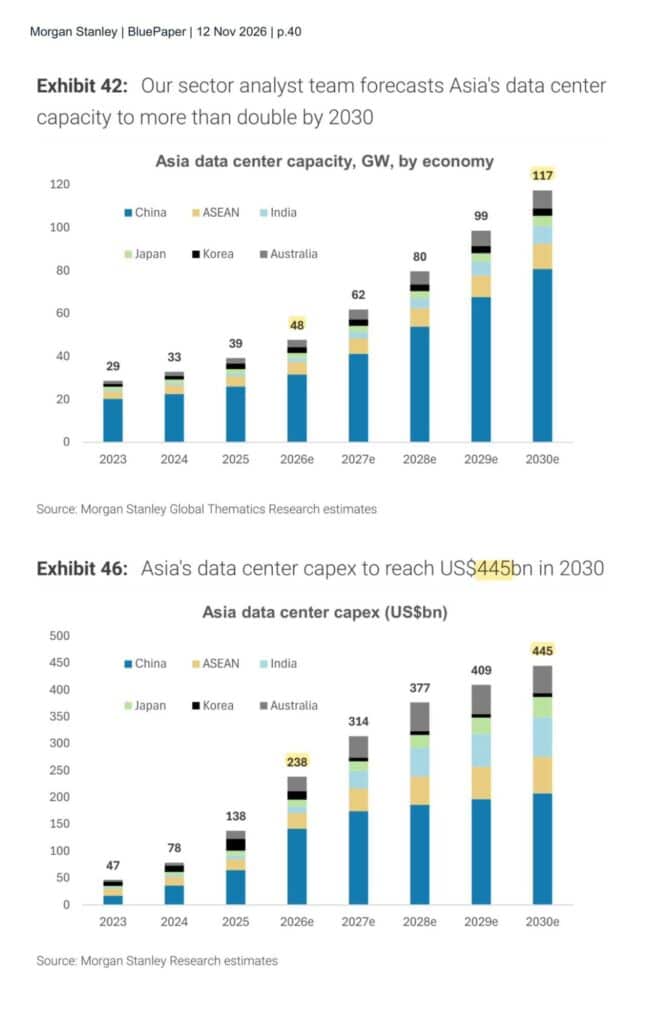
Morgan Stanley is projecting capacity to climb from 48 GW in 2026 to 117 GW by 2030. Source: @MojoTricks/X
The president claimed that he and Xi had agreed to establish “joint guardrails” for AI development. He did not explain what those safeguards would involve or whether they would lead to any formal agreement between the two governments.
Trump also described artificial intelligence as “super intelligence,” arguing that the United States remained ahead of China in the race to develop the technology. He presented the competition as largely revolving around the two countries, with China occupying second place in his assessment.
The comments come amid continuing US efforts to restrict China's access to advanced computing technology. The Commerce Department has moved to tighten controls on advanced AI chip exports to several Southeast Asian countries to prevent the technology from reaching Chinese companies through third-party channels.
Data centers have become part of this broader technology competition because they allow businesses to access powerful processors and computing resources without necessarily purchasing the hardware themselves. Reuters has reported that Chinese companies have continued accessing computing capacity through overseas data centers in countries permitted to receive advanced chips.
This creates a connection between Trump's proposed tax and the administration's semiconductor policies. Both approaches seek to protect America's technological position while limiting the channels through which China can access advanced AI computing resources.
Trump Calls for Jensen Huang's Return to Nvidia
Alongside his comments about AI infrastructure, Trump renewed his support for Jensen Huang's return as Nvidia chief executive.
Huang resigned from his positions as president, CEO, and board member on November 12, 2026, following reports involving alleged extramarital relationships. Nvidia's board subsequently appointed Chief Financial Officer Colette Kress as interim CEO while beginning the search for a permanent replacement.
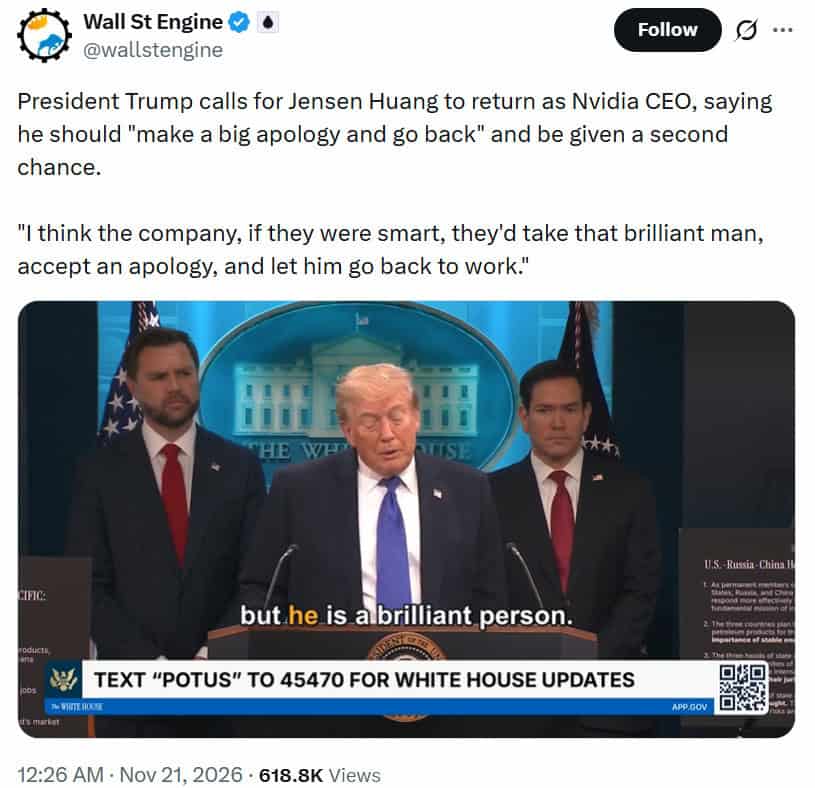
President Trump called on Nvidia’s board to reinstate Jensen Huang as CEO, urging it to accept his apology and give him another opportunity. Source: @wallstengine/X
Trump described Huang as one of the most talented figures in the technology industry and argued that Nvidia should consider giving him another opportunity to lead the company.
“I would love to see him back,” Trump said, adding that Huang should “be given a second chance.”
The president also suggested that Nvidia should accept an apology from its former chief executive and allow him to return to work. He credited Huang with helping develop the company's advanced Blackwell AI chip platform, which has become an important part of its computing business.
Trump further argued that Huang's technical contributions had helped put the United States significantly ahead in AI chip development. His remarks reflected concern about losing an executive whose work has been closely associated with Nvidia's expansion in the global semiconductor industry.
The comments followed an earlier wave of support for Huang from technology industry figures and investors. Elon Musk and Epic Games CEO Tim Sweeney were among those who backed a petition calling for Nvidia to reconsider the decision while an independent investigation proceeds.
Nvidia Board Maintains Leadership Transition
Despite Trump's public backing, Huang's return to Nvidia does not appear to be part of the board's current plans. The Associated Press reported that a person familiar with the board's thinking said directors were not considering reinstating the former CEO.
The circumstances surrounding Huang's resignation remain sensitive. Reports described alleged relationships with a senior Nvidia executive who reported to him and a Chinese businesswoman suspected by US intelligence of having connections to Beijing. The latter allegation has not been publicly established as fact, and Trump has questioned whether the woman was a spy.
The issue has also raised questions about corporate governance, executive conduct, and potential national security concerns. Nvidia's board now faces the task of maintaining confidence among investors, employees, and customers while the company searches for permanent leadership.
The administration itself has shown differing views on the company's future. Treasury Secretary Scott Bessent previously called for a significant leadership shake-up and suggested that Nvidia should consider an external candidate. Trump's endorsement of Huang's return therefore contrasts with Bessent's stated preference for a different leadership direction.
For now, Colette Kress remains responsible for Nvidia's executive leadership while the board considers potential successors. The company has said it expects operations, customer commitments, and its product roadmap to continue without interruption.
Trump's two announcements highlight the administration's growing focus on the strategic importance of AI infrastructure and semiconductor leadership. However, the proposed overseas data center tax still lacks an implementation framework, while Huang's potential return depends on a decision by Nvidia's board rather than presidential support alone.