


Shopify Inc. SHOP is positioning agentic commerce as a potential new demand channel for merchants as artificial intelligence begins to reshape how shoppers discover, compare and purchase products online. The company is embedding its platform into emerging AI shopping ecosystems, giving merchants another route to reach buyers beyond conventional search and direct website traffic.
The early signals are notable. In the first quarter of 2026, AI-driven traffic to Shopify stores increased 8x year over year, while orders generated from AI-powered searches rose nearly 13x. New buyer orders from AI searches also occurred at nearly twice the rate of traditional organic search, suggesting that AI-led discovery may help merchants reach incremental customers. Shopify has also structured more than 1 billion products with clean attributes, real-time pricing and accurate inventory, allowing AI agents to surface relevant products more effectively across channels such as ChatGPT, Microsoft Copilot and Google AI services.
The opportunity extends beyond traffic growth. More AI-driven shopping activity could support higher merchant GMV over time, which would benefit Shopify’s broader commerce ecosystem if those transactions flow through its platform. Shopify Payments processed $67 billion of GMV in the first quarter, up 41% year over year, while penetration reached 67% of total GMV. Shop Pay processed $35 billion of GMV, growing 59% year over year.
Shopify is also working to become part of the infrastructure layer behind AI commerce. The company co-developed the Universal Commerce Protocol with Google to support agentic commerce across platforms. Amazon, Meta, Microsoft, Salesforce and Stripe have joined the related council, reinforcing the importance of common standards as AI agents become more involved in product discovery, checkout, payments and post-purchase activity. For Shopify, that participation strengthens its position as a connector between merchants and emerging AI-led shopping surfaces.
Shopify’s ability to turn agentic commerce into a durable growth channel will likely depend on whether AI-led shopping continues gaining adoption and converts into meaningful merchant activity. The first-quarter metrics show strong early momentum, but the financial impact will depend on how much of that traffic converts into orders, GMV and deeper merchant engagement. If AI increasingly becomes a starting point for online shopping, Shopify’s catalog, payments infrastructure and unified commerce platform could give the company a larger role in the next phase of digital commerce.
Shopify’s Competitor Landscape
Amazon.com, Inc. AMZN provides a relevant benchmark for SHOP because it is also positioning AI as a major force in how consumers discover and purchase products. Amazon’s advantage lies in its marketplace scale, fulfillment network and large buyer base, supported by AI tools across shopping, advertising and AWS. However, Amazon’s model remains more controlled and marketplace-centered, while Shopify’s agentic commerce push is focused on helping independent merchants surface products across emerging AI shopping channels.
Wix.com Ltd. WIX provides a closer product-level comparison because it also serves merchants and small businesses building digital storefronts. Wix is using AI to simplify website creation, design and business workflows through tools such as Harmony and Base44. Its AI strategy is more focused on creation and site-building, while Shopify’s opportunity is tied more directly to commerce execution, including product discovery, checkout, payments and merchant services.
Against this backdrop, Shopify’s agentic commerce opportunity is distinct from Amazon’s marketplace-led scale and Wix’s website-creation focus. SHOP’s potential advantage is that its AI commerce push is being built on a platform already expanding across multiple merchant use cases, including online commerce, payments, Shop Pay, catalog infrastructure, POS and international selling. That broader commerce stack gives Shopify a wider transaction base through which AI-led discovery can translate into merchant activity over time.
SHOP’s Price Performance, Valuation & Estimates
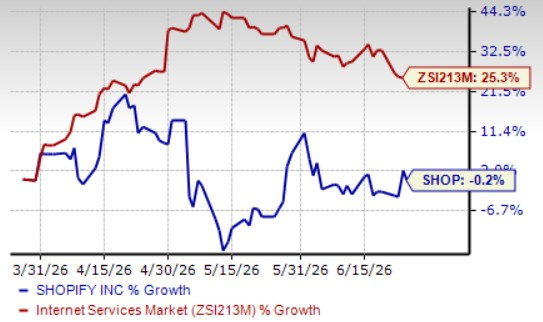
Shares of Shopify have declined 0.2% in the past three months against the industry’s 25.3% growth.
SHOP’s Stock Three-Month Price Performance
Image Source: Zacks Investment Research
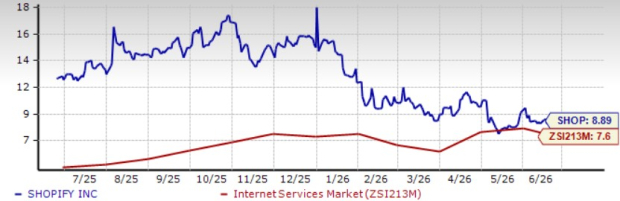
SHOP stock is currently trading at a premium. It is currently trading at a forward 12-month price-to-sales (P/S) multiple of 8.89, above the industry average of 7.6.
SHOP’s P/S Ratio (Forward 12-Month) vs. Industry
Image Source: Zacks Investment Research
The Zacks Consensus Estimate for SHOP’s 2026 earnings implies a year-over-year increase of 55.6%. Estimates for 2026 earnings per share have remained unchanged in the past 30 days.
EPS Trend of SHOP Stock
Image Source: Zacks Investment Research

SHOP stock currently has a Zacks Rank #3 (Hold). You can see the complete list of today’s Zacks #1 Rank (Strong Buy) stocks here.
Beyond Nvidia: AI's Second Wave Is Here
The AI revolution has already minted millionaires. But the stocks everyone knows about aren't likely to keep delivering the biggest profits. AI’s second wave is moving from infrastructure to implementation and these companies are at the forefront of this transition, positioned to become what Amazon and Google were to the internet era.
See Stocks Now >>Want the latest recommendations from Zacks Investment Research? Today, you can download 7 Best Stocks for the Next 30 Days. Click to get this free report
Shopify Inc. (SHOP): Free Stock Analysis Report
Amazon.com, Inc. (AMZN): Free Stock Analysis Report
Wix.com Ltd. (WIX): Free Stock Analysis Report
This article originally published on Zacks Investment Research (zacks.com).