


Mission Produce, Inc.’s AVO second-quarter fiscal 2026 results reflected the impact of an unusually challenging avocado pricing environment, with record Mexican supply and an unfavorable fruit-size mix weighing on margins. Despite these near-term pressures, management emphasized that the underlying profitability trajectory is improving as supply conditions normalize, pricing stabilizes and the company leverages its diversified sourcing network. With stronger contributions expected from Peru in the second half and the recently completed Calavo acquisition adding scale and operational flexibility, investors are closely assessing whether profitability is set to rebound.
The Marketing & Distribution segment continued to demonstrate resilience despite significant pricing headwinds. Avocado volumes increased 15% year over year, highlighting robust customer demand and effective commercial execution even as lower selling prices and temporary fruit-size mismatches compressed per-unit margins. Encouragingly, management noted that gross profit for the segment improved on a first-half basis versus the prior year despite the difficult fiscal second quarter, underscoring the strength of its vertically integrated business model. The company also indicated that the margin pressure experienced in April has largely subsided, with normalized supply and multi-region sourcing expected to drive meaningful margin improvement through the remainder of fiscal 2026.
Profitability trends also appear to be improving across Mission Produce's other businesses. While the International Farming segment remained seasonally weak due to investments in mango production and lower blueberry packing volumes, management expects a significantly stronger second half, supported by a robust Peruvian avocado harvest and higher blueberry yields. Meanwhile, the integration of Calavo is expected to enhance operational efficiency by expanding packing capacity, optimizing sourcing and generating at least $25 million in annualized cost synergies over the next 18 months, with benefits beginning to emerge in the fourth quarter and accelerating into fiscal 2027. Collectively, these factors suggest that Mission Produce is positioning itself for a stronger profitability profile after navigating an unusually difficult first half.
Is Profitability Improving Across Segments for Corteva and Dole?
Corteva, Inc. CTVA and Dole plc DOLE are strengthening profitability through better product mix, disciplined cost control and operational efficiencies despite challenging industry conditions.
Corteva continues to demonstrate improving profitability across its business segments, supported by disciplined cost management, a richer product mix and sustained pricing execution. The Seed segment has benefited from strong demand for premium corn and soybean genetics, while the Crop Protection business continues to gain from the adoption of differentiated biologicals and new crop protection products with higher margin profiles. At the same time, Corteva’s ongoing productivity initiatives and manufacturing efficiencies have helped offset input cost pressures, supporting margin expansion despite a mixed agricultural environment.
Dole is steadily strengthening profitability across its diversified fresh produce portfolio through improved operational execution, supply-chain optimization and a more favorable product mix. While fresh fruit pricing remains influenced by weather and industry supply conditions, the company has continued to enhance margins through efficiency initiatives, disciplined cost control and improved performance in value-added and diversified product categories. Dole’s strategic investments in farming operations, logistics and distribution are also supporting greater operating leverage, while normalization of supply conditions is helping improve pricing dynamics across key markets.
AVO’s Price Performance, Valuation & Estimates
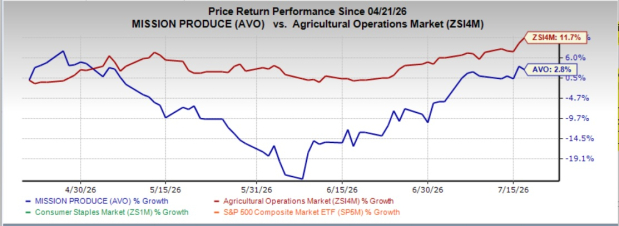
Shares of Mission Produce have gained 2.8% in the last three months compared with the industry’s rise of 11.7%.
Image Source: Zacks Investment Research
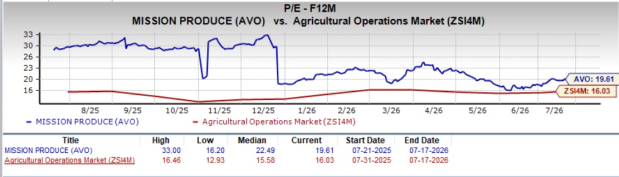
From a valuation standpoint, AVO trades at a forward price-to-earnings ratio of 19.61X, well above the industry’s average of 16.03X.
Image Source: Zacks Investment Research
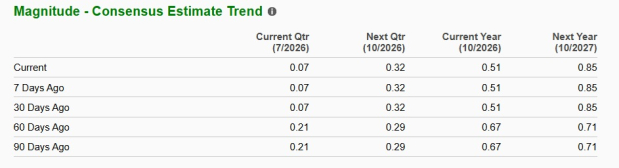
The Zacks Consensus Estimate for AVO’s fiscal 2026 earnings suggests a year-over-year decline of 35.44%, while that for fiscal 2027 indicates growth of 66.7%. The company’s EPS estimates for fiscal 2026 and 2027 have remained stable in the past seven days.
Image Source: Zacks Investment Research
AVO stock currently carries a Zacks Rank #3 (Hold). You can see the complete list of today’s Zacks #1 Rank (Strong Buy) stocks here.
Radical New Technology Could Hand Investors Huge Gains
Quantum Computing is the next technological revolution, and it could be even more advanced than AI.
While some believed the technology was years away, it is already present and moving fast. Large hyperscalers, such as Microsoft, Google, Amazon, Oracle, and even Meta and Tesla, are scrambling to integrate quantum computing into their infrastructure.
Senior Stock Strategist Kevin Cook reveals 7 carefully selected stocks poised to dominate the quantum computing landscape in his report, Beyond AI: The Quantum Leap in Computing Power .
Kevin was among the early experts who recognized NVIDIA's enormous potential back in 2016. Now, he has keyed in on what could be "the next big thing" in quantum computing supremacy. Today, you have a rare chance to position your portfolio at the forefront of this opportunity.
See Top Quantum Stocks Now >>Want the latest recommendations from Zacks Investment Research? Today, you can download 7 Best Stocks for the Next 30 Days. Click to get this free report
Mission Produce, Inc. (AVO): Free Stock Analysis Report
Dole PLC (DOLE): Free Stock Analysis Report
Corteva, Inc. (CTVA): Free Stock Analysis Report
This article originally published on Zacks Investment Research (zacks.com).