


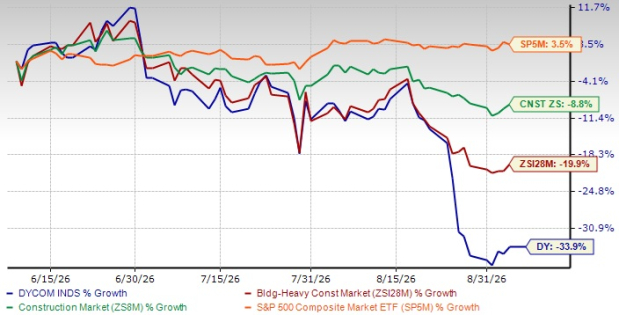
Shares of Dycom Industries, Inc. DY have lost 33.9% over the past three months compared with the Zacks Building Products - Heavy Construction industry's decline of 19.9%. The stock has also lagged the Zacks Construction sector and the S&P 500 Index, as evidenced by the chart below.
DY’s 3-Month Price Performance
Image Source: Zacks Investment Research
Despite strong demand across fiber and data center infrastructure, investor sentiment toward Dycom may remain cautious due to near-term margin pressure in Communications, wireless revenue deferral and the investments required to scale its workforce. These factors could moderate the pace of earnings growth in the near term.
However, Dycom’s record backlog, raised fiscal 2027 revenue outlook and strong demand for fiber infrastructure provide support for its longer-term prospects. Growing opportunities in long-haul fiber, data center interconnects and Building Systems, along with improving cash generation, strengthen the company’s growth outlook despite the near-term pressures.
Let us take a closer look at the factors shaping Dycom stock's prospects.
Record Backlog and Raised Guidance Improve DY’s Growth Visibility
A strong backlog gives Dycom greater visibility into future revenues and supports confidence in its growth outlook. Dycom ended the second quarter with a record backlog of $12.2 billion, with a book-to-bill ratio of 1.2x and 1.1x on an organic basis. Communications backlog stood at $10.98 billion, while Building Systems backlog was $1.26 billion. More than $6.47 billion of the total backlog is expected to be completed over the next 12 months, providing a solid base for future revenues. Contracted backlog for long-haul, middle-mile and inside-the-fence fiber also exceeded $1 billion, highlighting the growing scale of these opportunities.
The strong backlog position supported management's decision to raise its fiscal 2027 revenue outlook to $7.48-$7.66 billion from the prior expectations. At the midpoint, the updated outlook implies 36.5% total revenue growth and 11.3% organic growth. The higher outlook reflects strong execution, the addition of National Technology Integrators and the timing of wireless work moving into fiscal 2028.
Fiber Demand Creates a Long-Term Growth Opportunity for DY
The expansion of fiber infrastructure is creating a multi-year opportunity for Dycom as customers invest in connectivity across residential, enterprise and data center networks. Demand across Dycom's Communications business remains strong, particularly in fiber-to-the-home, long-haul and middle-mile fiber and data center interconnects. Fiber-to-the-home revenues increased nearly 60% in the first half, while cloud migration, AI workloads and data center expansion are driving greater demand for long-haul fiber corridors and high-strand interconnects. Management also said customers reinforced their fiber-to-the-home spending and build programs during the quarter.
Dycom has already secured more than $1 billion of backlog tied to long-haul, middle-mile and inside-the-fence fiber, with hundreds of millions of dollars of work completed. Management expects the broader $20 billion opportunity to be weighted toward the latter part of the decade, giving the company a long runway for growth. Its experience in handling complex fiber projects and the large Communications workforce could also help Dycom capitalize as these programs scale.
Building Systems Expansion Strengthens DY’s Growth Mix
Expansion in Building Systems gives Dycom an additional avenue to participate in data center infrastructure spending while broadening its business beyond Communications. Building Systems is becoming a larger contributor to Dycom's growth, with quarterly revenues of $397.5 million and adjusted EBITDA of $97.2 million, representing a strong 24.5% margin. Power Solutions continued to deliver substantial growth, supported by strong data center demand, while National Technology Integrators contributed $22.9 million in revenue during the quarter after joining Dycom.
The expansion of Building Systems also supports Dycom's diversification beyond its core Communications business. Management expects the segment's adjusted EBITDA margin to remain in the high teens to low 20s, reflecting the strength of its opportunity set and increasing operating leverage. Continued integration of National Technology Integrators and potential future acquisitions could further expand Dycom's presence across attractive markets.
Strong Execution and Margin Expansion Support Profitability
The ability to execute complex infrastructure programs while scaling operations remains important to Dycom's profitability as demand expands. Dycom delivered record quarterly revenues of $2.01 billion, up 45.6% year over year and 16.7% organically. Adjusted EBITDA increased 53.5% to $315.5 million, while adjusted EPS rose 45.3% to $5.29. Consolidated adjusted EBITDA margin improved 81 basis points to 15.7%, showing the benefit of higher revenues and strong execution across the business.
Building Systems was a key contributor to the margin improvement, while Communications generated higher EBITDA despite investments to scale operations. Management expects consolidated adjusted EBITDA margin to increase in fiscal 2027, although Communications margins are expected to face some pressure from workforce investments, wireless deferrals and higher fuel costs. This makes execution and the continued growth of higher-margin Building Systems important to the overall profitability outlook.
Earnings Estimate Revision of DY
Dycom’s earnings estimates for fiscal 2027 and 2028 have moved upward in the past 30 days to $16.82 and $20.24 per share, respectively. The estimates for fiscal 2027 and 2028 imply year-over-year growth of 40.5% and 20.4%, respectively.
DY EPS Estimate Revision
Image Source: Zacks Investment Research

What Is Hurting DY’s Prospects?
Communications Margin Pressure Could Limit Near-Term Profitability
Dycom’s Communications business faces some near-term pressure as it invests ahead of rising fiber demand. Adjusted EBITDA margin for the segment declined 134 basis points in the fiscal second quarter, partly due to higher workforce investments, the deferral of wireless work and higher fuel costs. Fuel alone created about 35 basis points of year-over-year pressure during the quarter.
Management expects Communications margins to decline slightly for fiscal 2027 as these factors continue to affect operating leverage. The company is also spending to ramp its operations across fiber programs, which could weigh on margins before the additional revenues fully offset those costs. While these investments are intended to support growth, they could limit near-term expansion in consolidated profitability.
Wireless Revenue Deferral Delays Near-Term Growth
The shift in wireless project timing creates a near-term headwind to revenue growth even though the underlying program remains intact. Dycom now expects approximately $150 million of wireless revenues to move from the second half of fiscal 2027 into 2028. Management said the overall program scope and backlog remain unchanged, but the timing shift will reduce revenues and operating leverage in the current fiscal year.
The deferral is also reflected in the Communications outlook, which now calls for fiscal 2027 revenues of $5.90-$6.01 billion despite continued strength across fiber programs. Management expects the wireless business to be more or less flat year over year after the shift, making growth from fiber-to-the-home and newer long-haul opportunities increasingly important to the segment's near-term performance.
DY’s Valuation Trend
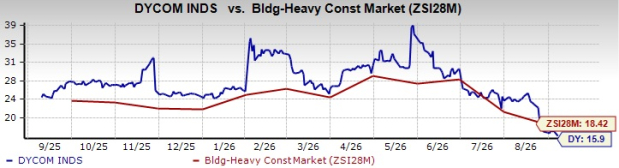
Dycom stock is currently trading at a discount compared with the industry peers, with a forward 12-month price-to-earnings (P/E) ratio of 15.9x, as the trend lines suggest below.
DY Valuation (P/E F12M)
Image Source: Zacks Investment Research
Dycom vs. Other Market Players
Dycom competes closely with Quanta Services, Inc. PWR, EMCOR Group, Inc. EME and MasTec, Inc. MTZ in the infrastructure and engineering construction market.
Quanta operates across utility, technology and load center markets, providing electrical, mechanical, civil and fabrication services. Its broad capabilities and long-standing customer relationships support large and complex infrastructure projects. Quanta also has exposure to technology, power generation and utility markets. However, utility capital spending and the timing of large project awards can affect growth.
Meanwhile, EMCOR has a diversified construction and services platform spanning electrical, mechanical, building and industrial markets. Strong demand from data centers, network and communications, manufacturing and institutional markets supports growth. EMCOR also benefits from its ability to execute complex projects across multiple trades and geographies. However, project mix and timing can affect margins and revenue growth.
Conversely, MasTec maintains a diversified infrastructure platform spanning telecommunications, power delivery, clean energy and infrastructure, pipeline and mission-critical construction. This broad exposure provides access to multiple infrastructure investment themes, including data center development, grid modernization, power generation and natural gas infrastructure. However, project timing across individual end markets can create variability, including near-term changes in Communications activity.
Dycom’s focus on digital infrastructure, fiber deployment and communications networks provides a more specialized market position. Strong demand for fiber-to-the-home, long-haul fiber routes and data center connectivity supports growth opportunities. However, concentrated exposure to telecommunications infrastructure increases dependence on customer network investment programs and broadband spending cycles.
How to Play DY Stock?
Dycom’s record backlog, strong fiber demand and raised fiscal 2027 revenue outlook provide a solid foundation for future growth. The expansion of Building Systems and the growing opportunity in long-haul and data center-related fiber infrastructure further strengthen its longer-term prospects. Improving cash generation also gives the company flexibility to invest in growth and pursue additional M&A opportunities.
However, near-term Communications margin pressure, the $150 million wireless revenue deferral and skilled labor constraints could weigh on growth and profitability. At the same time, the stock’s recent decline has brought its valuation to a more reasonable level, which could provide some downside support if execution remains on track. With a Zacks Rank #3 (Hold) at present, a cautious stance appears appropriate as investors wait for clearer signs of margin improvement and sustained growth. You can see the complete list of today’s Zacks #1 Rank (Strong Buy) stocks here.
Zacks' Research Chief Names "Stock Most Likely to Double"
Our team of experts has just released the 5 stocks with the greatest probability of gaining +100% or more in the coming months. Of those 5, Director of Research Sheraz Mian highlights the one stock set to climb highest.
This top pick is a little-known satellite-based communications firm. Space is projected to become a trillion dollar industry, and this company's customer base is growing fast. Analysts have forecasted a major revenue breakout in 2025. Of course, all our elite picks aren't winners but this one could far surpass earlier Zacks' Stocks Set to Double like Hims & Hers Health, which shot up +209%.
Free: See Our Top Stock And 4 Runners UpWant the latest recommendations from Zacks Investment Research? Today, you can download 7 Best Stocks for the Next 30 Days. Click to get this free report
Dycom Industries, Inc. (DY): Free Stock Analysis Report
Quanta Services, Inc. (PWR): Free Stock Analysis Report
EMCOR Group, Inc. (EME): Free Stock Analysis Report
MasTec, Inc. (MTZ): Free Stock Analysis Report
This article originally published on Zacks Investment Research (zacks.com).