


Shares of Serve Robotics Inc. SERV have tumbled 55.2% year to date (“YTD”), underperforming the Zacks Computers - IT Services industry, the broader Zacks Computer and Technology sector and the S&P 500 Index, as evidenced by the chart below.
SERV’s Price Performance (YTD)
Image Source: Zacks Investment Research
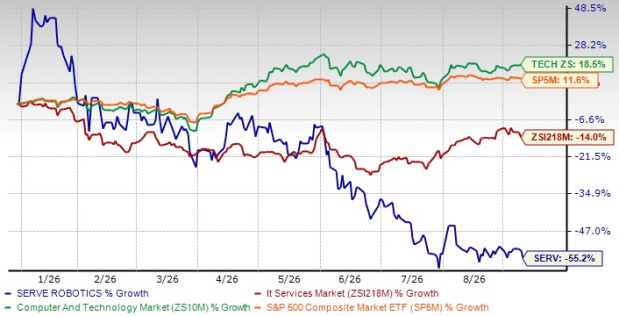
The decline in SERV’s shares reflects growing investor concerns over its near-term growth outlook, particularly following the sharp reduction in the 2026 revenue guidance. Uncertainty surrounding the Uber partnership, lower delivery volumes and continued pressure on profitability add to these concerns, while softer software revenues expected in the second half and the ongoing need to improve robot utilization could limit the pace of recovery. Let us take a closer look at the key factors weighing on SERV stock.
SERV’s Deep Gross Loss Keeps Profitability Under Pressure
Profitability remains a significant challenge as the company continues to invest in its robotics and autonomy platform. The company reported a gross loss of approximately $8.8 million in the second quarter, resulting in a negative gross margin of 271%, while non-GAAP operating expenses were approximately $40.4 million.
Serve Robotics is responding by tightening spending, including reducing its 2026 capital expenditure outlook to $15-$17 million from about $25 million and lowering the non-GAAP operating expense outlook to $140-$150 million. However, higher revenue per robot, better utilization and a greater mix of recurring revenues will remain important for moving the business toward positive gross margins.
Uber Partnership Uncertainty Adds to SERV’s Channel Risk
The outlook for Serve Robotics’ Uber partnership has become another concern. Delivery volume through Uber declined in the second quarter after growing for 17 consecutive quarters, with management attributing the reversal mainly to differences in the operating model and fleet integration between the two companies.
Serve Robotics does not currently expect to renew the agreement when it expires in early 2027 unless the operating model improves meaningfully. Although Uber represented a limited share of second-quarter revenues, the potential loss of the anchor partnership increases the need for Serve Robotics to scale other delivery channels and direct merchant relationships.
SERV’s Lower 2026 Revenue Guidance Limits Near-Term Visibility
Serve Robotics’ sharply reduced 2026 revenue outlook remains a key concern for the stock. The company lowered its revenue guidance to $9-$10 million from $26 million previously, after the delivery volume growth expected in the second half failed to materialize. Second-quarter revenues of $3.2 million, although up more than 400% year over year, were below the level needed to support the earlier outlook.
The revised outlook also reflects a real decline in delivery revenues during the second quarter rather than only a slower future ramp. While other revenue streams helped offset the weakness, software revenues are expected to be somewhat softer in the second half, adding to near-term revenue pressure.
SERV’s Valuation Trend
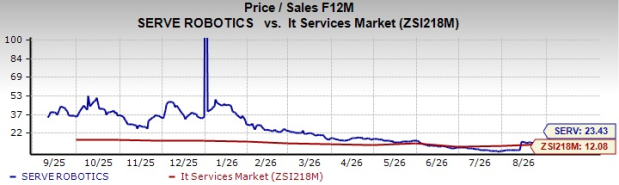
SERV stock is currently trading at a premium compared with the industry peers, with a forward 12-month price-to-sales (P/S) ratio of 23.43, as evidenced by the chart below.
Image Source: Zacks Investment Research
EPS Trend of SERV
Serve Robotics’ bottom-line estimate for 2026 indicates a loss per share of $2.71, which has widened over the past 30 days. The 2027 loss per share estimate stands at $2.22, which has remained unchanged over the same period. The revised estimated figures for 2026 imply a year-over-year decline of 66.3%, while the same for 2027 indicates growth of 18.2%.
Image Source: Zacks Investment Research

Despite the near-term pressure, Serve Robotics is building additional growth avenues through healthcare, new use cases and technology improvements. Hospital contract wins, progress in autonomy and plans to expand beyond food delivery could support broader revenue opportunities and better fleet economics over time.
Let us take a closer look at the factors shaping Serve Robotics stock’s prospects.
Serve Robotics’ Hospital Contract Wins Support Healthcare Growth
Serve Robotics’ hospital robotics business is gaining traction through new customer wins and contract extensions. During the first half of 2026, the company signed seven multi-year contract extensions with hospital customers and added two new hospitals. This points to continued demand for its healthcare automation platform and supports the growth of the recurring revenue base.
The healthcare business also generates contracted recurring revenues at attractive margins, making it an important part of Serve Robotics’ longer-term growth strategy. Management expects the strength of Diligent Robotics to continue and said the business is contributing positively to the company’s overall revenues and margin mix.
Serve Robotics’ Scaled Fleet Creates Room for Higher Productivity
Serve Robotics now has 2,000 robots distributed across more than 40 cities, giving it a sizable operating base for growth. Rather than relying only on additional fleet expansion, management is focused on making each robot more productive and increasing revenues generated per robot and operating hour.
The company is also working on commercial programs designed around denser order allocation and higher robot utilization. If these initiatives succeed, the existing fleet could generate more value without requiring a similar increase in robot count. This could improve fleet economics as Serve Robotics adds demand across its network.
Serve Robotics’ Autonomy Advances Could Improve Robot Economics
Technology improvements remain a key opportunity for Serve Robotics as it works to increase robot productivity. The company plans to provide more details later this year on its autonomy stack and said new AI models are making the robots safer, faster, smarter and more reliable. Management also said improvements are already being seen across the fleet.
The next-generation autonomy architecture is designed to enable robots to make smarter decisions with less loss of information. Better autonomy could help Serve Robotics complete deliveries more efficiently while supporting higher revenues and improved margins. Over time, this could strengthen the economics of the existing fleet and expand the markets where its robots can operate.
Serve Robotics’ Non-Food Initiatives Expand Long-Term Use Cases
Serve Robotics is working to expand its network beyond restaurant food delivery, creating opportunities to use the infrastructure across a broader range of goods and services. The company recently introduced NoScrubs, a laundry application, and expects to launch another product later this fall that will expand direct customer demand and the types of goods and use cases its network can support.
These initiatives could increase the number of situations in which Serve Robotics’ robots can be used and create additional sources of demand over time. Management acknowledged that building these new use cases will take time, but the investments could gradually expand the company’s addressable market beyond traditional food-delivery applications.
Serve Robotics vs. C3.ai, NVIDIA & Symbotic: AI Robotics Race
Although Serve Robotics, C3.ai, Inc. AI, NVIDIA Corporation NVDA and Symbotic Inc. SYM all operate within the automation industry, their business models are very different. C3.ai provides enterprise AI software for commercial and government organizations, while NVIDIA provides AI computing infrastructure and software for AI and robotics applications. Symbotic focuses on large-scale warehouse automation for retailers and distributors. Serve Robotics, on the other hand, is building autonomous robots for last-mile delivery while expanding into healthcare robotics, giving it exposure to multiple real-world service applications.
What sets Serve Robotics apart is that its technology is already operating at commercial scale on public streets. A growing fleet integrated with Uber Eats and DoorDash allows the company to collect real-world operating data, improve autonomous performance and increase fleet utilization over time. This creates advantages that differ from C3.ai's enterprise software business and NVIDIA's broader AI infrastructure position. At the same time, Symbotic holds a stronger position in warehouse automation, supported by a large deployment pipeline, recurring software revenues, a sizable backlog and established customer relationships.
Overall, Serve Robotics stands out as a differentiated player in autonomous delivery with an expanding presence in service robotics. While Symbotic remains the leader in warehouse automation because of its scale and financial strength, Serve Robotics offers more direct exposure to autonomous delivery than C3.ai and NVIDIA through the commercial fleet, strategic partnerships and a growing real-world robotics platform.
Is SERV Stock a Hold Amid Near-Term Uncertainty?
Serve Robotics faces several near-term challenges, including the sharp reduction in 2026 revenue guidance, lower delivery volumes and continued losses. The uncertainty surrounding the Uber partnership and softer software revenues expected in the second half also weigh on the outlook.
At the same time, hospital contract wins, progress in autonomy and new non-food applications are broadening the company’s growth opportunities. These initiatives could support higher robot utilization and revenue growth over time, but the path to stronger profitability remains uncertain. Given the mixed outlook, the Zacks Rank #3 (Hold) appears appropriate as investors await clearer signs of improving utilization, revenue growth and profitability. You can see the complete list of today’s Zacks #1 Rank (Strong Buy) stocks here.
Research Chief Names "Single Best Pick to Double"
From thousands of stocks, 5 Zacks experts each have chosen their favorite to skyrocket +100% or more in months to come. From those 5, Director of Research Sheraz Mian hand-picks one to have the most explosive upside of all.
This company targets millennial and Gen Z audiences, generating nearly $1 billion in revenue last quarter alone. A recent pullback makes now an ideal time to jump aboard. Of course, all our elite picks aren’t winners but this one could far surpass earlier Zacks’ Stocks Set to Double like Nano-X Imaging which shot up +129.6% in little more than 9 months.
Free: See Our Top Stock And 4 Runners UpWant the latest recommendations from Zacks Investment Research? Today, you can download 7 Best Stocks for the Next 30 Days. Click to get this free report
Serve Robotics Inc. (SERV): Free Stock Analysis Report
NVIDIA Corporation (NVDA): Free Stock Analysis Report
C3.ai, Inc. (AI): Free Stock Analysis Report
Symbotic Inc. (SYM): Free Stock Analysis Report
This article originally published on Zacks Investment Research (zacks.com).