

With West Texas Intermediate (WTI) oil prices currently hovering around $100 per barrel, according to Oilprice.com, and owing to the conflicts in the Middle East, the overall energy business is uncertain.
The U.S. Energy Information Administration (“EIA”) projects the spot average West Texas Intermediate price for 2026 at $84.65 per barrel, higher than $65.40 in 2025. Thus, Phillips 66 PSX, which generates significant margin from its refining activities, is likely to be hurt by high oil prices. Despite the high input cost, the refining business environment is highly profitable as demand for fuels remained strong, while global fuel inventories stayed relatively tight.
Investors should also know that although a leading refiner, PSX, unlike most of its refining peers, has diversified its business across midstream and chemicals. Along with investing in refining operations, Phillips 66 is allocating a significant amount of capital to midstream.
Midstream business, by its very definition, is stable since it generates stable cash flows as the assets are being utilized by shippers for the long term, and is less vulnerable to commodity price volatility. Hence, having a diversified business model, Phillips 66 is insulated from commodity price volatility to a great extent.
DINO & PARR Poised to Gain
HF Sinclair DINO and Par Pacific Holdings Inc. PARR, two other well-known refiners, are also likely to benefit from the ongoing favorable refining business.
On its second-quarter 2026 call,HF Sinclair mentioned that wars in the Middle East and Ukraine have disrupted refining capacities. DINO stated that inventories of fuel in the United States and in its key operating regions are low, especially when the demand for the end products remains healthy, thereby creating opportunities to earn healthy refining margins.
Par Pacific continued to benefit from a strong refining market at the start of the third quarter. Its refining index, which is a rough measure of how profitable it is to turn crude oil into products like gasoline and diesel, was still very high in July at $31.34 per barrel, only slightly below the second-quarter average of about $33.
Demand for fuels remained strong, especially on the mainland, while global fuel inventories stayed relatively tight. In simple terms, there was still healthy demand for refined products and limited excess supply, which helped PARR continue earning attractive margins from its refineries.
PSX’s Price Performance, Valuation & Estimates
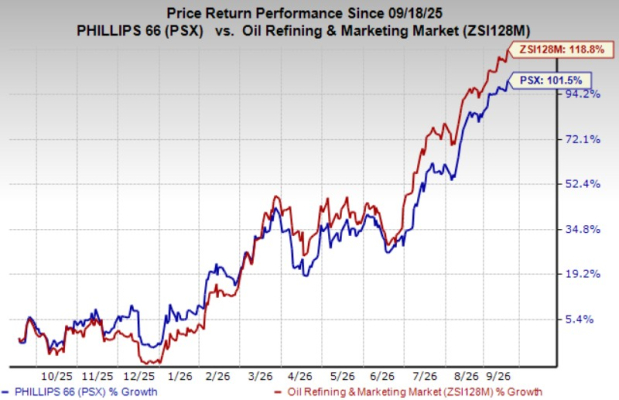
Shares of PSX have gained 101.5% over the past year compared with the 118.8% rise of the composite stocks belonging to the industry.
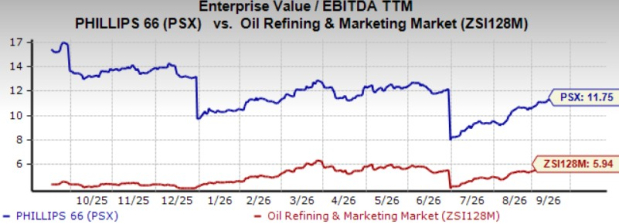
From a valuation standpoint, PSX trades at a trailing 12-month enterprise value to EBITDA (EV/EBITDA) of 11.75X. This is above the broader industry average of 5.94X.
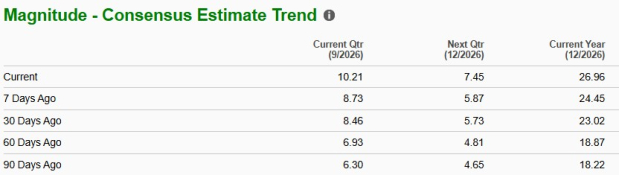
The Zacks Consensus Estimate for PSX’s 2026 earnings has gone up over the past seven days.
Phillips 66 currently sports a Zacks Rank #1 (Strong Buy). You can see the complete list of today’s Zacks #1 Rank stocks here.
Beyond Nvidia: AI's Second Wave Is Here
The AI revolution has already minted millionaires. But the stocks everyone knows about aren't likely to keep delivering the biggest profits. AI’s second wave is moving from infrastructure to implementation and these companies are at the forefront of this transition, positioned to become what Amazon and Google were to the internet era.
See Stocks Now >>Want the latest recommendations from Zacks Investment Research? Today, you can download 7 Best Stocks for the Next 30 Days. Click to get this free report
Phillips 66 (PSX): Free Stock Analysis Report
Par Pacific Holdings, Inc. (PARR): Free Stock Analysis Report
HF Sinclair Corporation (DINO): Free Stock Analysis Report
This article originally published on Zacks Investment Research (zacks.com).