

Earlier this summer, I thought the memory trade had run its course. The stocks had gone vertical, the July chip selloff pushed Micron, Samsung and SK Hynix into bear-market territory, and it looked like the easy money was gone.
I've changed my mind. Not only because the stocks bounced, but because the numbers underneath them keep getting stronger. When you put this shortage in context, it isn't a normal memory cycle. It's one of the biggest supply squeezes the chip industry has seen, and reviewing the setup can help elucidate why it may be a prolonged cycle.
Here's the big picture, and how investors may play it through Micron Technology ( MU) and Sandisk Corporation ( SNDK).
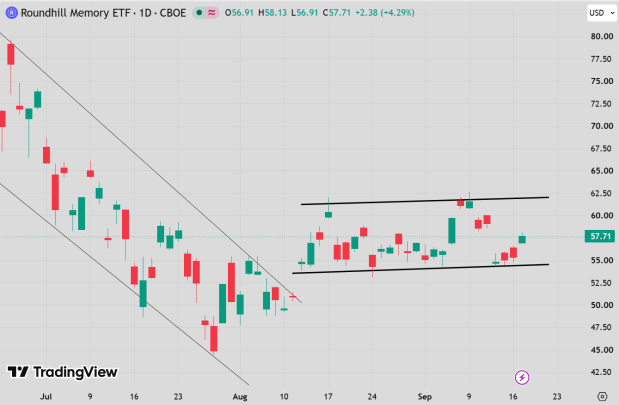
The Roundhill Memory ETF (DRAM) forms a clear consolidation following the summer correction.
Image Source: TradingView
How Big Is This Shortage?
Let’s start with what memory costs. According to TrendForce, regular DRAM contract prices jumped about 90%–95% in the first quarter of 2026, another 58%–63% in the second quarter, and are on track for a further 13%–18% increase in the third quarter. Stack those moves together and a DRAM chip that cost $1 in January costs roughly $3.50 today. NAND flash, the storage used in SSDs, is up about 3x over the same stretch.
For perspective, in a "good" memory upcycle, prices might rise 20%–40% over an entire year. This is a multiple of that in just nine months.
So why is this happening?
The first reason is that AI chips consume enormous amounts of memory. Every Nvidia GPU or custom AI accelerator ships with stacks of high-bandwidth memory, or HBM. HBM also uses considerably more wafer capacity than conventional memory, with roughly three wafers of normal DRAM capacity given up for every one wafer devoted to HBM.
At the same time, suppliers entered this cycle lean. After the 2023–2024 memory glut, Samsung, SK Hynix and Micron all cut production sharply. That meant the industry entered the AI boom without much excess capacity just as demand began accelerating.
Finally, new supply cannot come online quickly. A new memory fab takes roughly three years to build and ramp. SK Hynix's first Yongin fab and Micron's first new Idaho fab are not expected to meaningfully add output until mid-to-late 2027. Samsung's giant P5 fab is more of a 2028 story, while Micron's New York fabs are even further out.
IDC expects 2026 supply growth of only about 16% for DRAM and 17% for NAND, well below what AI demand requires.
And there are still signs the shortage isn't over. In past cycles, spot prices, or chips bought for immediate delivery, tend to crack first and fall below contract prices before the cycle turns. Right now, it is the opposite.
Recent Korean press reports put HBM spot prices at roughly four to five times long-term contract levels. Buyers who think prices are about to fall generally do not pay that kind of premium. They wait.
On top of that, suppliers are locking customers into multi-year agreements, some reportedly stretching toward 2030 and beyond, with prepayments included.
That's not what a peak normally looks like.
Micron Stock is the Cleaner Way to Own the Shortage
Micron's last quarter, fiscal Q3 ended in May, was one of the most remarkable prints I have seen from a large-cap company.
Revenue reached $41.5 billion, up from $9.3 billion a year ago, meaning sales more than quadrupled. Gross margin expanded to roughly 85%, compared with 39% a year earlier, while adjusted EPS jumped to $25.11 from $1.91. Adjusted free cash flow reached an extraordinary $18.3 billion in a single quarter.
Guidance for fiscal Q4 is even stronger, with management calling for roughly $50 billion in revenue, an 86% gross margin and approximately $31 in EPS. Micron reports on September 30.
There are several reasons I prefer Micron here.
Most importantly, DRAM is the tighter side of the memory market. Roughly four-fifths of Micron's revenue comes from DRAM, and that is the segment TrendForce expects to remain supply constrained into 2027.
Micron is also shipping HBM4 in high volume for its lead AI customer, with HBM4E planned for 2027. Meanwhile, the company's growing use of multi-year customer agreements should make earnings somewhat more durable than they have been during previous memory cycles.
The balance sheet has also improved considerably. Micron has paid down a meaningful amount of debt and now holds roughly $30 billion in cash and investments.
Micron currently trades at about 6x forward earnings. That looks absurdly cheap, but cyclical stocks always look cheapest at peak earnings. The real question isn't the multiple, but how long these margins last. My sense is that it’ll be longer than the market thinks, because new supply doesn't show up in size until late 2027.
Analysts appear to be in agreement, with Micron enjoying a Zacks Rank #2 (Buy) rating.
The stock sits roughly 20–25% below its high going into a report where management has a chance to extend the tightness narrative into 2027–2028. That's a compelling setup.
Sandisk Stock Represents a Higher Beta Trade
Sandisk is the pure-play NAND bet, and it has been the bigger winner of the two.
In its fiscal fourth quarter, which ended in early July, revenue reached $8.97 billion, up 51% sequentially. Roughly two-thirds of that increase came from higher pricing and another third from higher volumes. Adjusted EPS reached $39.25.
For the full year, revenue climbed to $20.25 billion, an increase of 175%, while data center revenue surged more than 400%.
Guidance for fiscal Q1 calls for $10.3 billion to $10.8 billion in revenue and adjusted EPS between $44 and $46. Management believes the total NAND market could exceed $300 billion in 2026, roughly triple last year's level, and has said customer demand continues to outrun available supply.
The bull case here is that Sandisk has signed about ten "New Business Model" agreements, multi-year deals with big customers, some including prepayments. That's a real change for a business that used to live and die by the spot market. Enterprise SSDs for AI inference are a genuine growth driver.
Alternatively, Sandisk has no DRAM to fall back on. If TrendForce is right that NAND loosens in the back half of 2027, Sandisk feels it first and hardest.
MU stands out as the core holding for the shortage. SNDK is the higher-octane add-on for investors who believe AI inference keeps soaking up storage through 2027.
Should Investors Buy Shares in MU and SNDK?
The memory shortage is bigger, broader and more durable than a typical chip cycle. Prices have roughly tripled this year, memory is eating a growing share of Big Tech's AI budget, and real new supply is still more than a year away.
That doesn't make these stocks a one-way bet. The pace of price gains is slowing, and memory cycles end eventually. But the signals that usually mark a top (falling spot prices, excess inventory, customers walking away) aren't here yet. Until they show up, I'd stay with the shortage: Micron as the core, Sandisk as the aggressive kicker, and a close watch on Micron's September 30 report for confirmation.
Beyond Nvidia: AI's Second Wave Is Here
The AI revolution has already minted millionaires. But the stocks everyone knows about aren't likely to keep delivering the biggest profits. AI’s second wave is moving from infrastructure to implementation and these companies are at the forefront of this transition, positioned to become what Amazon and Google were to the internet era.
See Stocks Now >>Want the latest recommendations from Zacks Investment Research? Today, you can download 7 Best Stocks for the Next 30 Days. Click to get this free report
Micron Technology, Inc. (MU): Free Stock Analysis Report
Sandisk Corporation (SNDK): Free Stock Analysis Report
This article originally published on Zacks Investment Research (zacks.com).