


Cameco Corporation CCJ and Denison Mines Corp. DNN are two Canada-based uranium companies with exposure to the nuclear energy industry. However, their businesses operate at different stages of the nuclear fuel value chain, resulting in distinct investment profiles.
Cameco is one of the world’s largest uranium producers with an integrated business spanning mining, milling and fuel services. The company owns interests in world-class assets such as McArthur River and Cigar Lake and benefits from established production, long-term contracts and strong operating cash flows.
Denison Mines, in contrast, is primarily an exploration and development-focused company, with its flagship Wheeler River project in the Athabasca Basin representing one of the largest undeveloped high-grade uranium assets in the world. The company is advancing the Phoenix uranium project aggressively as it seeks to become one of the few uranium developers capable of bringing meaningful new production online before the decade’s end.
With uranium demand expected to benefit from the global emphasis on clean energy and energy security, let us compare the two companies' fundamentals, growth prospects and risks to determine which stock currently presents the more compelling investment opportunity.
The Case for CCJ
Cameco's tier-one mining and milling operations are capable of producing more than 30 million pounds of uranium concentrates annually (its share). Cameco accounted for 15% of global uranium production in 2025. Beyond mining, the company has a diversified presence across the nuclear fuel cycle, including refining, conversion and fuel services. Its strategic stakes in Westinghouse and Global Laser Enrichment add long-term optionality tied to reactor deployment and enrichment technologies.
In the third quarter of 2026, Cameco’s total revenues increased 0.7% year over year to CAD 619 million. However, in U.S. dollar terms, revenues declined 0.8% to $442 million from $446 million in the prior-year quarter due to lower uranium sales volumes despite higher prices.
Uranium segment revenues decreased 1% to CAD 518 million ($370 million) as lower sales volumes were partially offset by an 8% increase in the average realized price. Fuel Services segment’s revenues increased 4% to CAD 95 million ($68 million), as 16% higher sales volumes more than offset a 13% decline in the average realized price due to an unfavorable product sales mix.
Cameco reported third-quarter 2026 adjusted net loss of CAD 2 million ($1.4 million) against adjusted earnings of CAD 32 million ($23.2 million) in the year-ago quarter. Adjusted earnings per share were at break-even against 5 cents a year earlier.
Cameco lowered its share of expected uranium production for 2026 to 19.5-20.5 million pounds from its previous guidance of 19.5-21.5 million pounds to account for the extended maintenance shutdown at the Key Lake mill, which has continued into the fourth quarter.
Cameco now expects uranium deliveries of 29.5-30.5 million pounds in 2026 compared with its previous outlook of 29-32 million pounds. Uranium revenues are projected at CAD 2.7-2.9 billion, based on an average realized price assumption of CAD 91-96 per pound. The midpoint of the guidance implies a roughly 2% decline in uranium revenues from 2025, primarily due to lower delivery volumes. Fuel Services revenues are expected to reach CAD 610-650 million, indicating approximately 12% year-over-year growth. Cameco projects total revenues of CAD 3.32-3.57 billion for 2026. The midpoint of the range suggests a roughly 1% decline from 2025.
Despite near-term operational headwinds, Cameco's uranium contract portfolio provides considerable revenue visibility. As of Sept. 30, 2026, the company had secured contracts representing average annual uranium deliveries of more than 28 million pounds over the next five years. Management expects annual delivery commitments to remain above this five-year average in 2026-2028 before falling below it in 2029 and 2030.
The company is also investing in its existing operations to capitalize on favorable uranium market conditions. Key initiatives include extending Cigar Lake's mine life to 2036 and increasing production at McArthur River and Key Lake toward their combined licensed annual capacity of 25 million pounds on a 100% basis.
The Case for DNN
Denison’s long-term investment case is centered on its portfolio of four prospective, low-cost uranium development assets: Phoenix, Gryphon, Midwest and THT/Waterbury. Phoenix and Gryphon are both located in the Wheeler project.
Denison’s third-quarter 2026 revenues were flat year over year at CAD 1.05 million ($0.77 million). Its reported revenues include the drawdown of deferred toll-milling revenues, which fluctuate depending on the timing of uranium processing at the McClean Lake mill and changes in the estimated mineral resources of the Cigar Lake mine. During the quarter, the mill processed 4.2 million pounds of uranium, unchanged from the year-ago period.
Flat revenues, coupled with higher mine development and selling, general and administrative expenses, resulted in an adjusted loss of CAD 0.03 per share (2 cents). This was wider than the adjusted loss of CAD 0.01 per share reported in the prior-year quarter.
A significant milestone for Denison was achieved in February 2026, when its Phoenix in-situ recovery (ISR) project received all the regulatory approvals required to begin construction. Construction commenced in July, and first uranium production is targeted for mid-2028. Phoenix hosts an estimated 70.5 million pounds of uranium at an average grade of 11.4%.
Gryphon, also part of the Wheeler River project, represents another important growth opportunity. Both Phoenix and Gryphon have the potential to compete with some of the lowest-cost uranium mining operations globally. Moreover, the expected cash flow generation from Phoenix could help finance the development of Gryphon, reducing Denison's reliance on external funding for its longer-term expansion plans.
The Midwest Main deposit adds further growth potential to the company's development pipeline. Denison holds a 25.17% interest in the asset, which has potentially mineable resources of 37.4 million pounds of uranium and an estimated mine life of six years.
Denison also owns a 22.5% stake in the McClean Lake uranium mill and mines. In July 2025, the McClean Lake joint venture commenced uranium mining at the McClean North deposit using Denison's patented Surface Access Borehole Resource Extraction (SABRE) mining method. The operation produced nearly 650,000 pounds of uranium in 2025 on a 100% basis, making McClean one of North America's most productive operating uranium mines.
Denison's strategy of advancing a diversified portfolio of operating, development and exploration assets positions it to benefit from favorable long-term uranium market fundamentals. However, earnings are likely to remain under pressure in the near term as the company continues to invest heavily in project development and prepares to transition toward commercial production.
The company's combination of physical uranium holdings, existing production exposure through McClean Lake and anticipated large-scale output from Phoenix and Gryphon provides an important foundation for future growth. Denison has already secured firm uranium sales commitments exceeding 8 million pounds and is negotiating additional contracts for more than 5 million pounds. Its customer base includes several major North American nuclear utilities that collectively operate more than 50 reactors, reflecting growing commercial confidence in its future production potential
How do Estimates Compare for CCJ & DNN?
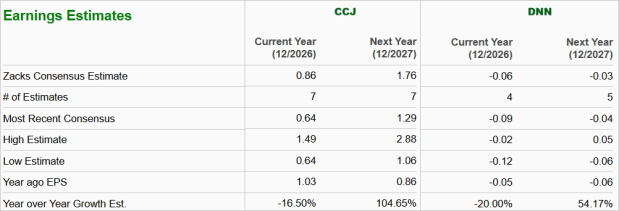
The Zacks Consensus Estimate for Cameco’s 2026 revenues implies a year-over-year decline of 3.9%. The consensus mark for earnings of 86 cents per share indicates a year-over-year decline of 16.5%. The Zacks Consensus Estimate for Cameco’s 2027 revenues suggests year-over-year growth of 21.4%, with EPS expected to rise 104.7% to $1.76 per share.
Image Source: Zacks Investment Research
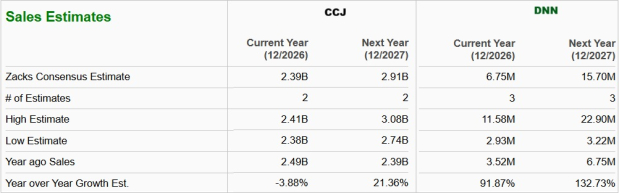
The Zacks Consensus Estimate for DNN's 2026 revenues suggests growth of 91.9%, and the estimate for earnings is pegged at a loss of 6 cents per share, wider than the 2025 loss of 5 cents per share. The 2027 estimate for revenues suggests 132.7% growth and earnings are pegged at a loss of 3 cents.
Image Source: Zacks Investment Research
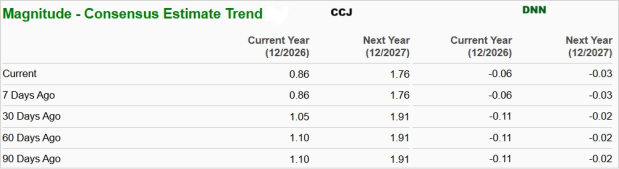
Earnings estimates for 2026 and 2027 for CCJ have moved down over the past 60 days. The estimates for Denison have also moved down for both years.
Image Source: Zacks Investment Research
Cameco & Denison: Price Performance & Valuation
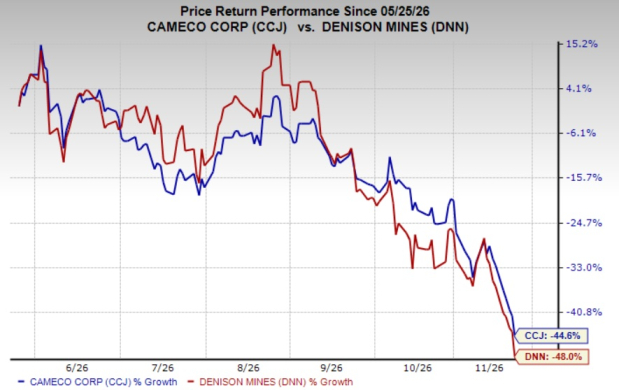
Cameco shares have declined 44.6% in the past six months, whereas Denison shares have fallen 48%.
Image Source: Zacks Investment Research
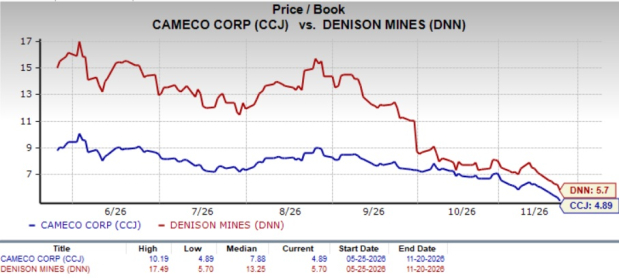
CCJ is trading at a price/book multiple of 4.89X. Meanwhile, DNN’s forward price-to-book multiple sits at 5.70X.
Image Source: Zacks Investment Research
CCJ or DNN: Which is the Better Investment Option?
Both Cameco and Denison currently carry a Zacks Rank #3 (Hold), making the investment choice less straightforward.
Cameco offers the advantages of established production, operational scale, an integrated presence across the nuclear fuel cycle and a sizeable long-term contract portfolio. Although operational disruptions and lower delivery expectations could weigh on near-term performance, its diversified business and existing production base provide greater earnings visibility and reduce execution risks.
Denison, on the other hand, offers a higher-risk, higher-reward investment proposition. Its high-grade uranium deposits, low-cost ISR mining strategy and progress toward first production at Phoenix in 2028 provide considerable long-term growth potential. However, the company remains largely development-focused, continues to report losses and faces execution and funding risks as it advances its projects. Its higher price-to-book multiple also suggests that investors are already assigning a premium to its growth prospects.
While Denison could offer greater upside if its development plans progress as expected, Cameco appears to be the relatively safer investment at present, backed by its established production capabilities, long-term contracts and diversified nuclear fuel-cycle exposure.
You can see the complete list of today’s Zacks #1 Rank (Strong Buy) stocks here.
Zacks' Research Chief Names "Stock Most Likely to Double"
Our team of experts has just released the 5 stocks with the greatest probability of gaining +100% or more in the coming months. Of those 5, Director of Research Sheraz Mian highlights the one stock set to climb highest.
This innovative software-as-a-service firm upped its user base +22% year over year. That rate is increasing and margins are expanding as AI efficiencies take effect. Of course, all our elite picks aren't winners, but this one could far surpass earlier Zacks' Stocks Set to Double like D-Wave Quantum, which shot up +680.1%.
Free: See Our Top Stock And 4 Runners UpWant the latest recommendations from Zacks Investment Research? Today, you can download 7 Best Stocks for the Next 30 Days. Click to get this free report
Cameco Corporation (CCJ): Free Stock Analysis Report
Denison Mine Corp (DNN): Free Stock Analysis Report
This article originally published on Zacks Investment Research (zacks.com).