A new XRP market thesis is circulating ahead of the Senate markup of the CLARITY Act on Thursday, May 14, 2026, at 10:30 AM ET, with XRP community member and developer Vincent Van Code arguing that regulatory clarity could turn XRP Ledger liquidity from a speculative narrative into institutional market structure. The argument centers on whether legal safe harbor for digital assets would allow major banks and payment networks to use XRPL liquidity pools at production scale.
In a post on X, Van Code described the upcoming markup, as a potential trigger for XRP’s institutional use case. He framed the legislation not merely as another policy milestone, but as the missing legal layer for large regulated financial institutions to engage more directly with on-chain settlement infrastructure.
Why XRP Needs $10 For Bank-Scale XRPL Liquidity
“The digital asset market has spent a decade in beta. This Thursday, May 14, 2026, the CLARITY Act Senate markup provides the final legal API for G-SIBs (Global Banks) to move trillions from static Nostro accounts to the XRPL. By converting Ripples 40B+ Escrow into Protocol-Native Liquidity Pools (LPs), we are witnessing a structural revaluation of XRP from a speculative token to High-Velocity Collateral.”
The core of the thesis is that Ripple’s XRP escrow , long viewed by market participants as a possible source of future sell pressure, could instead become a strategic liquidity reserve if deployed into automated market maker pools. Van Code called this “the mechanical flip,” arguing that escrowed XRP could be used to seed deep pools for institutional corridors rather than simply entering circulating supply through sales.
Under his scenario, the CLARITY Act would provide the legal safe harbor required for banks to interact with XRP Ledger-based liquidity. Ripple could then deposit between 5 billion and 10 billion XRP from escrow into pools such as RLUSD/XRP, EURCV/XRP and JPY/XRP. The post argues that this would create a deeper base of bridge liquidity and a stronger market structure for large transfers.
“For years, Ripples Escrow was a ‘Sell Pressure’ bug. In the post-CLARITY world, it becomes a Liquidity Feature. The Trigger: CLARITY Act passes -> Banks get Legal Safe Harbor.”
Van Code linked the thesis to four institutional corridors he says are already forming around XRPL-compatible settlement flows. These include RLUSD for US dollar treasury and B2B activity, EURCV from Societe Generale for European institutional settlement, JPY-related corridors involving SBI and Kiraboshi, and OUSG from Ondo as yield-bearing collateral. He also cited Mastercard and Societe Generale as examples of participants already connected to on-chain infrastructure, arguing that the missing ingredient is liquidity depth rather than connectivity.
The most aggressive part of the thesis is the price logic. Van Code argued that bank-scale settlement requires pools large enough to process major transfers without material slippage. In his example, moving $100 million in a single block with less than 0.1% slippage would require roughly $20 billion in total value locked.
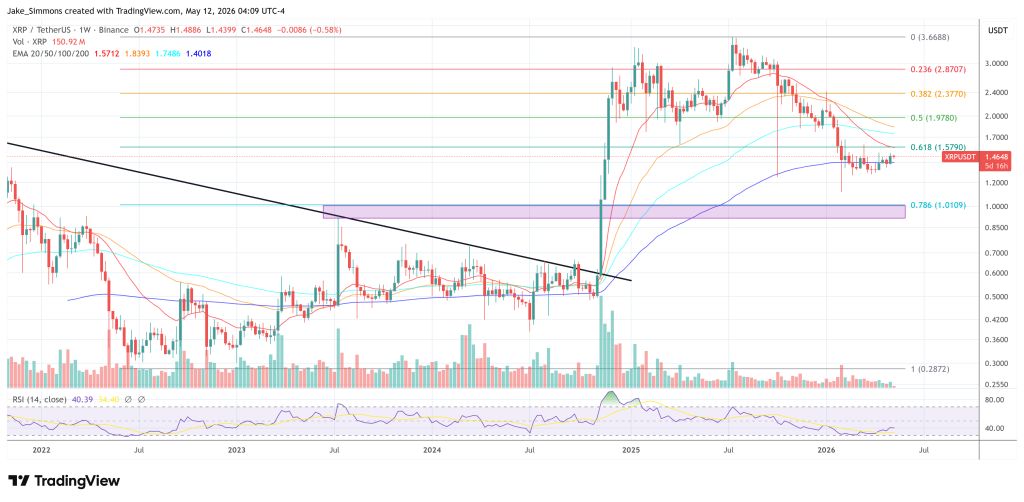
That assumption leads to his $10 XRP scenario. At a price of $1.47, he argued, the major pools would require around 18 billion XRP, which he described as mathematically impractical due to liquidity constraints. At $10, by contrast, the same liquidity base would require roughly 2.7 billion XRP, a level he framed as more sustainable for institutional deployment.
“The price doesn’t hit $10 because of hype; it hits $10 because the TVL must scale to handle the Mastercard/Bank Volume,” he wrote.
At press time, XRP traded at $1.46.