

Oracle Corporation’s (ORCL) stock has tumbled more than 20% in just five trading days as investors digested concerns about rising artificial intelligence (AI)-related spending, data center investments, and near-term margin pressure. But amid the sell-off, bulls may have found a fresh reason for optimism. The company has secured a major U.S. federal government contract to build a cloud-based human resources platform that will eventually replace more than 100 fragmented HR systems across federal agencies.
The federal contract was announced by the U.S. Office of Personnel Management and is valued at nearly $396 million over 10 years, making it one of the most significant government HR modernization projects in recent years. Oracle’s platform is expected to consolidate federal workforce management, payroll, benefits, and personnel systems into a single cloud-based environment, highlighting the growing demand for Oracle’s cloud and human capital management solutions.
More Top Stocks Daily: Go behind Wall Street’s hottest headlines with Barchart’s Active Investor newsletter.
For investors looking beyond the recent volatility, this could reinforce Oracle’s long-term cloud growth story and provide another avenue for recurring revenue expansion.
About Oracle Stock
Best known for its pioneering relational database software and enterprise tools, Oracle has evolved into a powerhouse in cloud infrastructure, SaaS applications, hardware systems, and consulting services. Headquartered in Austin, Texas, the firm serves a global client base, and with a market cap of $529.5 billion, the company ranks among the world’s top software and cloud computing firms.
Oracle shareholders have endured a sharp reversal in momentum. After benefiting from AI-driven optimism earlier in the year, the stock has come under intense selling pressure as investors reassess the cost of the company’s aggressive cloud and AI infrastructure expansion.
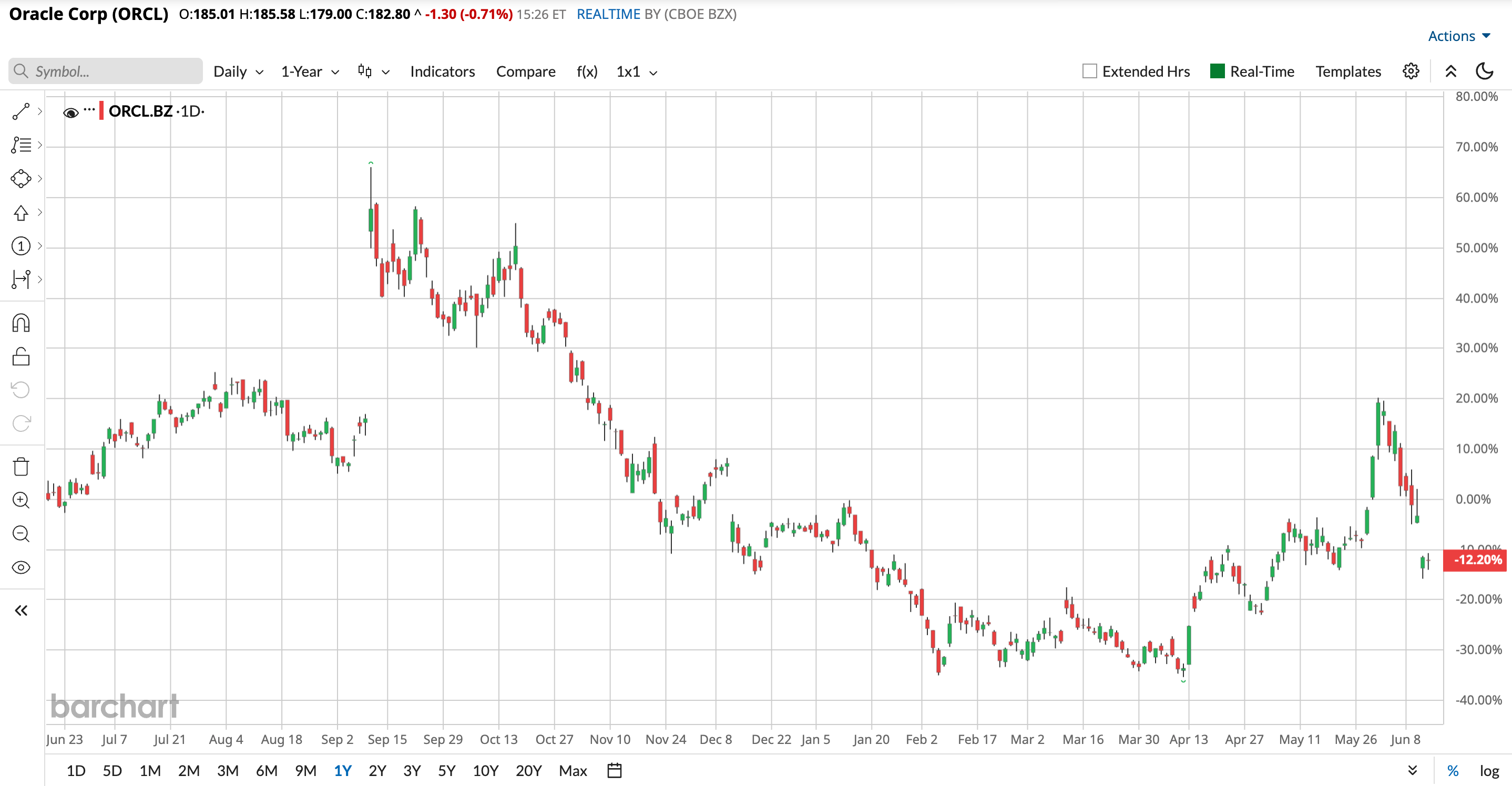
Over the past 52 weeks, Oracle stock is down by 9.6%. The shares are down 6.89% year-to-date (YTD) and have plunged 15.07% in just the past five trading days, wiping out a significant portion of the stock’s earlier gains. The selling accelerated on June 11, when Oracle shares tumbled 8.53%, following the company’s latest earnings report and investor concerns over soaring AI-related capital expenditures.
The sharp decline came despite Oracle reporting better-than-expected quarterly results and strong demand for its cloud infrastructure business. Instead, Wall Street focused on management’s plans for massive data center investments and the prospect of additional equity financing to fund its AI expansion strategy. Those concerns overshadowed strong cloud growth and a steady backlog of future business commitments, triggering a broad sell-off in the stock.
However, bulls believe Oracle’s selection by the U.S. Office of Personnel Management to build a government-wide cloud-based human resources platform might help in staging a rebound.
 www.barchart.com
 The stock is currently trading at a modest premium compared to peers and its own historical average at 31.82 times forward earnings.
Q4 Results Demonstrate Cloud Momentum
Oracle reported its fiscal fourth-quarter and full-year 2026 results on June 10, delivering another quarter of impressive cloud-driven growth. However, the strong operating performance was overshadowed by concerns over the company’s massive AI infrastructure spending plans, which triggered a sharp sell-off in the stock.
For the quarter ended May 31, 2026, Oracle generated $19.2 billion in revenue, an increase of 21% year-over-year (YOY). Adjusted earnings per share (EPS) came in at $2.11, up 24% from the prior-year period and above expectations.
Cloud remained the key growth engine. Total cloud revenue surged 47% YOY to $9.9 billion, while Oracle Cloud Infrastructure (OCI) revenue skyrocketed 93% to $5.8 billion, reflecting continued demand for AI workloads and large-scale cloud deployments. Meanwhile, software revenue declined 2% YOY as customers continued migrating from legacy software products to cloud-based offerings.
Another highlight was Oracle’s remaining performance obligations (RPO), a measure of future contracted revenue, which climbed 363% YOY to $638 billion, underscoring the company’s rapidly expanding backlog of cloud and AI-related business.
For fiscal 2026, Oracle delivered $67.4 billion in revenue, representing about 17% YOY growth. Moreover, the company invested heavily to support that growth. Capital expenditures reached around $55.7 billion during fiscal 2026, exceeding management’s original target of $50 billion as Oracle aggressively expanded data center capacity to meet surging AI demand.
Furthermore, management issued an exceptionally bullish outlook for fiscal 2027. Oracle reaffirmed its expectation of $90 billion in revenue, while raising its adjusted EPS outlook of $8.05 per share.
For the fiscal first quarter of 2027, Oracle expects revenue growth of 27% to 29% YOY, while cloud revenue is projected to increase 57% to 63%, signaling that AI-related demand remains extremely strong.
The main concern for investors is spending. Oracle expects fiscal 2027 capital expenditures of up to $95 billion, with around $70 billion funded directly by the company and another $20 billion to $25 billion expected to be reimbursed by customers. Management also plans to raise nearly $40 billion through debt and equity financing to support its expansion.
Analysts predict EPS to be $6.33 for fiscal 2027, up marginally YOY, and surge by 25.3% annually to $7.93 in fiscal 2028.
What Do Analysts Expect for Oracle Stock?
Analysts remain optimistic despite the recent sell-off. Most recently, BMO Capital raised its price target on Oracle to $220 from $200 and maintained its “Outperform” rating, citing strong quarterly results and better-than-expected growth in the company’s infrastructure-as-a-service business.
Also, TD Cowen reiterated its “Buy” rating and $300 price target on Oracle after the company’s fourth-quarter results.
Moreover, Piper Sandler raised its price target on Oracle to $225 from $210 and maintained an “Overweight” rating, citing growing confidence in the company’s AI-driven cloud growth prospects.
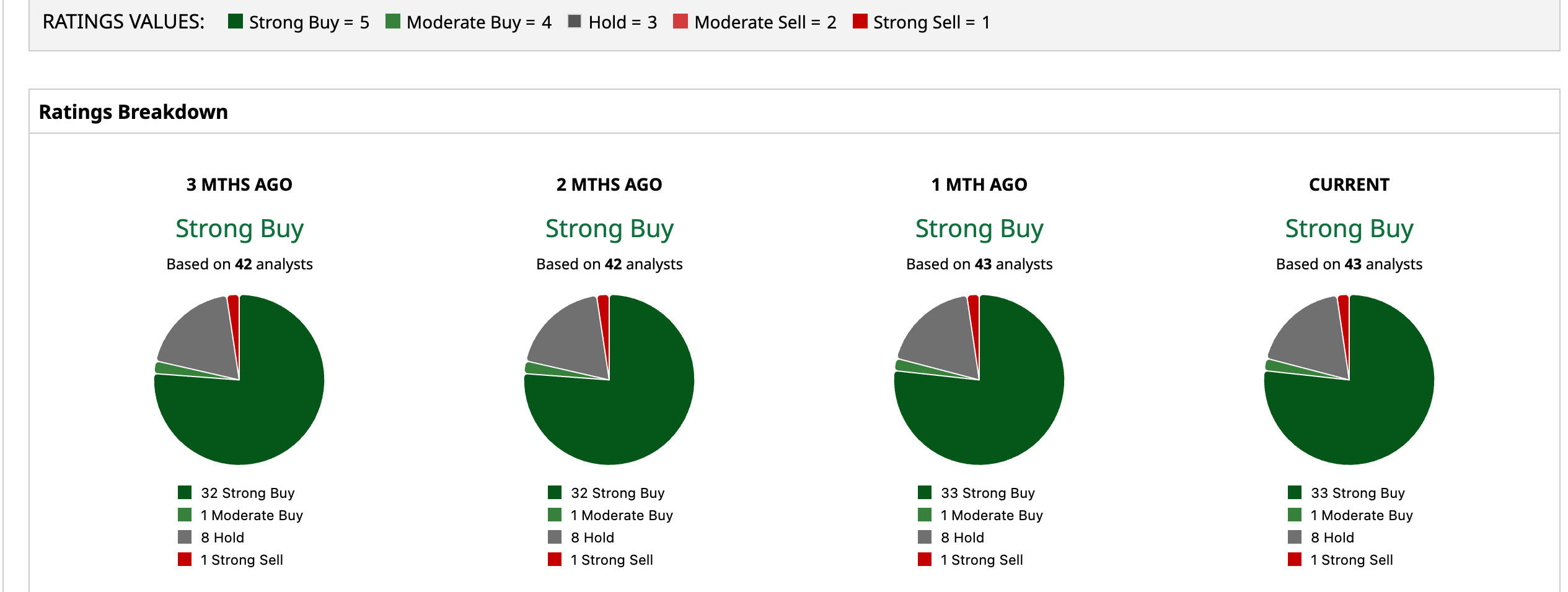
Oracle stock has a consensus “Strong Buy” rating overall. Among the 43 analysts covering the tech stock, 33 recommend a “Strong Buy,” one gives a “Moderate Buy,” eight analysts stay cautious with a “Hold” rating, and one gives a “Strong Sell” rating.
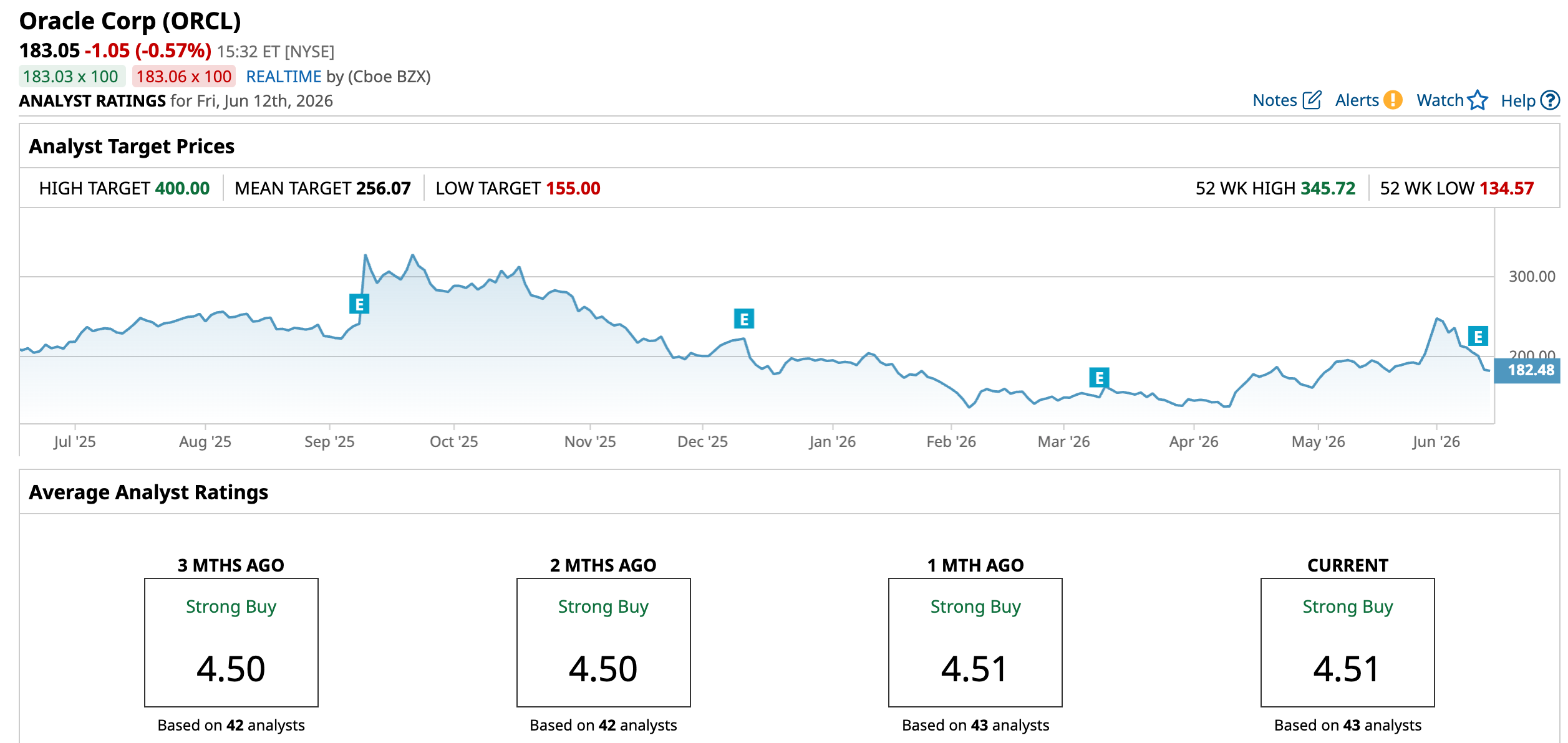
While its average price target of $256.07 indicates an upside of 40%, the Street-high target price of $400 suggests that the stock could rally as much as 118.5%.
 www.barchart.com
  www.barchart.com
 On the date of publication, Subhasree Kar did not have (either directly or indirectly) positions in any of the securities mentioned in this article. All information and data in this article is solely for informational purposes. For more information please view the Barchart Disclosure Policy here.
More news from Barchart
A Major Short Squeeze Could Be Brewing in Cracker Barrel Stock Ignore the Financial Influencers Pushing a ‘Trifecta’ ETF Strategy. Manage Risk and Volatility with 1 of These Savvy Funds Instead. A $1.24 Trillion Reason to Buy Dell Stock Now Micron Stock is Now Close to Fair Value, But Shorting 2-Week Puts Yield 7.0%