

Nvidia (NVDA) has been one of the biggest winners of the artificial intelligence (AI) boom, but investors are starting to ask a different question. After years of premium valuations, the latest Bloomberg report says that stock is now trading at its cheapest earnings multiple since before the AI rally began.
That comes even after another blockbuster earnings report. Yet NVDA stock has struggled to revisit its highs as investors weigh slowing China growth, rising competition, and lofty expectations.
More Top Stocks Daily: Go behind Wall Street’s hottest headlines with Barchart’s Active Investor newsletter.
Is Nvidia's lower valuation creating a buying opportunity? Or is the market signaling that tougher days lie ahead?
Nvidia's Stock Has Cooled Despite Another Strong Year
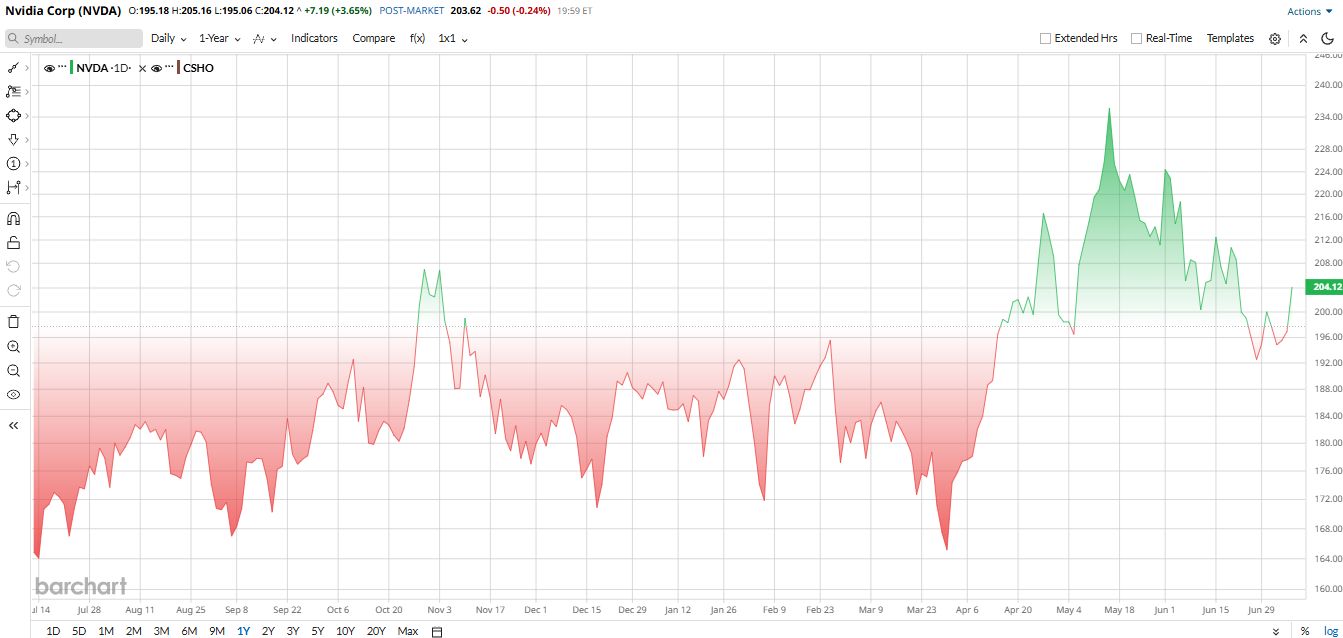
Nvidia shares remain well ahead of the broader market, even after pulling back from their February highs. The stock is still up roughly 13% year-to-date (YTD) in 2026, outperforming the S&P 500's ($SPX) gain of about 11%. However, rivals have delivered even stronger gains this year. Intel (INTC) has surged roughly 198% YTD and AMD (AMD) has climbed about 160% as investors have rotated into semiconductor companies seen as having more room for multiple expansion.
Nvidia's recent weakness has less to do with its business and more to do with investor expectations. The company has already produced extraordinary returns over the past two years, making NVDA stock vulnerable to profit-taking. At the same time, concerns surrounding China and export restrictions have added another layer of uncertainty.
 www.barchart.com
 The Valuation Looks More Attractive Than It Has in Years
Although Nvidia still trades at a premium to most semiconductor companies, its earnings multiple recently fell to its lowest level since before the AI boom at roughly 18 times forward earnings. That's a more than 50% discount from its own five-year average. Currently, Nvidia has a forward price-to-earnings (P/E) ratio closer to 23 times.
However, its price-to-sales (P/S) ratio remains elevated at around 22 times, showing expectations for continued rapid growth. Still, the P/E-to-growth (PEG) ratio sits near 0.45 times, suggesting analysts still expect earnings growth to more than justify today's valuation.
The biggest question is whether those growth expectations remain realistic.
A new Bloomberg survey showed Chinese technology companies expect to allocate roughly 46% of their AI chip spending to domestic suppliers over the next year, up from about 30% currently. Beijing has also encouraged companies to reduce purchases of foreign AI processors, creating additional pressure on Nvidia's long-term growth in one of its largest overseas markets.
Even so, Nvidia still controls roughly 85% of the global AI GPU market, meaning weakness in China could be offset by continued demand from cloud providers and enterprise customers elsewhere.
Nvidia Continues Expanding Beyond GPUs
The company's latest results suggest demand remains exceptionally strong. During the fiscal first quarter of 2027, Nvidia generated record revenue of $81.6 billion, up 85% year-over-year (YOY).
Profitability was just as impressive. Net income more than tripled to $58.3 billion, while GAAP EPS reached $2.39. Free cash flow totaled an enormous $48.6 billion, allowing Nvidia to return roughly $20 billion to shareholders through buybacks and dividends.
Looking ahead, management guided Q2 revenue to approximately $91 billion, despite assuming zero China data-center revenue because of export restrictions. That guidance signals Nvidia still expects enormous AI demand outside of China.
Nvidia's AI initiative isn't limited solely to revenue; the company is continuing to grow its capabilities. Nvidia recently launched its Vera Rubin AI platform, released the AI PC platform RTX Spark, expanded partnerships with companies such as Alphabet (GOOGL) and Marvell (MRVL), and further invested in networking, CPUs, and AI infrastructure. All told, Nvidia is making very steady progress toward becoming a full-blown AI infrastructure company instead of just a graphics card manufacturer.
Wall Street Believes Nvidia Has Room to Climb
Despite concerns surrounding China, Wall Street remains overwhelmingly bullish on Nvidia. Morgan Stanley recently maintained an “Overweight” rating and a $288 price target, arguing Nvidia remains the best value among AI processor companies because of its dominant market position. In May, Goldman Sachs also reiterated its “Buy” rating on NVDA stock with a $250 target, saying management continues to demonstrate that enterprise AI spending remains healthy. Bank of America is even more optimistic, raising its price target to $350, citing Nvidia's new Vera CPU platform as one of the company's most important product launches in years.
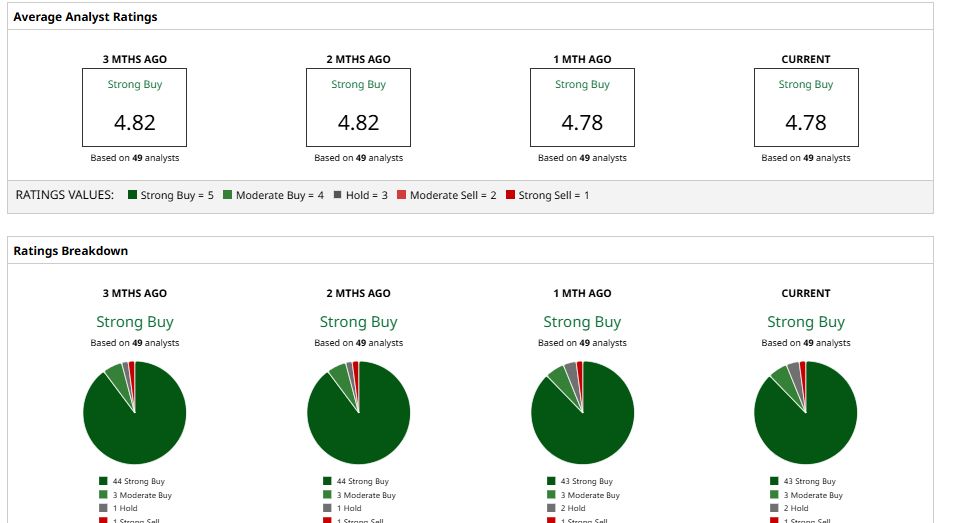
Overall, NVDA stock has a “Strong Buy” consensus rating on Wall Street. Of the 49 analysts covering Nvidia, 43 rate the stock as a “Strong Buy,” three have a “Moderate Buy” rating, two have a “Hold," and one analyst has a “Strong Sell.” The average price target sits at $302.55, suggesting 43% potential upside from here.
As far as I'm concerned, Nvidia isn't trading at the elevated price range investors have been willing to pay in the cocky days of the AI boom, but its businesses are still generating out-of-the-park revenue growth, industry-leading profit margins, and record cash flow. Still, as AI investments grow, China continues to be a not-so insignificant concern, and the rivalry is sure to escalate in time.
 www.barchart.com
 On the date of publication, Nauman Khan did not have (either directly or indirectly) positions in any of the securities mentioned in this article. All information and data in this article is solely for informational purposes. For more information please view the Barchart Disclosure Policy here.
More news from Barchart
Nvidia Stock Hasn’t Been This Cheap Since Before 2019. How to Play NVDA Stock Here. Meta Has Raised Its AI Game. The Stock Should Continue to Rise In 2026. Marvell’s Hidden Growth Engine Just Achieved a Major Milestone That the Market Hasn’t Priced In Yet Huge Earnings, Inflation Data and Other Key Things to Watch this Week