

Advanced Micro Devices (AMD) hosts its Advancing AI event in San Francisco on July 22-3, and Jefferies expects a busy day. Analyst Blayne Curtis, who has a “Buy” rating and a $615 price target, thinks AMD will raise its estimate of the total market for its processors past $200 billion. He expects fresh details on the MI500 chips due after the current generation. The part investors will be keen on watching is the customer list. The analyst believes Microsoft (MSFT) is signed up for the MI450. There are also growing talks of a deal with Anthropic, which has reportedly been hiring engineers familiar with AMD’s software.
The reason a new customer matters so much comes down to how AMD won the last two. To land OpenAI and Meta Platforms (META), each committing to six gigawatts of chips, AMD handed both companies warrants to buy up to 160 million shares. Combined, AMD has promised away about a fifth of itself to secure those orders.
More Top Stocks Daily: Go behind Wall Street’s hottest headlines with Barchart’s Active Investor newsletter.
That is what makes the next announcement different. Curtis said that the terms of any Anthropic deal matter more than the announcement itself. A normal agreement, without a large slice of equity attached, would tell the investors something the last two deals could not. It would show AMD can win serious AI customers on the strength of its chips rather than on incentives. The current share price already assumes OpenAI and Meta deploy their full six gigawatts each. So the question on July 22 is not whether AMD gets more customers. It is what AMD has to give up to get them.
About AMD Stock
Advanced Micro Devices designs high-performance semiconductors for data centers, personal computers, artificial intelligence, embedded applications, and gaming. Its product portfolio includes CPUs, GPUs, networking products, AI accelerators, and cloud. Founded in 1969, the company is headquartered in Santa Clara, California and is led by President and CEO Dr Lisa Su.
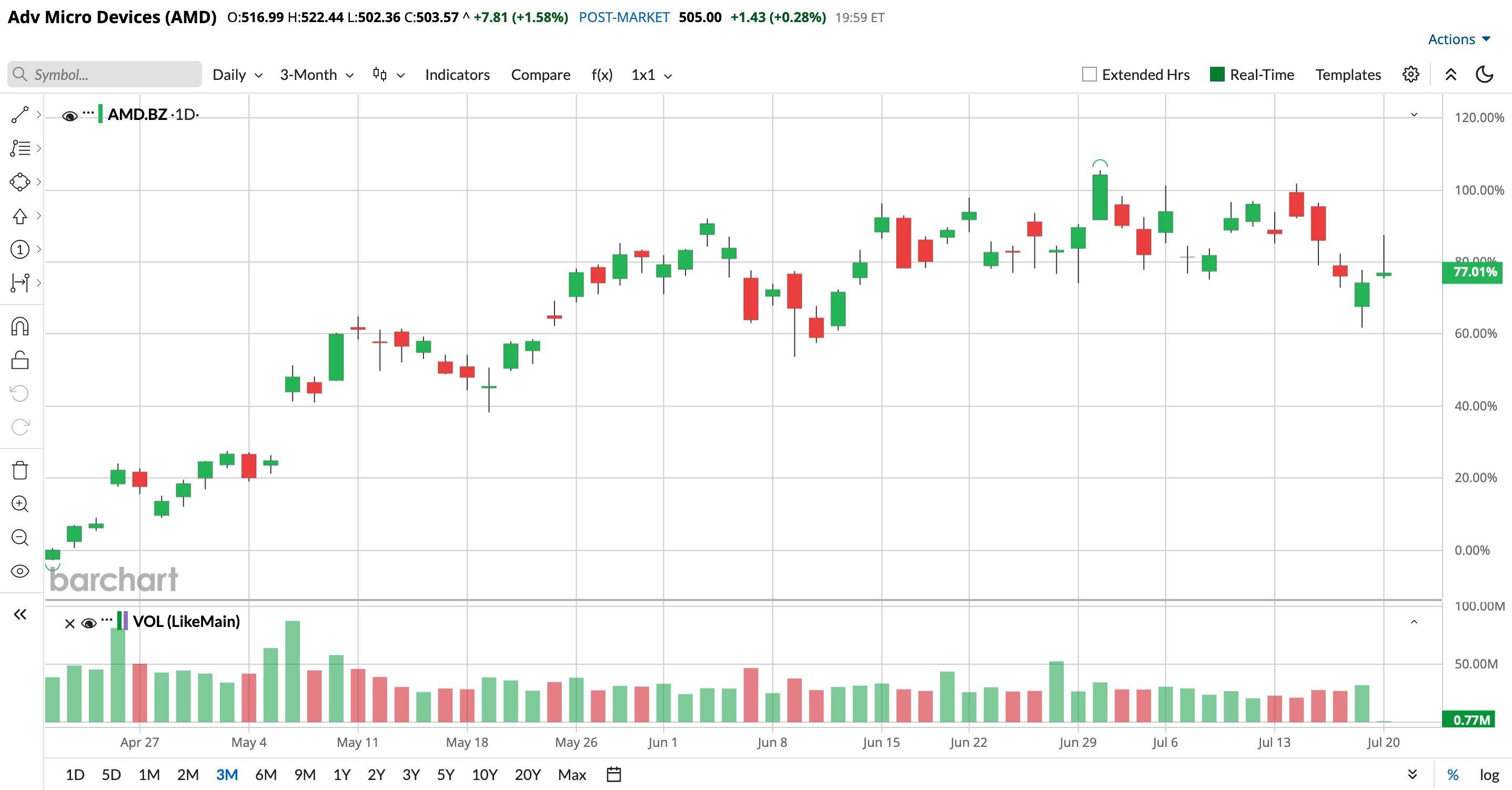
Year-to-date (YTD), AMD’s stock has surged 135.14%, comfortably outperforming the S&P 500 Index’s 8.73% gain during the same period. The rally only began in April and then accelerated after the company’s first-quarter results in May. In the last 5 days, though, the stock has fallen 5.77%, mainly due to a broader selloff across semiconductor stocks.
 www.barchart.com
AMD’s valuation sends mixed signals. The forward GAAP price-to-earnings ratio of 91.78 times sits 4% below its 5-year average of 95.60 times. The modest-looking discount is actually notable when considering that the stock price has more than doubled this year. The forward price-to-sales ratio of 16.28 times tells the opposite story, trading at a 96.78% premium to its 5-year average of 8.28 times. The gap is due to AMD’s improved profitability, with each dollar of sales now earning more profit than before. This pulls the P/E down while the P/S stays high. The earnings outlook supports the premium. EPS is expected to grow 78% in 2026 and a further 81% in 2027. The balance sheet is another genuine strength. AMD holds $12.35 billion in cash against just $3.87 billion in debt. The one thing the numbers do not capture is dilution. The warrants promised to OpenAI and Meta could add roughly 20% more shares over time. This would quietly reduce what each existing share is worth.
AMD Guides Higher As MI450 Ramps Into the Second Half
AMD reported its first-quarter fiscal 2026 earnings on May 5. Revenue of $10.3 billion increased 38% year-over-year (YOY), while the gross profit of $5.4 billion also increased by 45%. Data Center segment revenue of $5.8 billion increased by 57%. The company stated that the revenue was driven by strong demand for EPYC processors and continued acceleration in AMD Instinct GPU shipments. CFO Jean Hu said that the firm achieved strong performance across all key financial metrics. The quarterly free cash flow went from $0.73 billion to a record $2.57 billion.
Looking forward, the company expects revenue of roughly $11.2 billion for the second quarter. AMD is scaling supply to meet demand. Once the capacity is increased, CEO Lisa Su expects server growth to surge rapidly. When asked about the MI450 Series and Helios forecast, Su said that it was above the company’s initial plans for 2027. She said that the increased forecast was driven by a broad range of customers, rather than one or two large deals. Additionally, the CEO stated that the company’s server CPU market share can very likely increase to over 50%. AMD’s second-quarter earnings will be reported on August 4.
What Analysts Are Saying About AMD Stock
Bank of America Securities analyst Vivek Arya increased AMD’s price target from $550 to $620 while maintaining a “Buy” rating. The analyst cited strong cloud demand, continued EPYC share gains, and supply visibility as the reasons for the bullish view. A couple of days before this, Rosenblatt Securities analyst Kevin Cassidy raised the firm’s price target from $490 to $665 while maintaining a “Buy” rating as well.
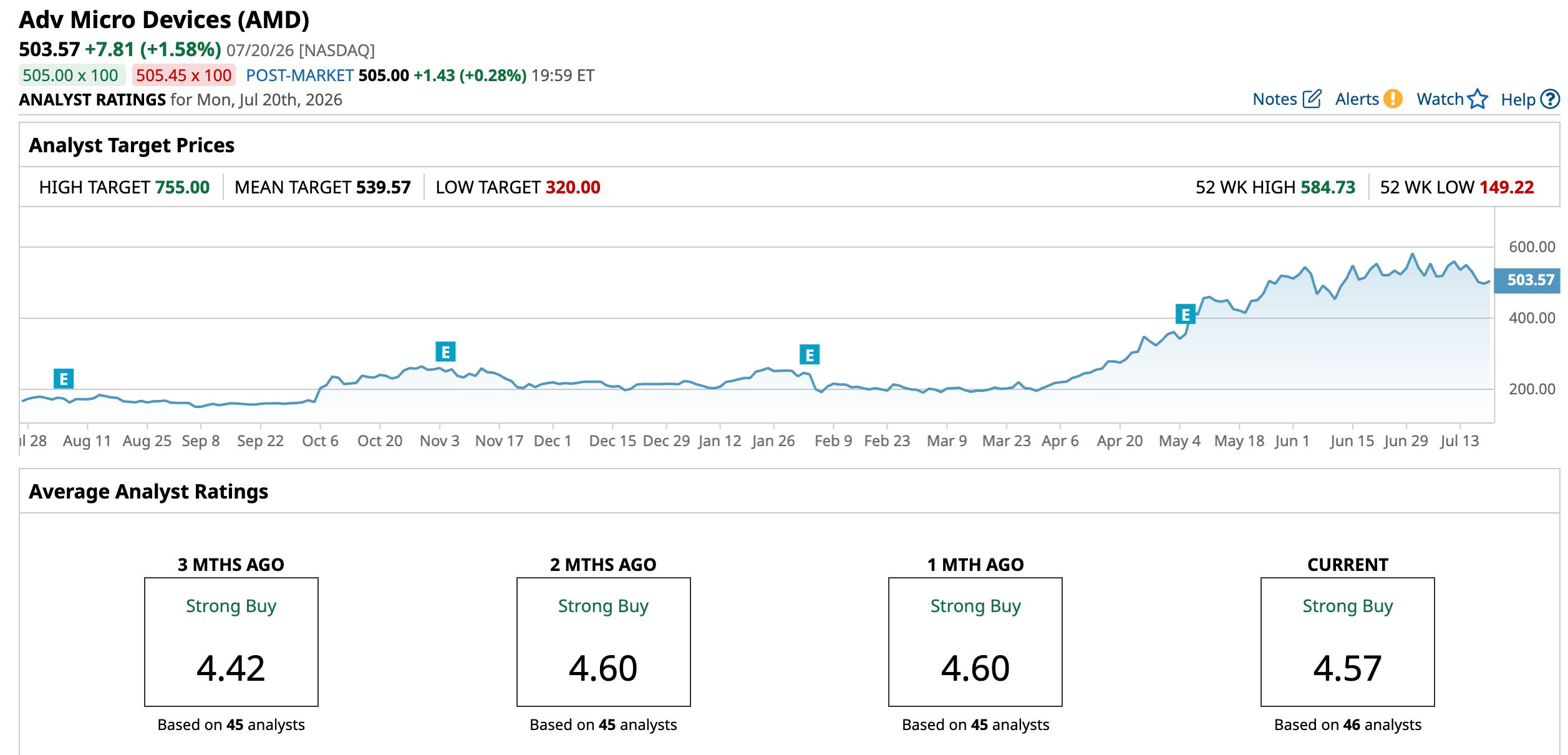
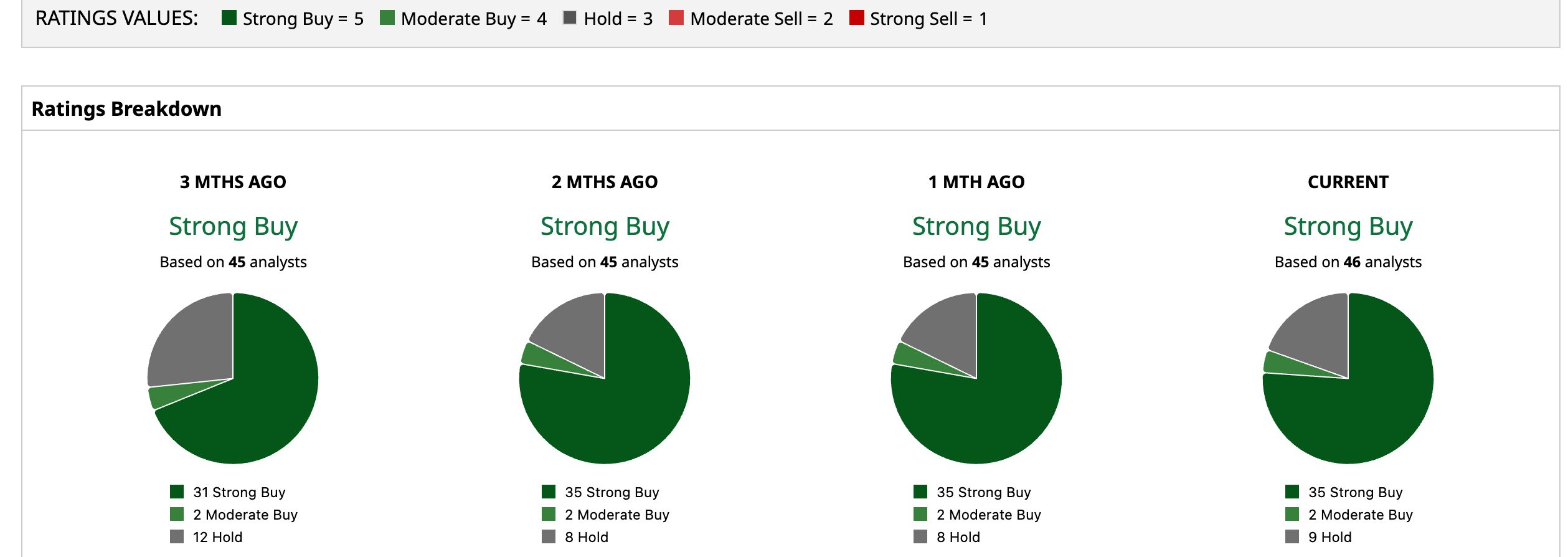
Based on the 46 Wall Street analysts, AMD holds a “Strong Buy” rating with a mean price target of $539.57, indicating a 7.15% upside. While the upside is modest, the overall consensus remains largely positive, with none of the analysts recommending a “Sell.”
 www.barchart.com
 www.barchart.com
 On the date of publication, Jabran Kundi did not have (either directly or indirectly) positions in any of the securities mentioned in this article. All information and data in this article is solely for informational purposes. For more information please view the Barchart Disclosure Policy here.
More news from Barchart
AMD Is Expected to Unveil New AI Customers. One Detail Matters Most for AMD Stock. Domino's Pizza Delivers Strong FCF and FCF Margins - Is DPZ Stock Too Cheap? TSMC’s AI Boom Is Just Getting Started: Why Investors Should Buy the Pullback in TSM Stock Now How AI-Driven Protein Generation Is a Margin Killer for Drugmakers