

After correcting about 30% since its shares went public in June 2026, SpaceX (SPCX) stock may be bound for another round of decline. A lock-up period for pre-IPO shareholders is set to expire on Aug. 6, just days after the company will release its first set of quarterly numbers as a public company.
Approximately 911.5 million shares are set to go for sale at a value of about $116 billion, with potentially more shares coming into the market if certain performance milestones linked to its post-IPO share price are achieved. Meanwhile, liquidity in SpaceX is expected to increase by the end of the year when 5.3 billion shares of the company may be available for trading.
More Top Stocks Daily: Go behind Wall Street’s hottest headlines with Barchart’s Active Investor newsletter.
 www.barchart.com
 A Look Back at Tesla
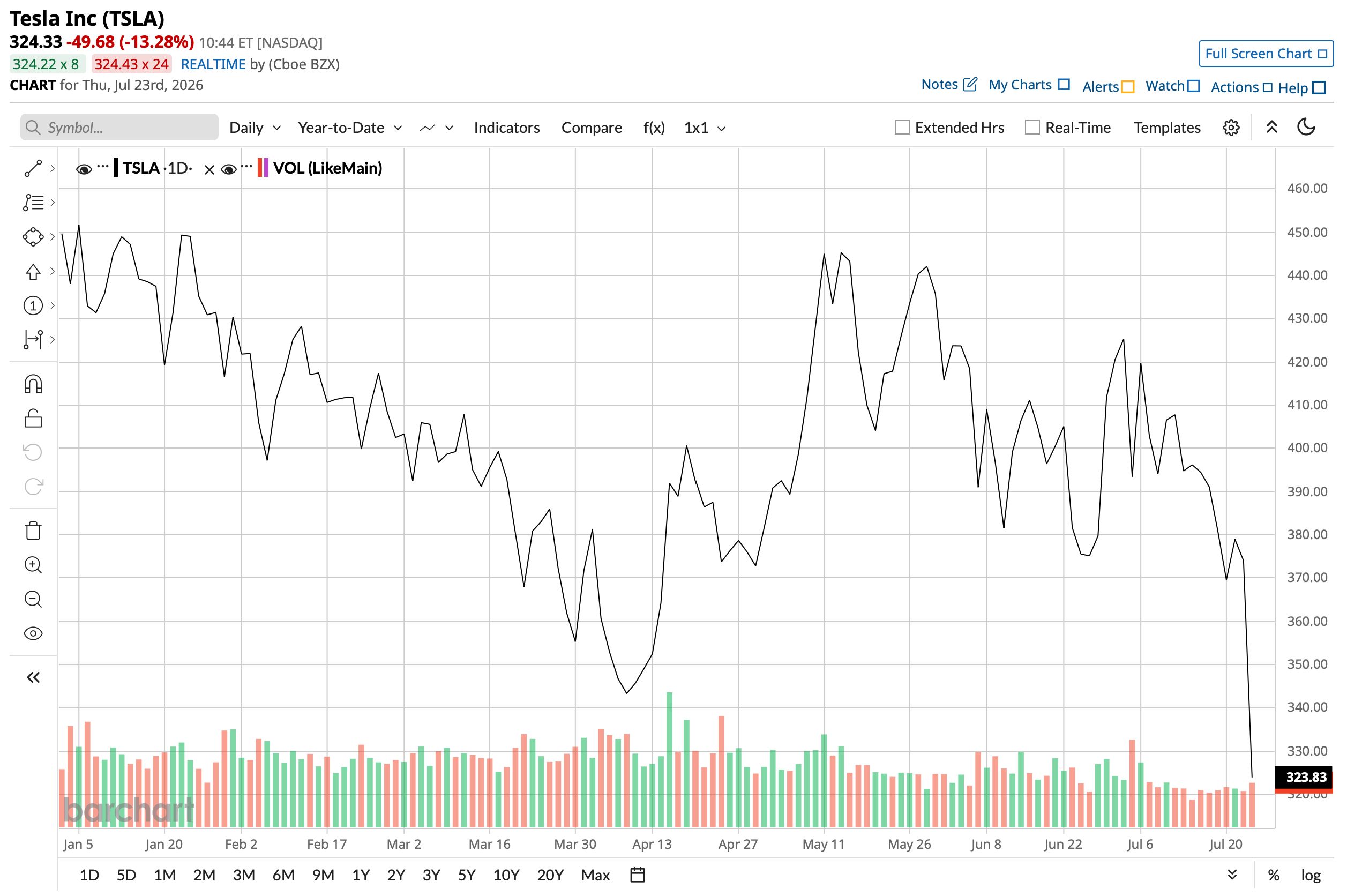
The impending ending of SpaceX's lock-up period and its subsequent price performance cannot be predicted. However, for historical reference, we can study a similar scenario from CEO Elon Musk's other company: Tesla (TSLA).
Tesla went public at $17 per share on June 29, 2010. By November 2010, shares doubled to around $35. Then TSLA stock started sliding — and when the lock-up period expired on Dec. 27, 2010, shares dropped about 15%, with thin holiday volume making the move sharper. Having said that, investors who took the risk and added to Tesla at that time have been handsomely rewarded, with an almost 40% compound annual growth rate (CAGR) over the past 16 years.
What's more, Tesla at that time was essentially just an automobile company (although, by revenue contribution, it arguably still is). Today, SpaceX is not just a space company. It has sky-high ambitions of building data centers in space, has a thriving broadband business through Starlink, its own generative AI chatbot through xAI's Grok, and one of the world's largest social media platforms in X. If reports are to be believed, Tesla may also be brought into the fold, which would bring electric vehicles (EV) and Optimus humanoid robots into the mix.
Thus, the upside potential for SpaceX is huge — with the caveat that execution will take time, maybe even decades. Yet the payoff could be bigger than what Tesla has given its shareholders until now, considering the sheer scale of the markets that SpaceX is dabbling in.
SpaceX's Financials Are Decent, But Not Otherworldly
SpaceX has achieved meaningful revenue growth in recent years, moving from $10.4 billion in 2023 to $18.7 billion in 2025. The company generated profits of $791 million in 2024 before shifting to losses of $4.9 billion the next year.
Cash flow from operations improved over this span, advancing to $6.8 billion in 2025 from $4.5 billion in 2023. The firm ended 2025 with a solid cash position of $24.7 billion and very limited short-term debt, helping mitigate liquidity risks.
During the first quarter of 2026, revenue expanded more than 15% year-over-year (YOY) to $4.7 billion. Net losses widened notably to $4.3 billion from $528 million in the year-ago quarter. Meanwhile, operating cash flow for the period rose to $1.05 billion from $727 million, while the company maintained $15.9 billion in cash reserves by the end of Q1.
Capital spending has increased considerably across the past three years, growing from $4.4 billion in 2023 to $20.7 billion in 2025. Artificial intelligence-related expenditures have shown particularly rapid expansion, starting at $463 million in 2023 — making it the smallest category behind space and connectivity — before surging to $12.7 billion in 2025 and becoming the leading area of investment. This trend highlights how the company, which initially concentrated on space missions and connectivity offerings, is increasingly positioning AI as a core foundation for future initiatives across its businesses.
Reviewing the Q1 2026 breakdown reveals that connectivity remains the dominant revenue source, contributing $3.3 billion out of total revenue of $4.7 billion. The AI segment followed with $818 million, a notable amount for a relatively new area, while the space segment added $619 million.
Even following a recent decline, SPCX stock trades at very high valuation levels. For example, SpaceX's price-to-sales (P/S) ratio of 82.7 times stands well above the sector median.
What Do Analysts Think of SPCX Stock?
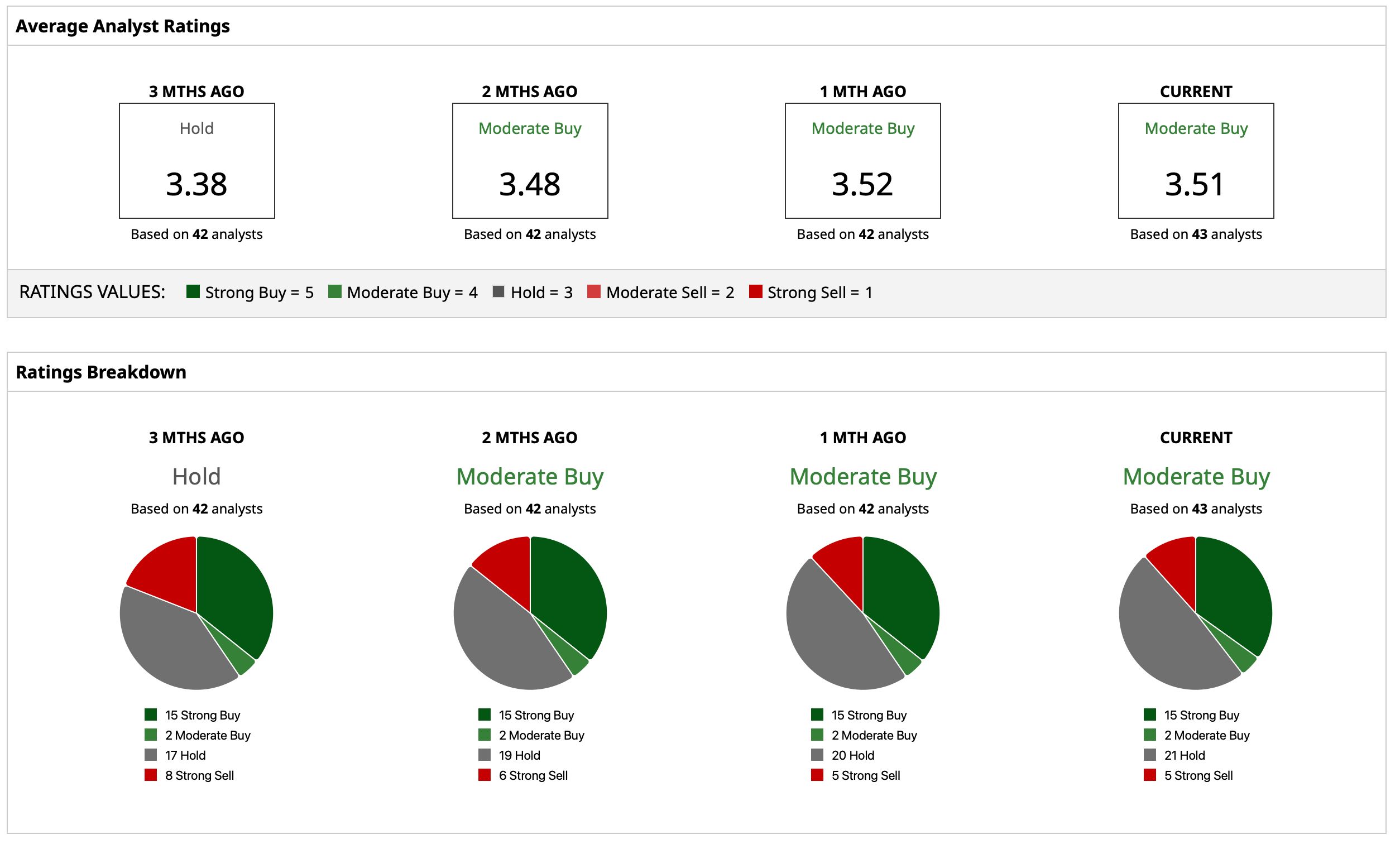
Overall, analysts have a consensus “Moderate Buy” rating for SPCX stock. The mean target price of $231.83 denotes huge potential upside of 101% from current levels. Out of 33 analysts covering the stock, 22 have a “Strong Buy” rating, two have a “Moderate Buy” rating, eight have a “Hold” rating, and one analyst has a “Moderate Sell” rating.
 www.barchart.com
 On the date of publication, Pathikrit Bose did not have (either directly or indirectly) positions in any of the securities mentioned in this article. All information and data in this article is solely for informational purposes. For more information please view the Barchart Disclosure Policy here.
More news from Barchart
Dear SpaceX Stock Fans, Mark Your Calendars for August 6 SpaceX Bears May Be Right On Value And Wrong On Timing Amazon Stock Just Hit a Major Hurdle Ahead of Earnings Fed Decision, Tech Earnings and Other Can't Miss Items this Week