

SoundHound AI (SOUN) recently posted an extraordinary second quarter. Revenue grew 45% from a year earlier to $61.9 million, and SOUN stock jumped more than 20% in the days following the release. That’s the headline that people are focusing on. But I believe there’s a more interesting story that the market seems to be missing. It’s not the growth, but rather how SoundHound is growing.
Unlike most companies signing customers one at a time, SoundHound buys whole companies and folds them in. The company runs a simple playbook, and it has repeated it several times. It buys a business in the voice or chat space and moves that company’s customers onto its own platform, called OASYS. It then sells them extra services they didn’t have before. Usually that means adding voice to companies that only offered text chat. Speed is what sets it apart. OASYS lets customers build and launch artificial intelligence (AI) agents in minutes, not months. That speed is showing up in sales, too. SoundHound signed an eight-figure commitment less than 90 days after the first demo. Management calls this its repeatable formula, and the Q2 report showed it paying off.
More Top Stocks Daily: Go behind Wall Street’s hottest headlines with Barchart’s Active Investor newsletter.
LivePerson Is the Real Test
Most recently, SoundHound moved to acquire LivePerson, a pioneer in web chat that has run into trouble. What SoundHound really wants is LivePerson’s customer base, which includes 25 of the Fortune 100. From there, the company plans to run the same plan as always, moving customers onto OASYS and adding the voice tools they’ve been asking for.
The scale is what makes it a real test. In the Q2 report, SoundHound forecast full-year fiscal 2026 revenue of $230 million to $260 million, but that doesn’t count LivePerson at all. The forecast for 2027 is at least $350 million, with LivePerson expected to be a major contributor once it is part of the company. That means SoundHound has already promised investors a much bigger 2027, based on a deal that hasn’t yet closed and a turnaround that hasn’t started.
There’s a cost to the model, too. Buying weaker businesses has been hurting SoundHound’s margins until they’re absorbed, something management has admitted. When asked if a bigger AI company could simply overrun SoundHound, CEO Keyvan Mohajer replied that customers “don’t want an API, they want a partner." Whether that holds as SoundHound takes on one of its biggest acquisitions is a question the next year will answer.
About SoundHound Stock
SoundHound provides independent voice AI solutions that help businesses create conversational experiences for customers. Its technology is used across industries such as automotive, restaurants, customer service, smart devices, and televisions. The company offers the Houndify platform, which provides a suite of tools to help brands build conversational voice assistants, and also provides enterprise AI agents through its Amelia platform. Founded in 2005, SoundHound is based in Santa Clara, California.
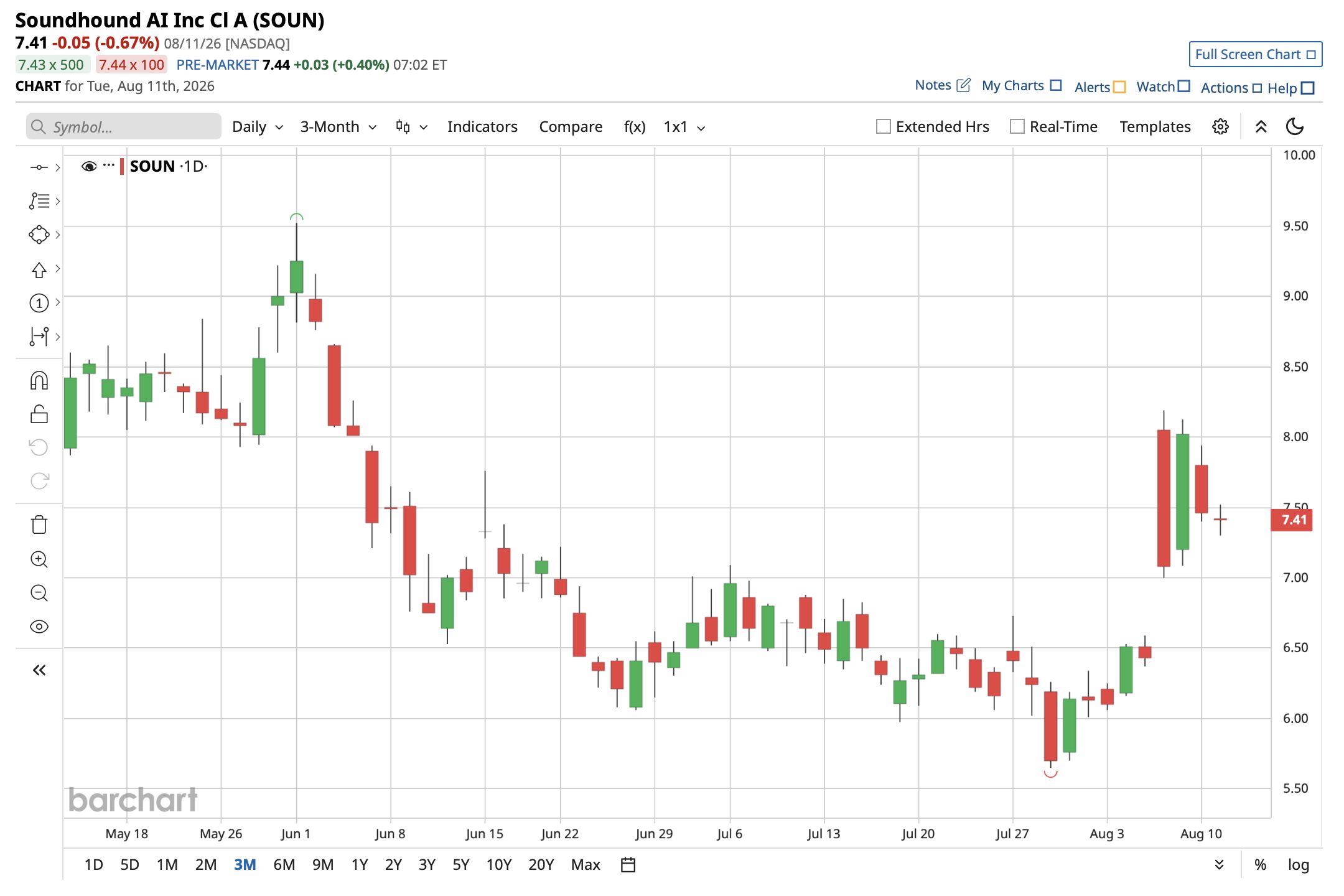
SOUN stock's 52-week high of $22.17 and 52-week low of $5.65 suggest that investors have had a rough ride over the last 12 months. Over the past year, SOUN stock has fallen roughly 54%, significantly underperforming the broader market. In contrast, the S&P 500 ($SPX) has returned around 20% during the same period.
 www.barchart.com
 SoundHound is still in its buildout phase, making it hard to judge on the usual measures. The forward price-to-earnings (P/E) ratio isn’t meaningful, since the company isn’t profitable yet. Meanwhile, the price-to-sales (P/S) multiple of 19.1 times has no multiyear average to compare against but seems steep on its own.
The EPS outlook in the near term seems concerning on paper. Analysts expect a steep drop in earnings growth in fiscal 2026 — although that figure is exaggerated by the company’s near-zero earnings base — followed by a 39% rise in fiscal 2027. That improvement in 2027 reflects analysts who expect revenue to start catching up with the spending. That also falls in line with management’s own guidance for a considerably bigger year.
The balance sheet is clean as well. SoundHound holds $203 million in cash against little debt, making it essentially debt-free. This gives SoundHound room to keep buying and integrating businesses like LivePerson without strain. It’s a rare bit of safety in a stock that otherwise asks investors to bet heavily on the future.
SoundHound Raises Revenue Outlook
SoundHound reported earnings for Q2 2026 on Aug. 5. The company reported record revenue of $61.9 million, up 45% year-over-year (YOY) from $42.7 million. Loss per share came in at $0.02, while GAAP gross margin was 45%, up from 39%. The company’s R&D expenses came to $27.1 million in Q2 while sales and marketing expenses were $16.6 million. Interim CFO James Hom said that the company’s GAAP operating loss of $43.3 million improved by 45% YOY. Cash and equivalents at quarter-end stood at $203 million with no debt.
Looking forward, SoundHound raised its full-year 2026 revenue guidance to a range of $230 million to $260 million. The company said the updated outlook reflects a strong first half and continued demand for its AI products. SoundHound expects gross margin to exceed 70% in the future as it continues to modernize infrastructure, optimize cloud spending, and shift more work onto its own technology stack. Hom said that the company will remain disciplined on costs as it drives the business toward achieving profitable growth, while CEO Keyvan Mohajer noted that the guidance does not include the LivePerson acquisition. Management will provide another update once the LivePerson acquisition closes in the second half of 2026.
What Do Analysts Expect for SOUN Stock?
DA Davidson analyst Gil Lauria recently lowered the price target on SOUN stock from $12 to $10 while keeping a “Buy” rating. Despite the decrease, that target still reflects potential upside of 35% from current levels. Northland Securities analyst Michael Latimore also recently reiterated a “Buy” rating on the stock with a price target of $12.
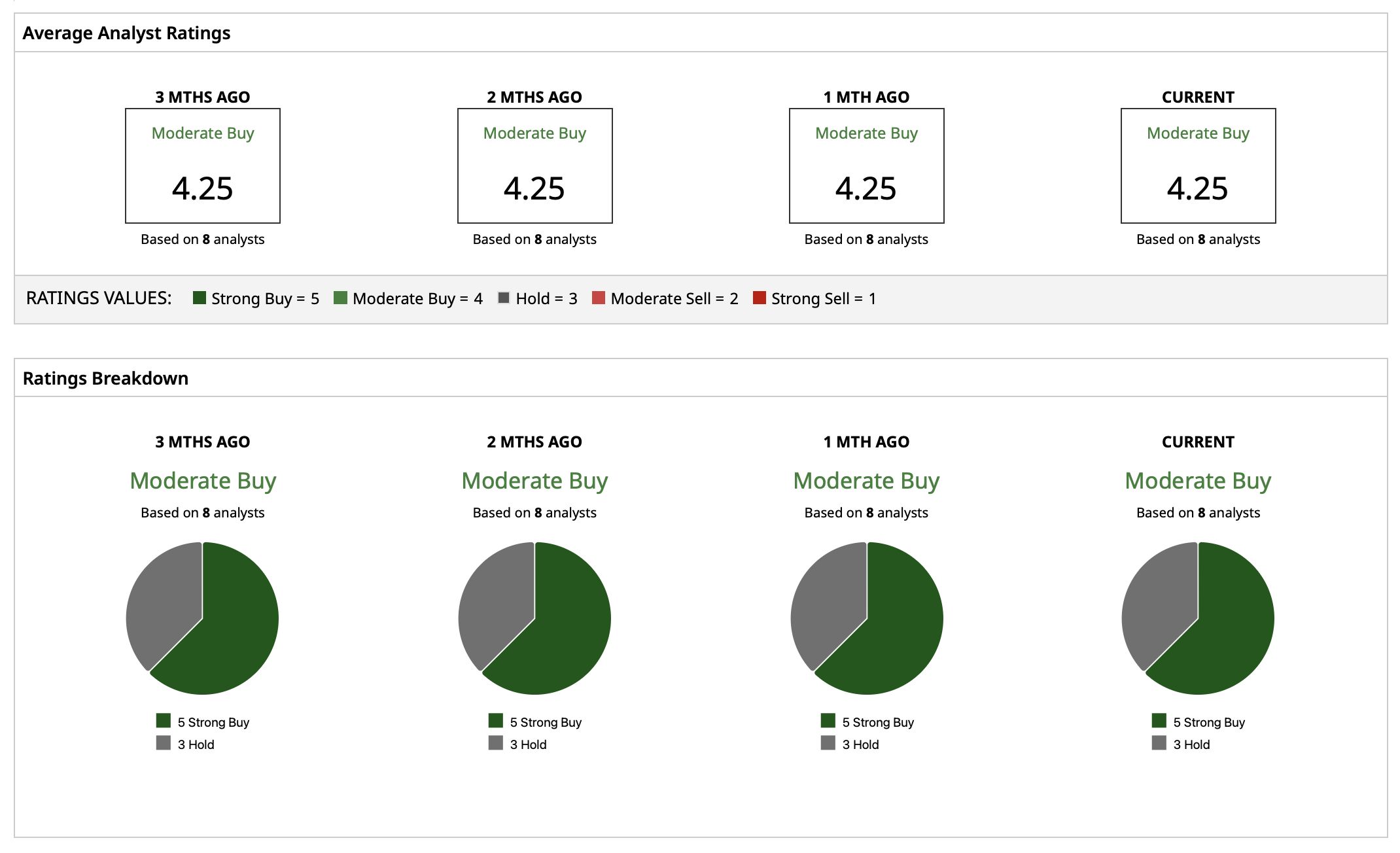
SOUN stock is currently covered by eight Wall Street analysts and carries a consensus “Moderate Buy” rating. The mean price target of $11.57 implies potential upside of 56% from current levels, while the highest price target of $16 reflects impressive potential upside of 116% from here.
 www.barchart.com
 On the date of publication, Jabran Kundi did not have (either directly or indirectly) positions in any of the securities mentioned in this article. All information and data in this article is solely for informational purposes. For more information please view the Barchart Disclosure Policy here.
More news from Barchart
SoundHound AI's Acquisition Strategy Is Either Genius or Dangerous. How to Evaluate SOUN Stock. SpaceX Could Be Making $235 Billion From a Business It's Not Known For. SPCX Stock Investors Should Pay Attention. Dear Dell Stock Fans, Mark Your Calendars for September 3 Why Wall Street Isn't Buying Super Micro's $60 Billion Backlog Quite Yet