

Nvidia Corporation (NVDA) has been one of the biggest success stories of the artificial intelligence (AI) boom, delivering spectacular gains and leaving investors constantly searching for the next NVDA. But Nvidia itself still has plenty of room to grow, with its graphics processing units (GPUs) remaining in huge demand as companies race to build AI-powered data centers. One of the biggest hurdles in that growth story, however, is China.
China is a large and important market for Nvidia. The country once contributed more than 20% of Nvidia’s data center revenue, but escalating U.S. export restrictions, combined with China’s push to build domestic technology, have caused Nvidia to lose much of its advanced AI chip market share there and cost the company billions in revenue. And now, the chipmaker appears to be getting a small opening back into China, but it may be too early for investors to celebrate.
More Yield, Less Trap: Sign up free to get Barchart’s daily Dividend Investor newsletter straight to your inbox.
Chinese tech giants ByteDance and Tencent (TCEHY) have reportedly begun receiving Nvidia’s H200 AI chips, giving Nvidia a much-needed foothold in a market where its more powerful chips remain restricted. Still, Wedbush analyst Matt Bryson believes the development will provide only a “minimal” boost to Nvidia’s China revenue for the foreseeable future. Beijing wants most of the H200 chips to remain outside mainland China, and every purchase still requires case-by-case approval from regulators.
While companies can use the chips in Hong Kong, limited data center capacity and power constraints could make large-scale deployment challenging. Nvidia also has around 500,000 H200 chips in stock, largely intended for Chinese customers, but selling those chips at scale remains difficult. In other words, Nvidia may have found a way back into China, but it’s a small door rather than a wide-open market. With that in mind, let’s take a closer look at NVDA stock.
About Nvidia Stock
Over the past five years, few companies have been as synonymous with the AI boom as Nvidia. As AI evolved from an emerging technology into one of the biggest investment themes in the world, demand for the computing power needed to run it exploded, and Nvidia was perfectly positioned to capitalize. Today, its GPUs power everything from ChatGPT and cloud-based AI platforms to autonomous vehicles, robotics, and advanced scientific research, putting the company at the heart of the massive global spending spree on AI infrastructure.
It is quite a journey for a company that was founded in 1993 by Jensen Huang, Chris Malachowsky, and Curtis Priem in a Denny’s diner and grew from a struggling gaming startup into the world’s most valuable publicly traded company. Nvidia’s rise, however, was decades in the making. The company initially made its name designing graphics processors for the gaming industry before gradually expanding its GPUs into much broader computing applications. That early investment in high-performance, parallel computing eventually became a huge advantage when generative AI took off.
Training and running large language models requires enormous computing power, and Nvidia’s technology was already well suited for the job. Since then, Nvidia has kept its foot on the accelerator. Its Hopper-based H100 became the go-to AI accelerator during the early generative AI boom, while its newer Blackwell platform has taken performance to another level. The company is now looking toward its upcoming Rubin architecture, which is expected to power the next generation of AI workloads. This rapid product cycle has helped Nvidia maintain a commanding position as businesses and cloud providers continue pouring billions into AI infrastructure.
And the numbers reveal the extent of that success. Nvidia is now valued at roughly $5.20 trillion, making it the world’s most valuable publicly traded company. Its stock has delivered an extraordinary 13,902% gain over the past decade, putting it among the greatest wealth creators in market history. That kind of performance naturally attracts competition for investor attention. Recently, several memory-chip companies and emerging AI-focused players have delivered even bigger gains, while profit-taking has also taken some steam out of Nvidia’s rally.
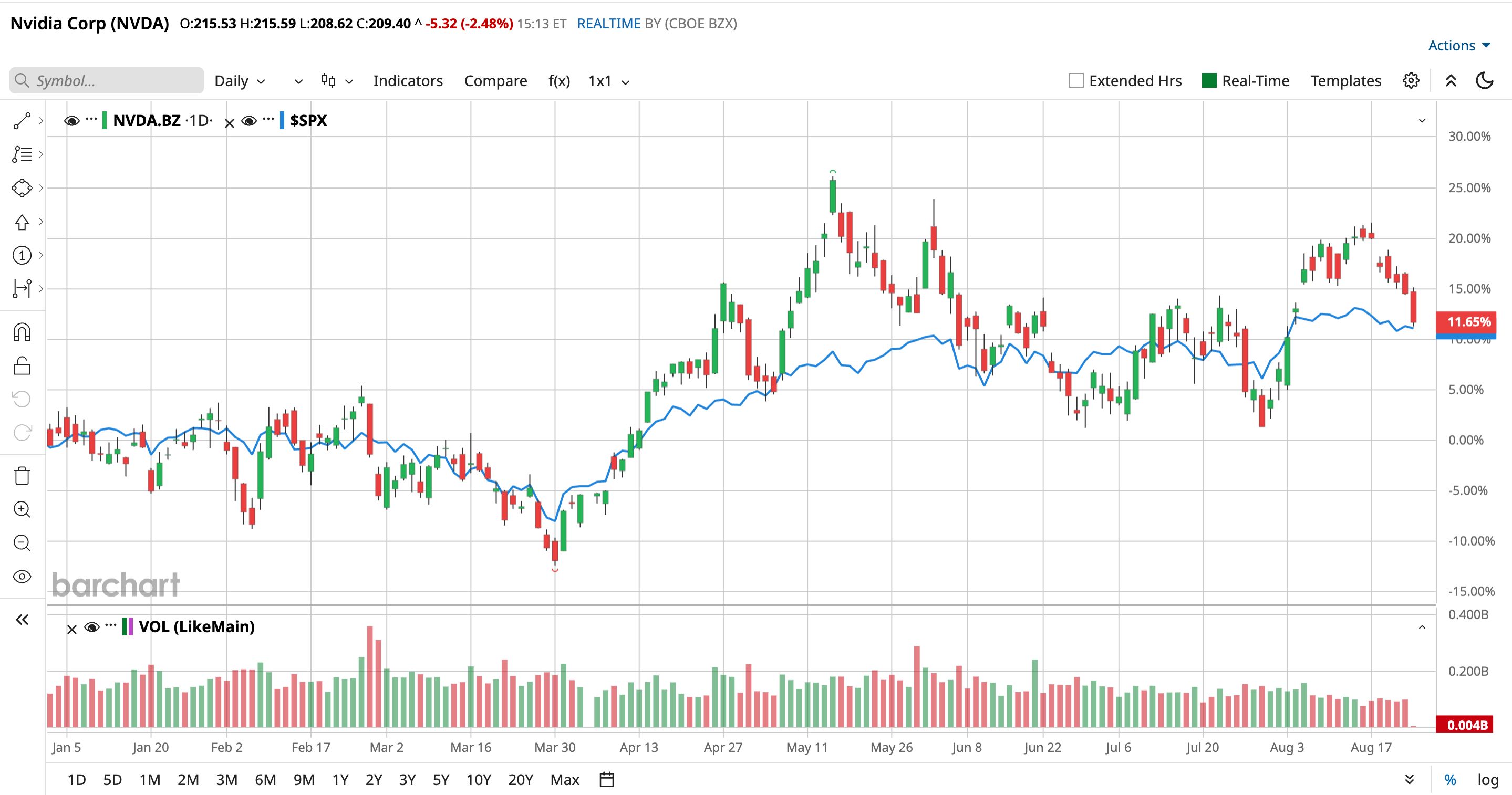
Still, Nvidia continues to outperform the broader market. NVDA is up 17.9% over the past year and 12.5% so far in 2026, compared with gains of 18.5% over the past year and 11.9% in 2026 for the S&P 500 Index ($SPX). More recently, Nvidia shares have started picking up momentum again, helped by strong demand for AI infrastructure, easing concerns about how hyperscalers will finance their massive AI spending, and growing anticipation ahead of the company’s next earnings report. The stock hit its all-time peak of $236.54, reached on May 14.
 www.barchart.com
 A Closer Look Inside Nvidia’s Q1 Earnings Report
Nvidia’s latest earnings revealed that demand for AI computing power remains incredibly strong as cloud providers, businesses, and governments continue pouring money into the infrastructure needed to support increasingly powerful AI models. That surge in spending helped Nvidia deliver yet another record-breaking quarter. For the first quarter of fiscal 2027, Nvidia reported revenue of $81.62 billion, up an impressive 85% year-over-year (YOY) and comfortably ahead of Wall Street’s $78.84 billion estimate. The bottom line was even more impressive.
Adjusted earnings per share jumped 140% YOY to $1.87, beating analysts’ consensus estimate of $1.77. The results further highlight Nvidia's dramatic evolution from a graphics-chip company into a full-fledged AI infrastructure powerhouse. That transformation is reflected in Nvidia’s new reporting structure, which divides the business into two main segments: Data Center and Edge Computing.
As expected, Data Center remains the star of the show. The segment generated $75.2 billion in revenue, accounting for more than 92% of Nvidia’s total sales and growing a remarkable 92% YOY. The performance highlights the solid demand for Nvidia’s AI accelerators as customers race to expand data center capacity for generative AI and other compute-heavy workloads. Meanwhile, Nvidia’s smaller Edge Computing business is also picking up speed. Revenue increased 29% YOY to $6.4 billion, supported by growing AI adoption across gaming and PCs, industrial robotics, networking, autonomous systems, and automotive applications.
Nvidia is not just growing rapidly. It is also maintaining impressive pricing power and efficiency. The company posted a GAAP gross margin of 74.9%, unchanged from the previous quarter and significantly above 60.5% a year earlier. Holding margins at such elevated levels despite increasing competition is another sign that demand for Nvidia’s products remains exceptionally strong. The company is finding plenty of ways to reward shareholders while continuing to invest heavily in future growth.
During the quarter, Nvidia returned approximately $20 billion through share buybacks and cash dividends, while continuing to fund the technologies and products that could power its next phase of expansion. Perhaps the biggest takeaway for investors, however, was Nvidia’s guidance. The company expects fiscal 2027 second-quarter revenue of around $91 billion, well above Wall Street’s $86.11 billion estimate, while projecting gross margins to remain near 75%. And there is an important detail buried in that forecast.
The guidance assumes zero Data Center compute revenue from China. In other words, Nvidia expects demand from the rest of the world to be strong enough to deliver another record quarter even without counting China’s contribution, despite ongoing geopolitical restrictions. Investors won’t have to wait long to see whether Nvidia can deliver on that outlook. The company is scheduled to report its fiscal 2027 second-quarter earnings on Wednesday, Aug. 26, after the market closes.
How Do Analysts View Nvidia Stock?
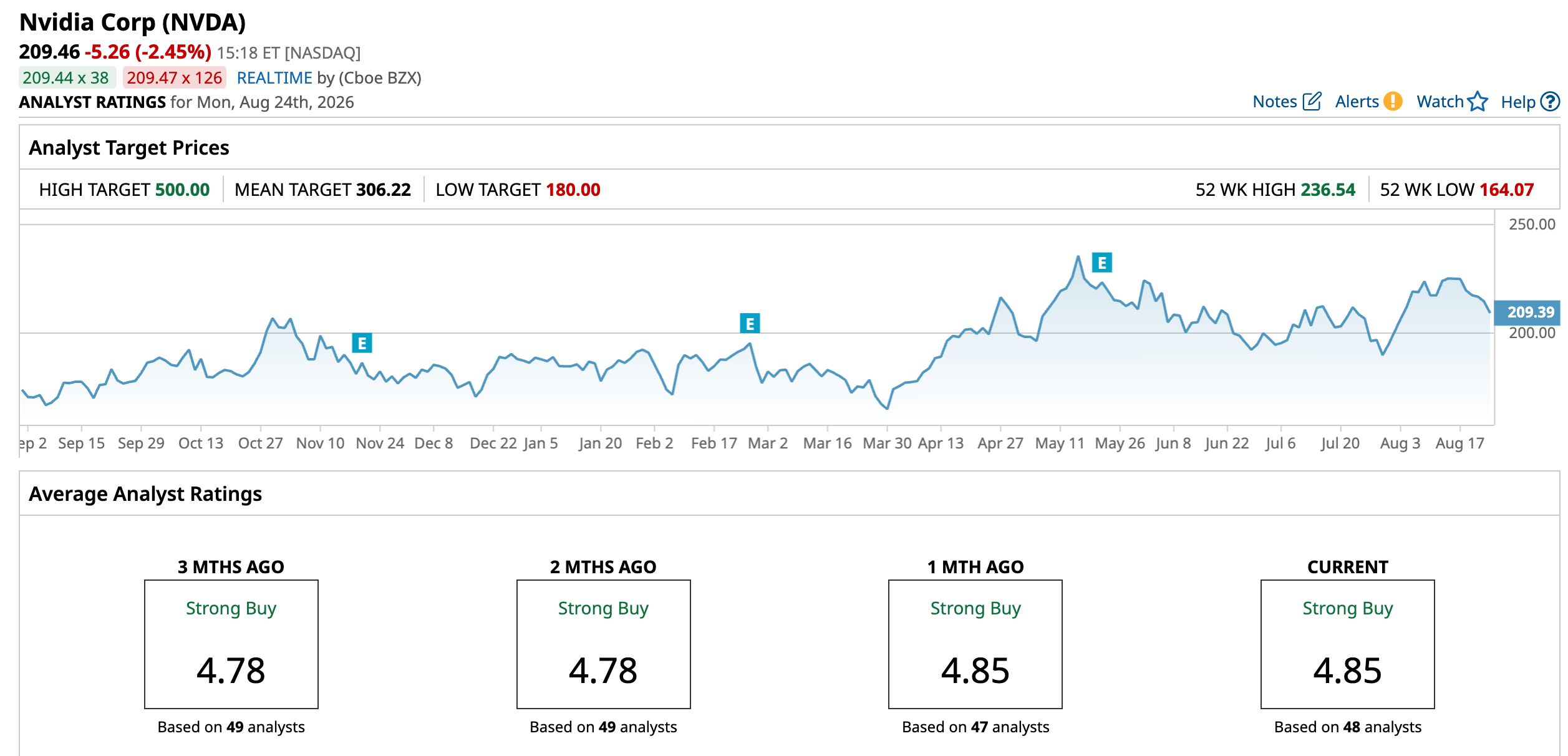
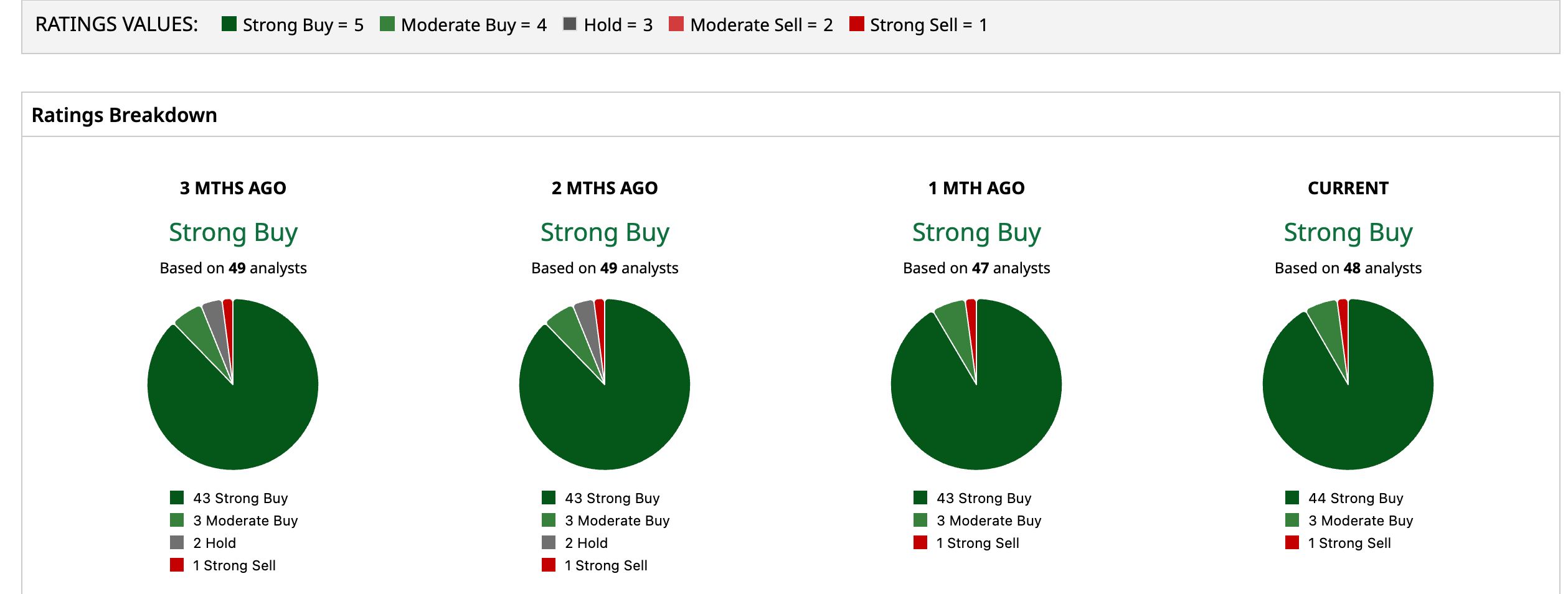
Overall, Wall Street remains firmly in Nvidia’s corner, with the stock carrying a consensus “Strong Buy” rating. Out of 48 analysts covering NVDA, 44 recommend a “Strong Buy,” three rate it a “Moderate Buy,” and only one calls for a “Strong Sell.” The optimism is reflected in the price targets, too. The average target of $306.22 points to 46.2% upside, while the Street-high target of $500 suggests Nvidia could climb as much as 138.7% from current levels.
 www.barchart.com
  www.barchart.com
 On the date of publication, Anushka Mukherji did not have (either directly or indirectly) positions in any of the securities mentioned in this article. All information and data in this article is solely for informational purposes. For more information please view the Barchart Disclosure Policy here.
More news from Barchart
Nvidia Scored an H200 Win in China, But These Analysts Warn It May Not Be a Reason to Buy NVDA Stock New Layoffs Just Hit Apple’s Vision Pro Staff. What That Means for AAPL Stock. Better Than Nvidia: 3 AI Dividend Stocks Leaving It in the Dust Microsoft vs. Broadcom: One Has 85% Upside, But I'm Picking the Other