

Nvidia (NVDA) delivered a commanding second-quarter fiscal 2027 performance after the close on Wednesday, Aug. 26, with revenue of $96.2 billion more than doubling from the year-ago period and comfortably exceeding the Wall Street consensus of approximately $92.2 billion.
Adjusted earnings per share came in at $2.22, well above the $2.09 analysts had projected, while GAAP net income surged 126% year-over-year to $59.69 billion, or $2.46 per diluted share. The data center segment, which now represents over 92% of total revenue, generated $89 billion in quarterly sales, up 117% from a year earlier and roughly $3 billion above consensus expectations.
Can’t Get Enough Options?: Join the list for Barchart’s daily unusual options report, delivered free.
Nvidia also returned approximately $26 billion to shareholders through buybacks and dividends during the quarter, with about $99 billion remaining under its repurchase authorization.
Nvidia Makes Billions on Its AI Stock Picks
A notable but underappreciated component of the quarter was the $7.8 billion in gains from Nvidia's equity investment portfolio, which boosted reported net income significantly. The company's public and private equity holdings have ballooned to approximately $95.6 billion as of late July, up from less than $100 million in early 2020, reflecting Nvidia's deepening role as both supplier and financier of the AI ecosystem.
“Our equity investments are focused on AI model makers, infrastructure financiers, and other private companies, subject to certain contingencies,” according to the CFO Commentary accompanying Nvidia’s fiscal second-quarter figures.
These stakes span companies including CoreWeave (CRWV), Nebius (NBIS), Intel (INTC), Nokia (NOK), Coherent (COHR), and Synopsys (SNPS), and the company has also disclosed a roughly $21 billion position in SpaceX (SPCX).
CFO Colette Kress addressed “circular financing” criticism directly on the earnings call, including Nvidia’s new partnership for an OpenAI data center in Ohio.
“We recognize the scale of this support, and we know some will call this circular financing. We see it differently,” she said, describing them as investments in “once-in-a-generation companies” and adding, “The equity returns on our invested capital will be excellent.”
Regardless, Nvidia’s portfolio picks didn’t escape some Q2 volatility. The portfolio’s return was down sharply from $15.94 billion in Q1 of fiscal 2027.
Nvidia Forecasts $108 Billion in Current-Quarter Revenue
The forward guidance will likely prove even more impactful for market sentiment than the quarterly beat. Nvidia projected third-quarter revenue of $108 billion, plus or minus 2%, marking the first time its quarterly forecast has exceeded $100 billion and surpassing the analyst consensus of roughly $104 billion to $105 billion.
More dramatically, the company issued its first-ever full fiscal year forecast, projecting 70% revenue growth in fiscal 2028 — far exceeding the 44% Wall Street had modeled — though management characterized this as supply-constrained rather than demand-limited.
CEO Jensen Huang stated that actual demand exceeds the 70% figure, with supply-chain bottlenecks, particularly in high-bandwidth memory, acting as the binding constraint.
The combination of the earnings beat and the aggressive forward guidance reversed an initial post-earnings decline of roughly 2%, propelling shares up approximately 4.7% in extended trading to $219.53. That move, if it holds, would be roughly in line with the options market’s expected price swing for NVDA.
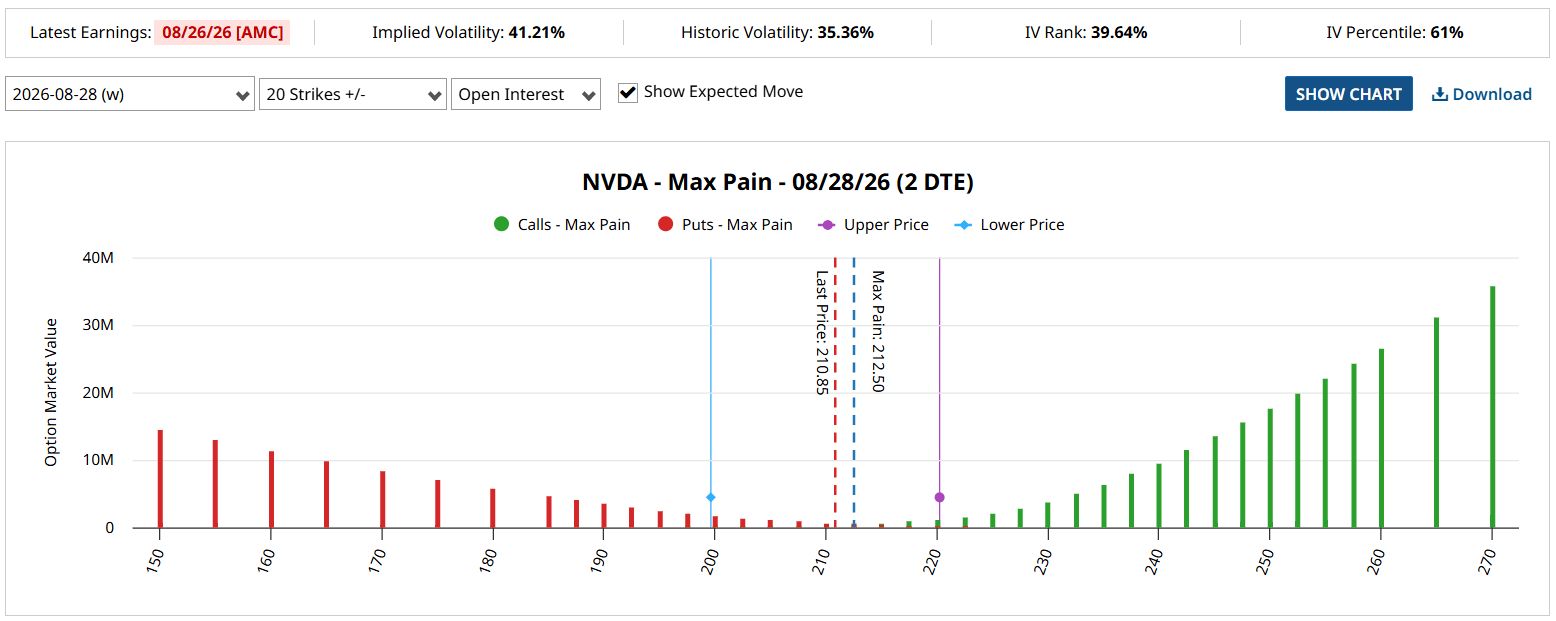 NVDA max pain with expected move ahead of Q2 earnings.
 Emerging Risks to Watch for Nvidia
However, the company flagged emerging risks, including gross margin compression to 74% in the third quarter from 75%, rising indebtedness with $33.5 billion in senior notes outstanding, and $15 billion in debt maturing within five years.
An expanded Amazon (AMZN) AWS partnership to deploy two million additional GPUs through fiscal 2029, combined with the $500 billion financing platform assembled with Apollo, BlackRock, Blackstone, Brookfield, Goldman Sachs, and KKR, underscores Nvidia's transformation from a pure semiconductor company into the central financial and technological infrastructure provider for the global AI buildout.
That said, for investors who once flocked to NVDA for its clean, easy-to-love narrative as a fabless semiconductor designer with an asset-light balance sheet, there’s quite a bit more than a beat to consider with this quarter’s report.
This article was created with the support of automated content tools from our partners at Sigma.AI. Together, our financial data and AI solutions help us to deliver more informed market headline analysis to readers faster than ever.
On the date of publication, Sarah Holzmann did not have (either directly or indirectly) positions in any of the securities mentioned in this article. All information and data in this article is solely for informational purposes. For more information please view the Barchart Disclosure Policy here.
More news from Barchart
Nvidia Reports $7.8 Billion in Q2 Gains on Equity Portfolio That Includes SpaceX, Intel, CoreWeave, and More HP, Inc. Results Today - Huge, Unusual Options Activity in Long-Dated HPQ Puts Extreme Speculators Should Keep Close Tabs on Intuitive Machines (LUNR) Stock Bearish Outlook? Try These 2 Bear Call Spread Trades on Wednesday