


If there is one investor who knows how to make a contrarian bet, it is Michael Burry. The investor made his name by spotting the cracks in the U.S. housing market before the 2008 financial crisis — a call immortalized in ‘The Big Short’. His bets have never been about following the crowd. It is about questioning what everyone else takes for granted, especially when valuations start looking disconnected from reality.
That mindset is especially interesting today, with artificial intelligence (AI) driving some of the market’s biggest rallies. Burry appears to be taking a skeptical look at that enthusiasm. In his latest update, he said he had “pulled in risk” across his portfolio, trimmed positions, and was holding more cash while waiting to see how markets develop this fall.
More Top Stocks Daily: Go behind Wall Street’s hottest headlines with Barchart’s Active Investor newsletter.
And three AI-related names remain at the center of his bearish positioning – enterprise-software and cloud-infrastructure giant Oracle (ORCL), Nebius Group (NBIS) — the AI cloud company — and data analytics and AI software company Palantir Technologies (PLTR). Different businesses, but all three have benefited enormously from the AI spending boom.
Burry has also made some tactical changes. He sold his December 2026 Palantir puts rather than rolling them over, citing time decay, but continues to hold 2027 puts on PLTR.
A short position simply means Burry is betting that a stock will fall rather than rise. If the shares decline, the trade can make money, and if they climb, the bet can lose money. So, with Oracle, Palantir, and Nebius among his biggest short positions, Burry is essentially saying their current prices may be too high.
For investors, that makes these three names worth watching closely.
Stock #1: Oracle
Founded in 1977 and headquartered in Texas, Oracle has grown from a database software company into one of the biggest names in enterprise technology, with a market capitalization of roughly $440.5 billion. Its Oracle Database remains a backbone for businesses worldwide, while its cloud applications, including ERP, HCM, and NetSuite, help companies manage everything from finances and employees to day-to-day operations. Oracle has been steadily expanding its cloud infrastructure and AI capabilities, turning its high-performance, cost-efficient technology into a critical backend for some of the world’s biggest AI players.
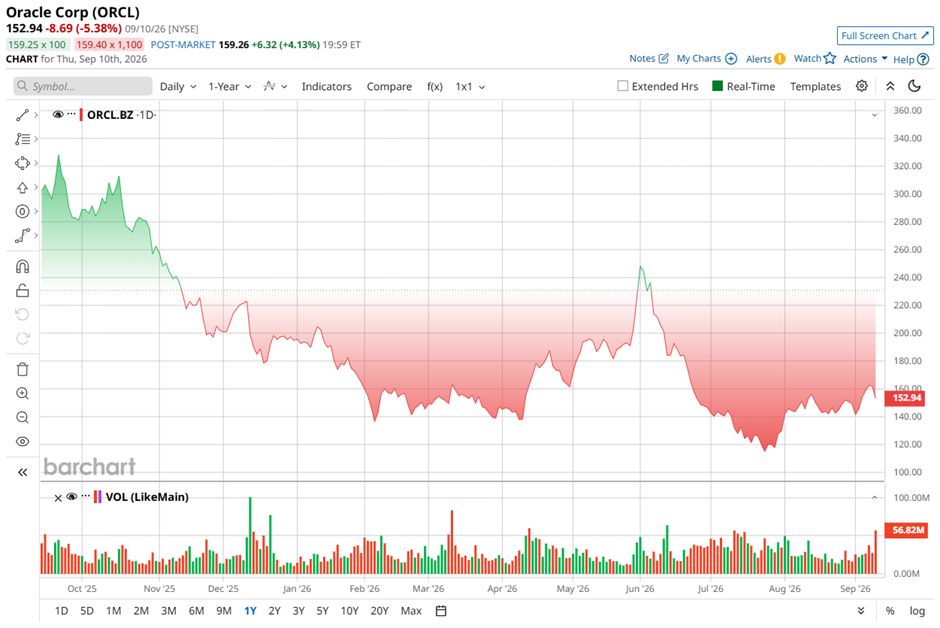
Investors certainly bought into that story last year, sending ORCL stock to a record $345.72 on Sept. 10, 2025. But the mood has changed dramatically since then. Shares are down nearly 56% from that peak and about 53.4% over the past 52 weeks, including a roughly 24% drop in the last three months.
The problem is not Oracle’s long-term opportunity as much as the price of pursuing it. Heavy AI infrastructure spending has pushed free cash flow deeper into negative territory, while debt has climbed sharply. Investor concerns have also been amplified by credit-rating downgrades and widening credit default swap spreads. Those worries intensified after the company’s Q4 FY26 results, when its spending outlook and deeper negative free cash flow raised fresh questions about its balance sheet.
Then came Oracle’s latest Q1 FY27 report, which showed negative free cash flow of $5.4 billion, compared with negative $362 million a year earlier, while total debt reached about $125 billion. Still, the market’s reaction was not entirely bearish. ORCL stock moved higher following the Q1 report, suggesting that investors were willing to look past the near-term cash burn and focus again on Oracle’s strong cloud and AI demand.
 www.barchart.com
 Oracle doesn’t look particularly stretched on valuation. ORCL trades at about 20.05 times forward non-GAAP earnings, a level that looks fairly modest compared with its own historical range and the broader sector. But investors aren’t just paying attention to the earnings multiple anymore — the balance sheet matters too. Oracle’s 2.8x debt-to-equity ratio and 5.25 interest coverage show that leverage is something investors can’t simply brush aside, especially if growth cools.
On the brighter side, shareholders still have a steady payout to lean on. Oracle has paid dividends for 16 consecutive years and increased them for 11 straight years. Its latest $0.50 quarterly dividend works out to $2 per share on an annualized basis, giving the stock a yield of roughly 1.24%.
On Sept. 10, the enterprise software giant rolled out its fiscal first-quarter 2027 numbers, generating revenue of $19.4 billion, up 29.6% year over year (YoY) and ahead of expectations, while non-GAAP EPS jumped 30% to $1.92, also beating estimates. Cloud revenue surged 62% to $11.6 billion, with cloud infrastructure more than doubling to $7.4 billion. Cloud Applications, or SaaS, was steadier, growing 10% to $4.2 billion.
The rest of the business was more mixed. Software revenue slipped about 3% to $5.55 billion as customers continued shifting from on-premises systems to the cloud. Services revenue increased 5% to $1.4 billion, while hardware revenue climbed 15% to $0.8 billion.
But the really interesting part of the quarter was what happened underneath those headline results. Demand for Oracle’s AI cloud training and inferencing services continues to run ahead of supply. The company booked more than $30 billion in additional AI cloud contracts during Q1, pushing remaining performance obligations (RPO) to a massive $664 billion. Oracle also delivered more than 300,000 GPUs to AI cloud customers since the end of Q4, nearly tripling the capacity delivered in the prior quarter.
That growth, however, comes with a hefty price tag. Capital expenditures jumped to $28.5 billion from $8.5 billion a year earlier, while Oracle delivered 850 megawatts of data-center capacity. Negative free cash flow widened to $5.4 billion, compared with $362 million a year earlier, and total debt reached about $125 billion.
Looking ahead, Oracle expects Q2 adjusted EPS of $1.85 to $1.93, with revenue growth of 30% to 34%. For fiscal 2027, management now expects adjusted EPS of $8.10 and at least $90 billion in revenue. Oracle is betting big on AI infrastructure, and investors are watching closely to see whether that enormous investment turns into equally enormous returns.
Analysts tracking Oracle expect the tech stock’s fiscal 2027 EPS to grow 3.2% YoY to $6.51, followed by a 38.7% surge to $9.03 in fiscal 2028.
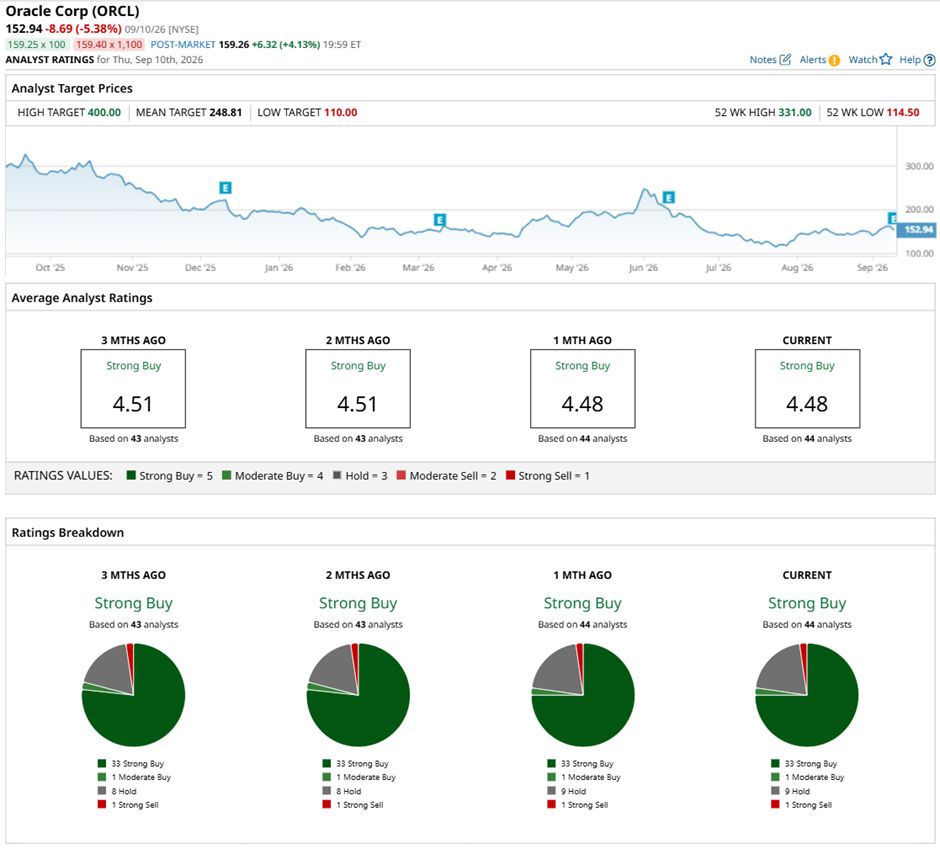
Overall, analysts are upbeat on ORCL, giving a consensus “Strong Buy” rating. Of the 44 analysts covering the stock, a majority of 33 analysts rate it a “Strong Buy,” one advises a “Moderate Buy,” nine are playing it safe with a “Hold” rating, and the remaining one is outright skeptical, with a “Strong Sell” rating.
The tech stock’s consensus price target of $248.81 implies 62.7% upside potential. Meanwhile, the Street-high target of $400 suggests the stock could rally as much as 161.5%.
 www.barchart.com
 Stock #2: Nebius
Nebius is building its business around one of the hottest corners of tech: the infrastructure needed to make AI actually work at scale. Headquartered in Schiphol, the Netherlands, the company operates a full-stack AI cloud, offering large GPU clusters, cloud services, and developer tools for training and deploying AI models. But there’s more to the story.
Nebius also owns TripleTen, a tech reskilling platform, and Avride, which focuses on autonomous driving and delivery robots. With NVIDIA backing its AI infrastructure push, Nebius is expanding across markets ranging from healthcare and finance to robotics and government. Led by founder and CEO Arkady Volozh, the company is also moving into AI supercomputing and now has a market capitalization of about $57.7 billion.
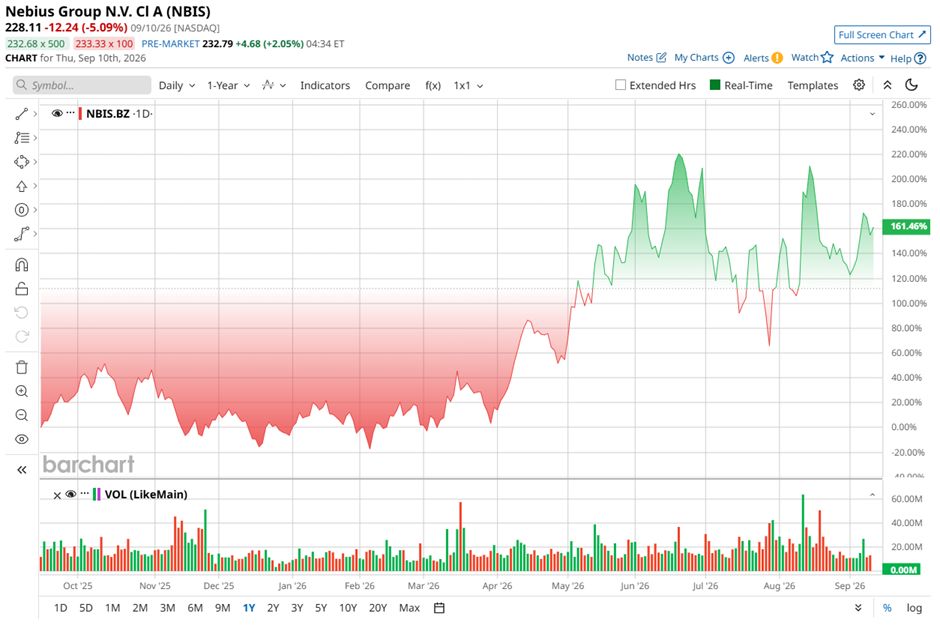
NBIS has been on quite a ride, and so far, investors who stayed strapped in have had plenty to cheer about. Over the past 52 weeks, the stock has soared 144.3%, while its 172.5% YTD gain puts it among the year’s standout AI plays. The rally really picked up steam after Nebius delivered a strong Q1 report in May and then earned a spot in the Nasdaq-100 in June. The stock rose further after the company released its Q2 earnings report, with NBIS jumping 34.1% on Aug. 12.
But no stock climbs a mountain in a straight line. After touching a record $299.86 on June 22, NBIS pulled back as investors took profits and worries grew that AI valuations had gotten ahead of themselves. Shares are now roughly 24% below that peak.
Lately, though, the bulls appear to be finding their footing again. A major partnership with Palantir, combined with upbeat commentary at the Goldman Sachs Communacopia + Technology Conference, has helped put the spotlight back on Nebius.
 www.barchart.com
 Valuation-wise, NBIS stock is priced at 18.7x forward sales, representing a premium to the sector average.
On Aug. 12, Nebius released its second-quarter results, generating revenue of $582.3 million, up 454% YOY, with Nebius AI Cloud accounting for $574.9 million, up 514% YOY and roughly 98% of total revenue. Its annualized run-rate revenue also jumped to $3 billion from $1.9 billion at the end of March.
The improvement was not just on the top line. Adjusted EBITDA swung to $236.2 million from a $21 million loss a year earlier, while AI Cloud produced $285.7 million of adjusted EBITDA, translating into a 49.7% margin. The group still posted an adjusted net loss of $33.2 million, but that was significantly narrower than the $91.5 million loss in Q2 2025.
Of course, building an AI cloud business doesn’t come cheap. Nebius invested about $5.7 billion in GPUs and data centers during the quarter, yet ended Q2 with $8 billion in cash, including $2.3 billion of operating cash flow. More importantly, customer demand is already providing some visibility — the company has more than $40 billion in customer commitments and signed four Q2 deals with average total contract values above $1 billion.
That momentum is also why management is not changing its 2026 outlook. Nebius reaffirmed its full-year guidance for $7 billion to $9 billion in annualized run-rate revenue, $3 billion to $3.4 billion in group revenue, and an adjusted EBITDA margin of about 40%. It still expects a hefty $20 billion to $25 billion in capex.
Management also expects capacity deployed late in Q2 to start contributing to revenue in Q3. And there’s already an eye on 2027, with new capacity being built around commitments already secured.
Analysts monitoring the company anticipate losses for fiscal 2026 coming in at $3.76 per share, widening by 112.4% YOY. Looking further ahead, fiscal 2027 loss per share is expected to narrow by 20.2% annually to $3.00.
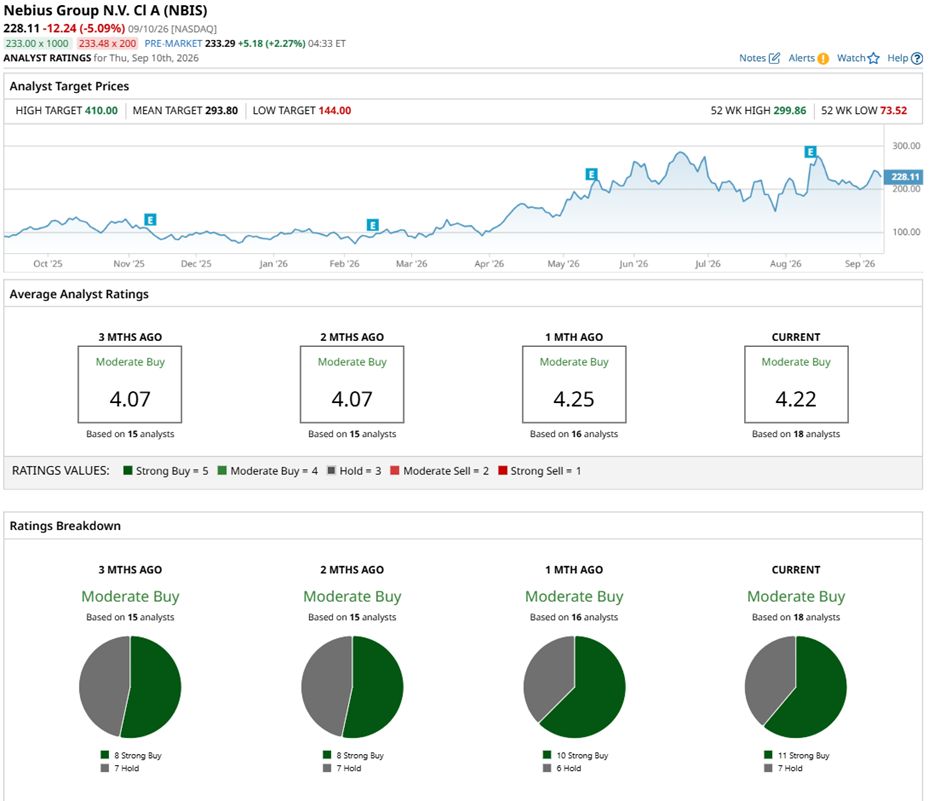
Overall, NBIS stock carries a consensus “Moderate Buy” rating. Among the 18 analysts in coverage, 11 suggest a “Strong Buy,” and seven analysts recommend a “Hold.”
The stock has a mean price target of $293.80, implying upside potential of 28.8% from the current price levels. The Street-high target of $410 suggests that NBIS stock could rise as much as 79.7%.
 www.barchart.com
 Stock #3: Palantir Technologies
Palantir Technologies has come a long way from its 2003 beginnings in Denver, where it was built around a simple idea: help governments make sense of complex data for national security. Today, its platforms — Gotham, Foundry, and the Artificial Intelligence Platform (AIP), launched in 2023 — turn scattered information into actionable intelligence for organizations across governments and industries. With operations spanning four continents and a market capitalization of about $398.6 billion, Palantir has evolved into a major mega-cap software company, positioning itself at the intersection of data, AI, and mission-critical decision-making.
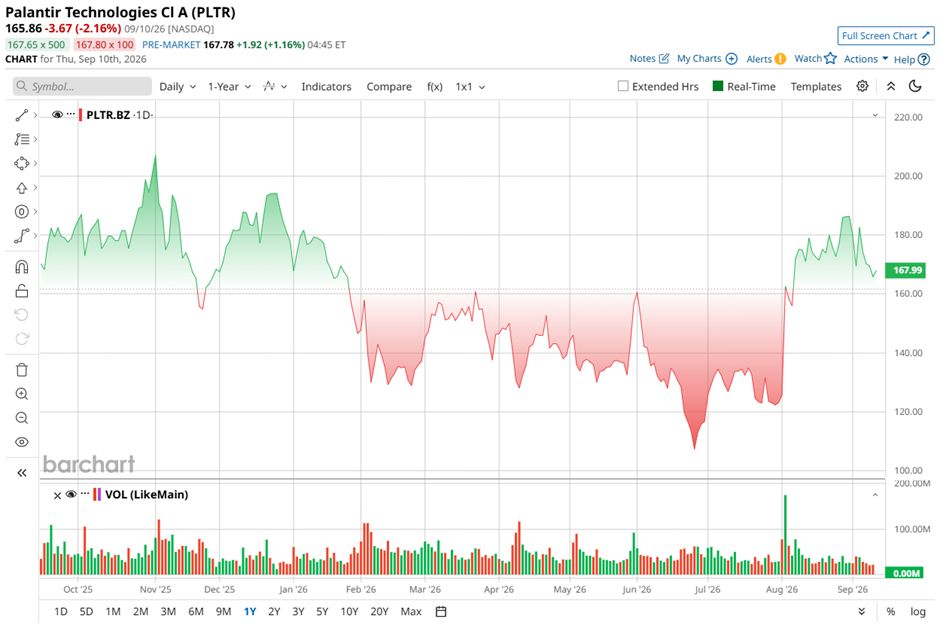
Palantir has given investors plenty of reasons to buckle up this year. After hitting a 52-week high of $207.52 last November, PLTR slid to $106.37 on June 25 before staging a sharp 56% rebound. Even after that comeback, shares remain about 20.1% below the peak. Over the past 52 weeks, the stock is down marginally and has slipped 6.7% YTD, but the three-month picture looks much brighter, with a 27.4% gain. Much of that spark came after Palantir’s blockbuster Q2 results, which sent shares nearly 30% higher.
Lately, though, the ride has hit another bump. On Sept. 2, PLTR dropped about 6% as Google unveiled its Fairwind Program and Gemini 3.8 Flash Cyber for trusted government and critical-infrastructure users. The market clearly saw that as a fresh competitive threat to Palantir’s government and defense AI turf.
Still, one rival doesn’t erase Palantir’s momentum. The company continues adding heavyweight relationships, including a larger alliance with PwC U.S., alongside partnerships with Nvidia, the U.S. Army, GNP Seguros, and Zeta Global.
 www.barchart.com
 Palantir’s numbers may be moving fast, but the stock price has arguably moved even faster. At roughly 105.4 times forward non-GAAP earnings and 49.8 times sales, PLTR is asking investors to pay a serious premium for that growth. That doesn't necessarily make the stock a bad bet, but it leaves little room for disappointment. In simple words, Palantir has delivered the growth, and now it has to keep delivering at a pace that justifies the price.
Palantir’s growth story is getting harder to ignore. In August, the company reported impressive Q2 numbers, generating revenue of $1.94 billion, representing growth of 93% YOY, which comfortably beat Wall Street’s expectations. U.S. revenue was even stronger, surging 115% to $1.57 billion, while U.S. commercial revenue nearly doubled, climbing 149% to $764 million.
And the deal flow backed up the numbers. Palantir closed 220 contracts worth at least $1 million, including 98 deals above $5 million and 73 topping $10 million. Profitability was equally impressive, with adjusted operating income reaching $1.19 billion, a 62% margin, while adjusted EPS of $0.41 topped estimates.
Management clearly liked what it saw, raising its FY2026 U.S. commercial revenue outlook to more than $3.42 billion, implying at least 134% growth. Its 155% Rule of 40 score further highlights the rare mix of explosive growth and profitability.
Wall Street expects earnings to keep growing, with fiscal 2026 EPS projected to skyrocket by 101.6% YOY to $1.27, followed by another 44.1% annual growth to $1.83 in fiscal 2027.
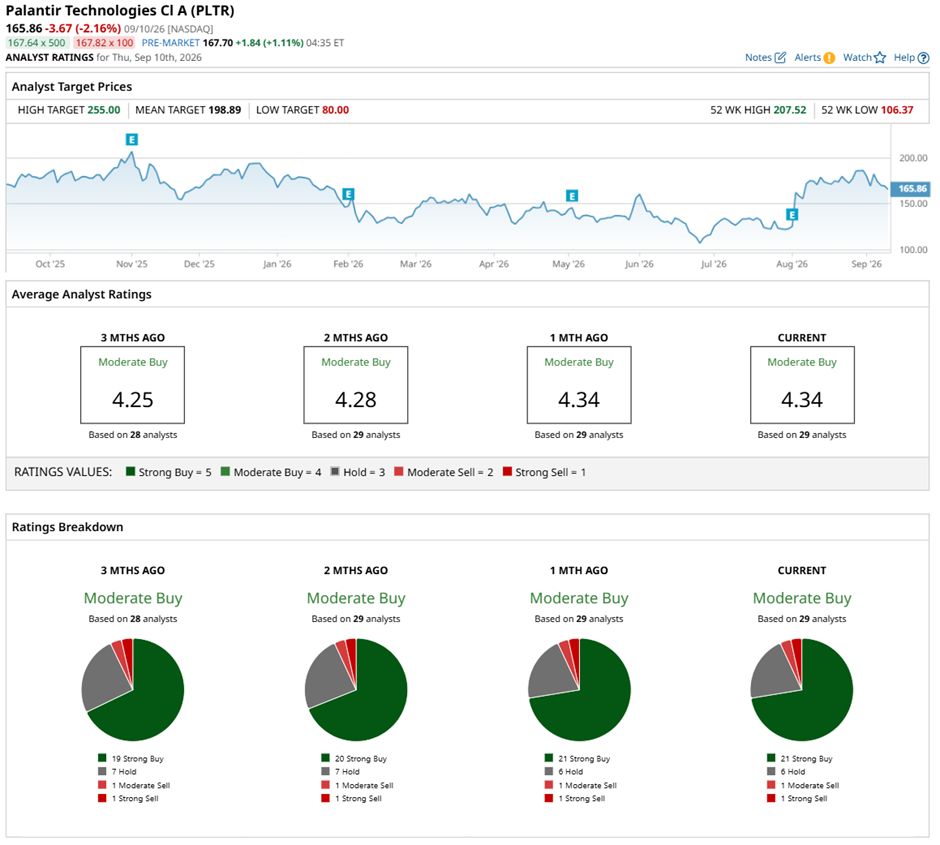
Palantir may be expensive, but Wall Street still sees enough growth to keep the bulls interested. The 29 analysts covering PLTR have a consensus “Moderate Buy” rating, with 21 calling it a “Strong Buy.” Six analysts are playing it safe with a “Hold,” while only two are bearish — one with a “Moderate Sell” rating and another with a “Strong Sell.”
PLTR’s average analyst price target of $198.89 implies the tech stock has upside potential of 19.9%. The Street-high target of $255 signals that PLTR can still rise as much as 53.7% from current levels.
 www.barchart.com
 On the date of publication, Sristi Suman Jayaswal did not have (either directly or indirectly) positions in any of the securities mentioned in this article. All information and data in this article is solely for informational purposes. For more information please view the Barchart Disclosure Policy here.
More news from Barchart
How to Play IBM Stock as It Teams Up with NASA to Launch a New Open-Source Model 3 Stocks to Bet Against If You Want to Invest Like Michael Burry You Can’t Spell SPY Without AI: How the Stock Market Became a 1-Way Bet on the Future Dear Nike Stock Fans, Mark Your Calendars for September 21