

The artificial intelligence (AI) trade suddenly had something new to worry about—what if the race to build bigger and better frontier models starts slowing down? That question rattled investors recently after Anthropic CEO Dario Amodei argued over the weekend for moderating the pace of model development. His comments, backed by OpenAI CEO Sam Altman and Elon Musk, quickly put AI infrastructure stocks under pressure as investors began wondering whether slower model development could eventually mean slower demand for the mountains of computing power behind AI.
Semiconductor and software powerhouse Broadcom (AVGO) was caught in that selloff, with shares falling 4.8% on Monday and another 1.6% on Tuesday. And there is a reason that investors were paying close attention—Anthropic is one of Broadcom’s key custom-chip customers and is expected to become its largest in 2027 and remain so in 2028.
More Top Stocks Daily: Go behind Wall Street’s hottest headlines with Barchart’s Active Investor newsletter.
But Broadcom CEO Hock Tan is not exactly losing sleep over it. Asked by CNBC whether the AI slowdown debate had changed his view of Broadcom’s fiscal 2027 and 2028 semiconductor outlook, Tan’s answer was blunt: “No, not in the least.” He pointed instead to what he sees as durable demand—not just for training frontier models, but for inference, the everyday computing power needed to actually run AI products at scale.
That distinction could be important. Even if the pace of frontier-model development cools, the AI industry still has a massive infrastructure bill to pay. For now, Tan sees plenty of demand still ahead. With the slowdown debate now hanging over the chip sector, let’s take a closer look at AVGO stock and what the numbers say about where Broadcom stands.
About Broadcom Stock
Broadcom has become a major force in the global semiconductor industry, even if its name is less familiar to everyday consumers. The company, based in San Jose, provides chips and infrastructure software that support data centers, cloud platforms, broadband networks, smartphones, and enterprise systems. Its semiconductor portfolio focuses heavily on connectivity, networking, and data processing, while its infrastructure software business adds another source of revenue and diversification.
Broadcom has emerged as a key beneficiary of the AI boom, with demand rising for its custom AI accelerators and high-speed networking solutions. These technologies help connect and power the large computing systems needed to train and run advanced AI models. With a market capitalization of about $1.6 trillion, Broadcom is now among the world’s most valuable technology companies.
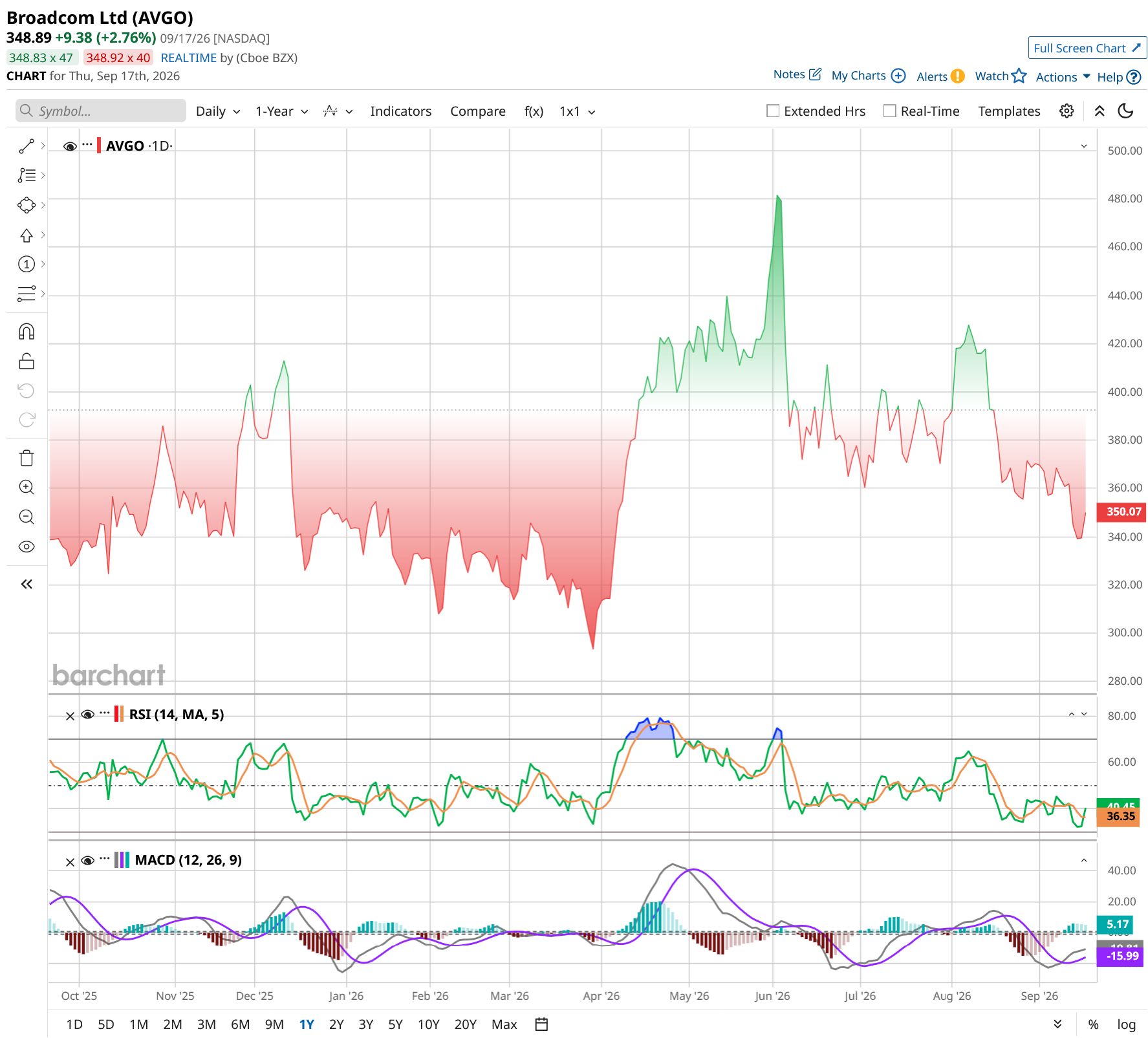
Broadcom’s AI story has been a pretty rewarding one for shareholders—at least until the stock hit the brakes. AVGO shares have climbed 114% over the past two years as demand for AI infrastructure has turned Broadcom into one of the semiconductor industry’s biggest beneficiaries. That run eventually pushed the stock to a record $495 in June.
Since then, though, the mood has changed. Shares have fallen 30% from that peak, including a 3.4% decline over the past five trading sessions. Monday’s drop came as semiconductor stocks were caught in a broader AI selloff after technology executives raised questions about the pace of frontier AI development. The concern is that if model development slows, could the enormous spending on data centers and AI infrastructure slow with it?
That question has left investors looking beyond Broadcom’s impressive growth numbers and asking how sustainable hyperscaler spending will be. The technical picture reflects that caution. Trading volume has been relatively weak, while the 14-day RSI sits around 34, putting the stock near oversold territory. At the same time, the MACD has crossed above its signal line, with the histogram turning positive—a small technical bright spot in an otherwise cautious setup.
 www.barchart.com
 After such a big run, it is natural for investors to look at AVGO’s price tag and wonder whether the stock has gotten ahead of itself. Broadcom trades at about 43 times forward GAAP earnings and roughly 15.3 times forward sales, both representing premiums to the broader sector. That said, the earnings multiple remains below the stock’s historical median, giving the valuation a little more context.
The premium also comes with a growth story behind it. Management expects solid AI revenue growth in the future, while Broadcom’s relationships with major hyperscalers, including Meta (META) and Alphabet’s (GOOG) (GOOGL) Google, give it exposure to continued data center spending.
Then there’s the dividend, which adds another piece to the puzzle. Broadcom has raised its payout for 15 consecutive years and currently pays $2.60 per share on an annualized basis, translating to a modest 0.77% yield. With a payout ratio of 26.6%, the company retains plenty of earnings for investment while still returning cash to shareholders.
A Snapshot of Broadcom’s Q3 Numbers
Broadcom’s latest quarterly results signaled that the AI infrastructure spending story is still moving at a serious pace. In its fiscal third quarter, reported on Sept. 2, Broadcom posted revenue of $29.6 billion, an 86% year-over-year (YoY) jump that beat Wall Street's expectations. The semiconductor business was impressive, with Semiconductor Solutions revenue surging 127% to $20.8 billion, or about 70% of total sales. Infrastructure Software was no slouch either, growing 29% to $8.8 billion.
AI semiconductor revenue skyrocketed 221% YoY and 54% sequentially to $16.7 billion. Broadcom said XPU shipments grew more than 3.5 times from a year earlier, while AI networking revenue more than doubled. That kind of growth also flowed through to the bottom line. Non-GAAP operating income jumped 92% to $20.1 billion, while non-GAAP EPS climbed 96% to $3.32.
The cash picture was just as striking. Operating cash flow nearly doubled to $14.2 billion, while free cash flow rose 95% to $13.7 billion. During the quarter, Broadcom paid $3.1 billion in dividends, cut long-term debt by roughly $5 billion, and finished with $24 billion in cash and cash equivalents. Capital expenditures were relatively modest at $532 million.
And management is not exactly tapping the brakes. For fiscal Q4, Broadcom expects revenue of $34.8 billion and non-GAAP operating income equal to 66% of revenue. Semiconductor revenue is projected at roughly $26.1 billion, including $21.7 billion from AI semiconductors, up 236% YoY. If that happens, full-year fiscal 2026 AI semiconductor revenue would reach about $58 billion, up 186% and ahead of the company’s previous forecast.
AI semiconductor revenue is anticipated to reach approximately $115 billion in fiscal 2027 and $230 billion in 2028. Management says current demand is actually running above its fiscal 2027 outlook, although the timing of deployments depends on data center readiness, leading-edge silicon, substrates, and memory availability.
For fiscal 2026, analysts see revenue reaching $106 billion, with EPS jumping 84% annually to $10.36. Better yet, earnings are expected to take another big step higher in fiscal 2027, rising 68.53% YoY to $17.46 per share.
What Do Analysts Expect for AVGO Stock?
Piper Sandler sees plenty of runway left for Broadcom’s AI business. The brokerage recently initiated coverage on AVGO stock with an “Overweight” rating and a $460 price target, pointing to the company’s leadership in ASIC chips for AI inference, where it holds an estimated 75% market share. Most hyperscalers and AI labs also work with Broadcom on ASIC co-design. Broadcom is ramping Meta’s MTIA and OpenAI’s Jalapeño chips, along with products for two other customers.
Its networking attach rate is around 30%, supporting $20 billion-$30 billion of content per gigawatt. The brokerage firm sees 12 gigawatts of fiscal 2027 demand, rising to 38 gigawatts by fiscal 2030, and estimates roughly 51% EPS CAGR through 2030.
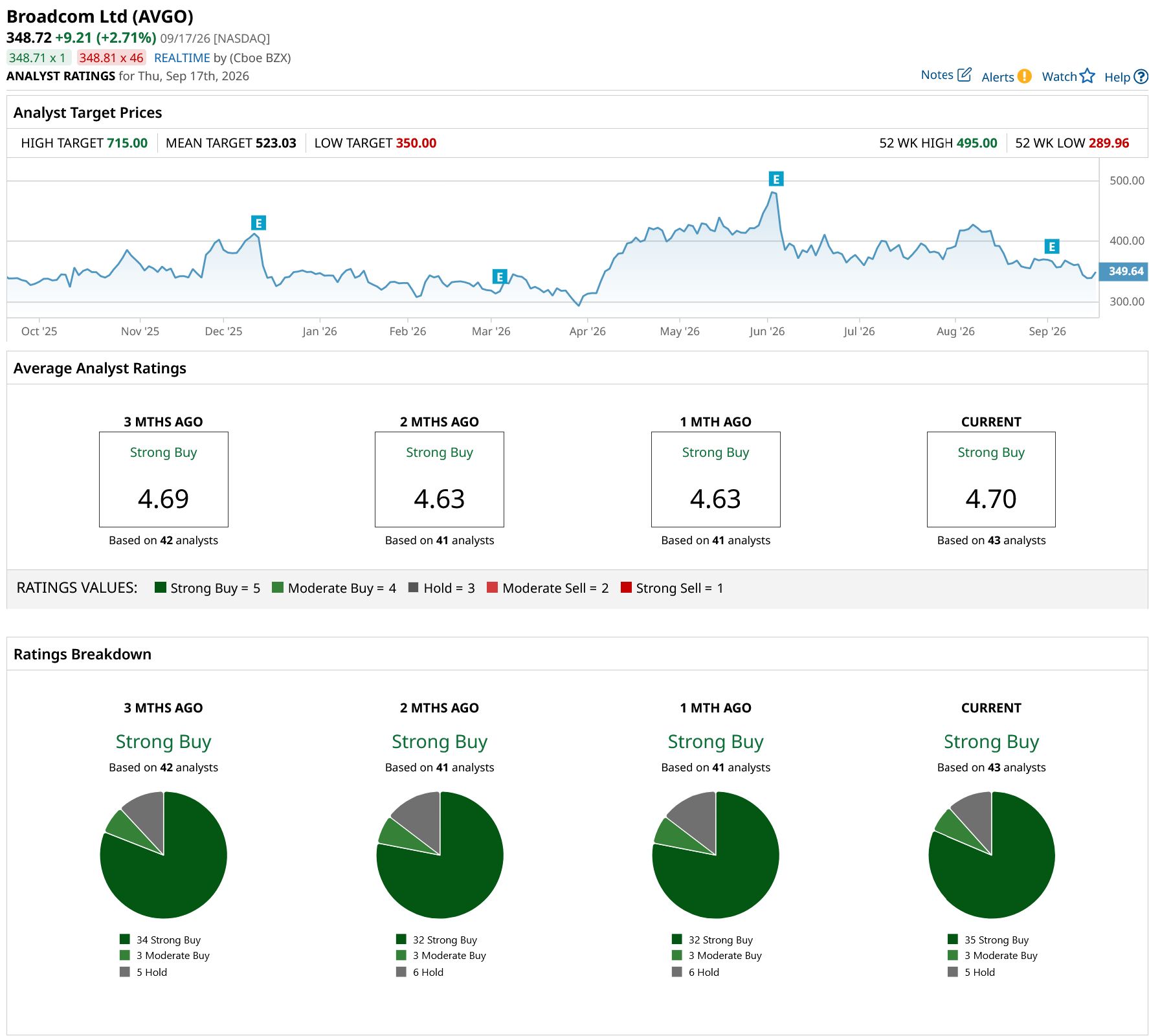
Wall Street remains optimistic on AVGO stock, with the shares carrying an overall “Strong Buy” rating. Of the 43 analysts tracking the stock, 35 back it with a “Strong Buy,” and three have a “Moderate Buy,” while just a handful of five sit on the sidelines with a “Hold” rating.
AVGO’s average target price of $523.03 suggests 50% upside potential from here. Yet the Street’s highest $715 price target hints that the stock could rise as much as 105%. In addition to bullish analysts’ sentiments, for investors, the CEO’s upbeat view could matter as much as the headline growth numbers, especially if Broadcom continues to deliver on its AI targets.
 www.barchart.com
 On the date of publication, Sristi Suman Jayaswal did not have (either directly or indirectly) positions in any of the securities mentioned in this article. All information and data in this article is solely for informational purposes. For more information please view the Barchart Disclosure Policy here.
More news from Barchart
Wall Street May Have Overpriced the Fed Rate Hike’s Impact on Citigroup Stock Spreads Broadcom CEO Hock Tan Says He Isn’t Worried – ‘No, Not in the Least’ – About AVGO as AI Extinction Fears Rattle Stocks I Sold Micron Before Q2 Earnings and It Fell 23%. Here’s Why I'm Buying Before the Next Report. Nvidia, OpenAI, and Oracle's $745B Financing Circle Just Hit Its First Stress Test: A Fed Rate Hike