

IonQ (IONQ) is a quantum computing company whose stock has been a favorite among speculative buyers and high-volatility traders, thanks to its high beta (3.30 over the last 60 months) and news-driven price action. It’s not uncommon to see the stock swinging by double-digit percentages around news, earnings, partnership announcements, or sector sentiment shifts.
But today, we have a rare event.
Can’t Get Enough Options?: Join the list for Barchart’s daily unusual options report, delivered free.
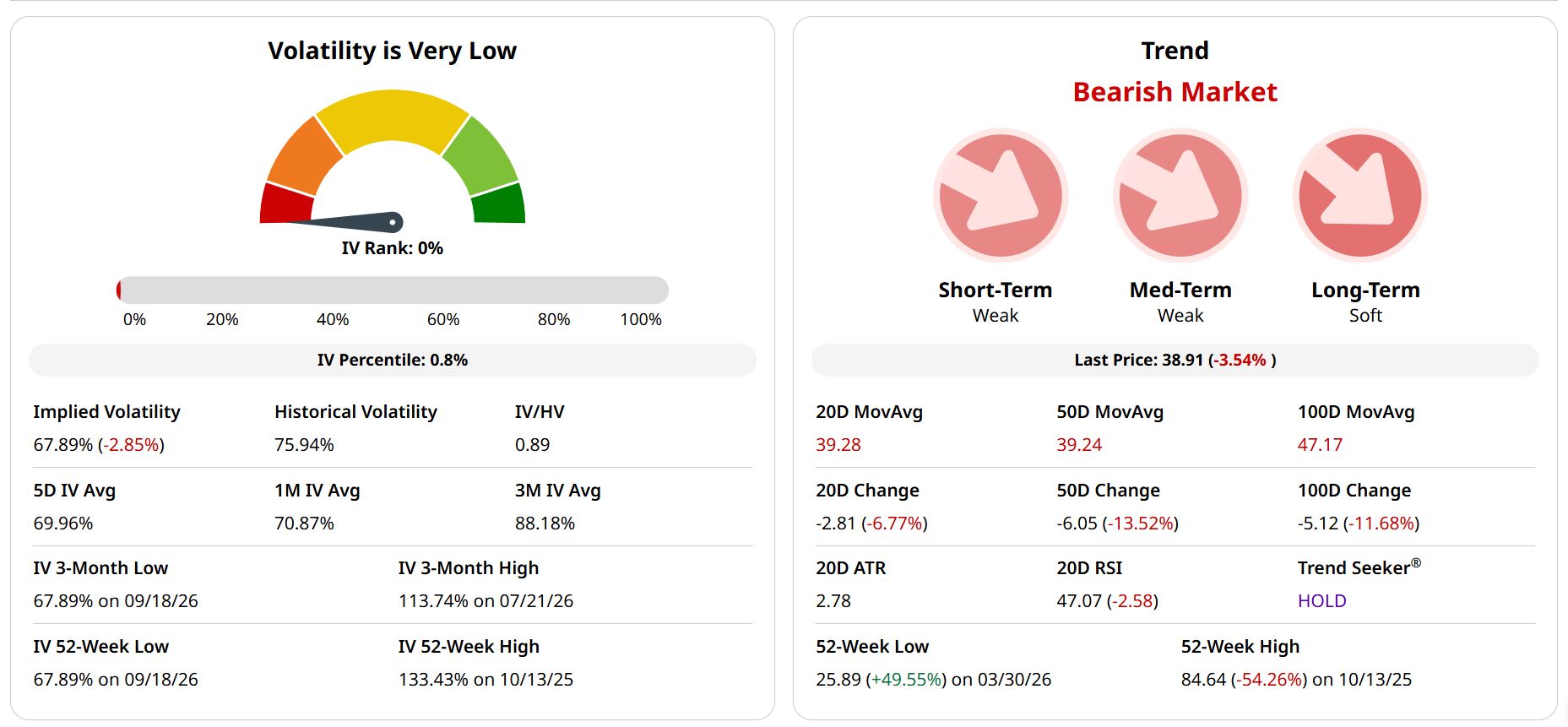
IonQ, the volatile quantum stock, is now sitting at 0% IV rank. That means options on IONQ are priced much cheaper than they have been historically, creating an opportunity to go long.
 Screenshot courtesy of www.barchart.com
 But which option strategy should you use?
Well, based on Barchart Technical Opinion and Trendseeker, the outlook is grim, making long puts a viable choice. Today, I’ll break down the strategy and help you find a trade that matches the trend.
Long Put Explained
A long put is one of the simplest bearish options trades. It’s a single-legged trade that makes money when the stock falls.
The trade mechanics are simple. You buy a put that gives you the right, but not the obligation, to sell 100 shares of the underlying asset at a certain price (strike price) on or before a specific date (expiration date). You pay a premium for the put, which is typically expressed on a per-share basis.
The only money you stand to lose on a long put is the premium you paid at the start. For a volatile name like IONQ, that defined, limited risk profile is a big part of the appeal versus betting against the stock directly.
Why IV Rank Matters When Trading Options
But before I find long put trades on IONQ, I need to explain why that 0% IV rank matters so much to the trade thesis.
Implied volatility (IV) is one of the main factors that move option premiums. IV is essentially the market's forecast of how big the stock's swings will be going forward, baked into the option's price.
Higher IV means higher option premiums, which typically benefits sellers. Low IV, meanwhile, favors buyers because options are cheaper.
Now, you might notice that IonQ’s implied volatility is actually 68%. That’s not low by standard measures.
That’s where IV rank’s value becomes clear. IV rank tells you where a stock's implied volatility sits compared with its own range over the past year. It's measured on a scale of 0% to 100%.
IV rank helps you determine which is which. Even if IonQ’s IV is 68%, IV rank tells you it’s the lowest it's been this past year. And since a low IV relative to the stock’s history means lower premiums, a long put makes even more sense, especially if you’re bearish.
Finding Long Put Trades
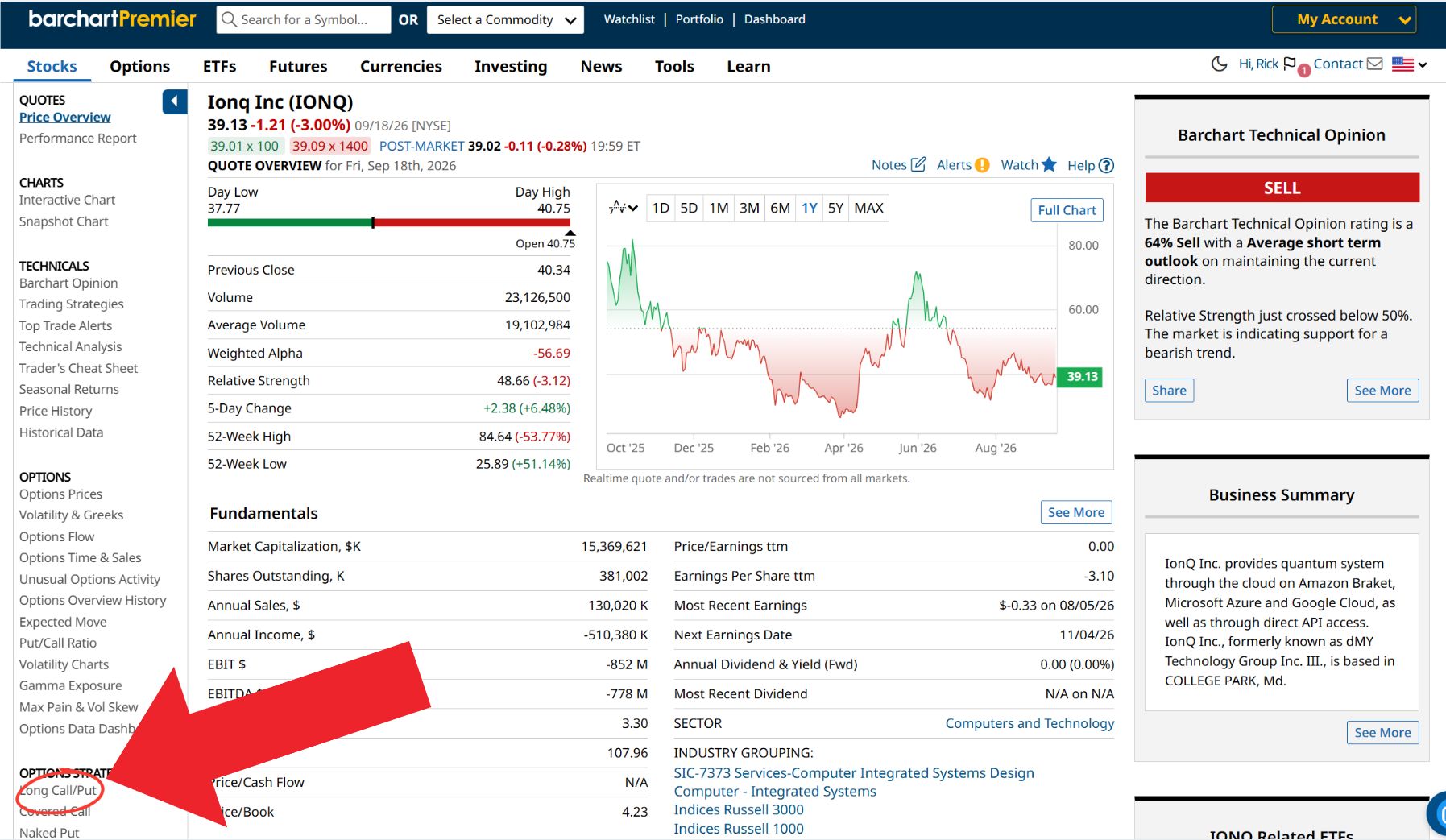
To find long put trades, go to Barchart and find the stock page you want. From there, you can see Long Call/Put under the Options Strategy menu right here, then click the Long Put tab.
 Screenshot courtesy of www.barchart.com
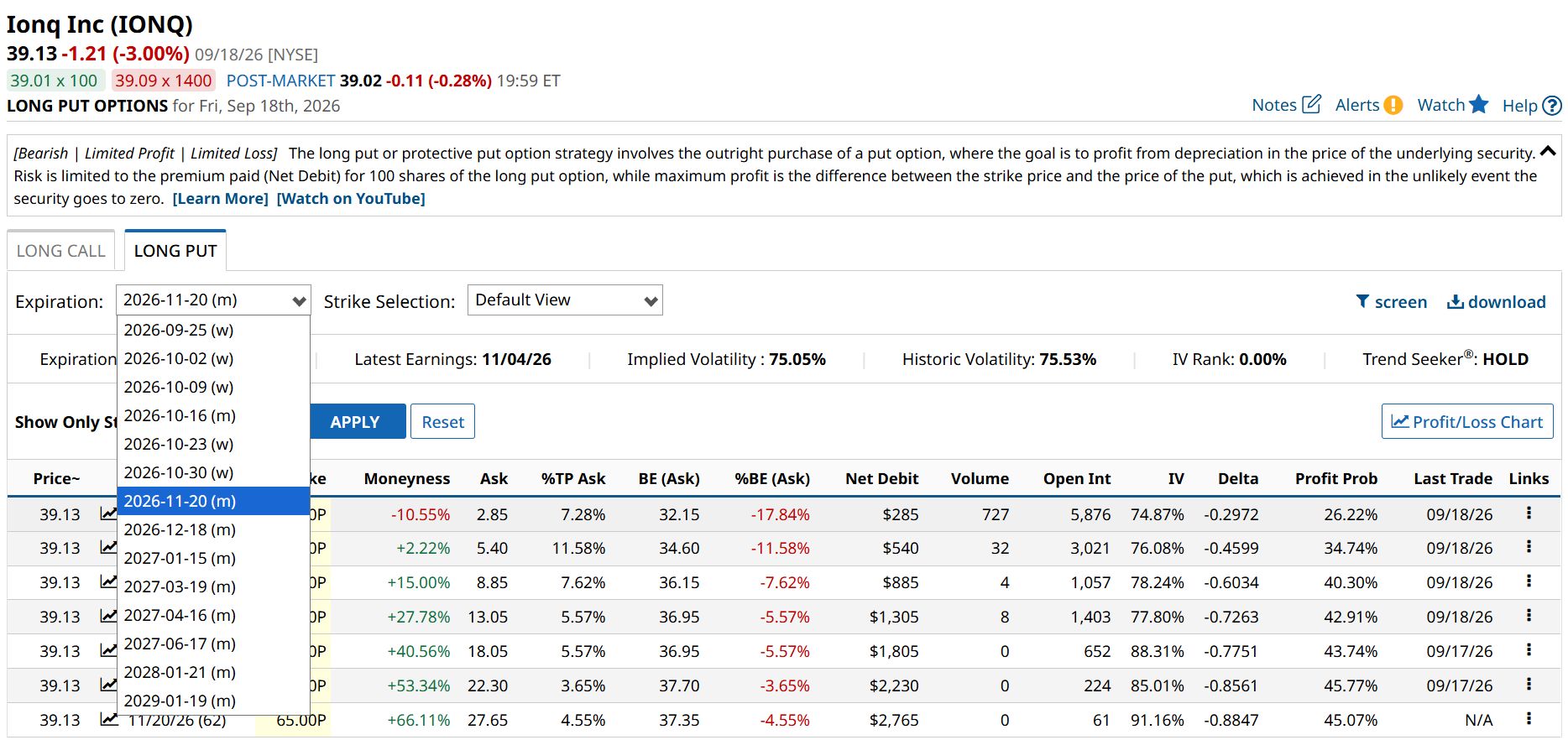
 Next, choose an expiration date. For long puts, giving the trade more time is typically preferable, though it does come with a bigger price tag. But again, since IV rank is so low, the premiums won’t be that expensive.
So, I’ll choose the November 20, 2026 expiration date here from the dropdown.
 Screenshot courtesy of www.barchart.com
 Now, to take advantage of the relatively low prices due to low IV rank, I’d choose an at-the-money (or near-the-money) put - around a $40 strike price.
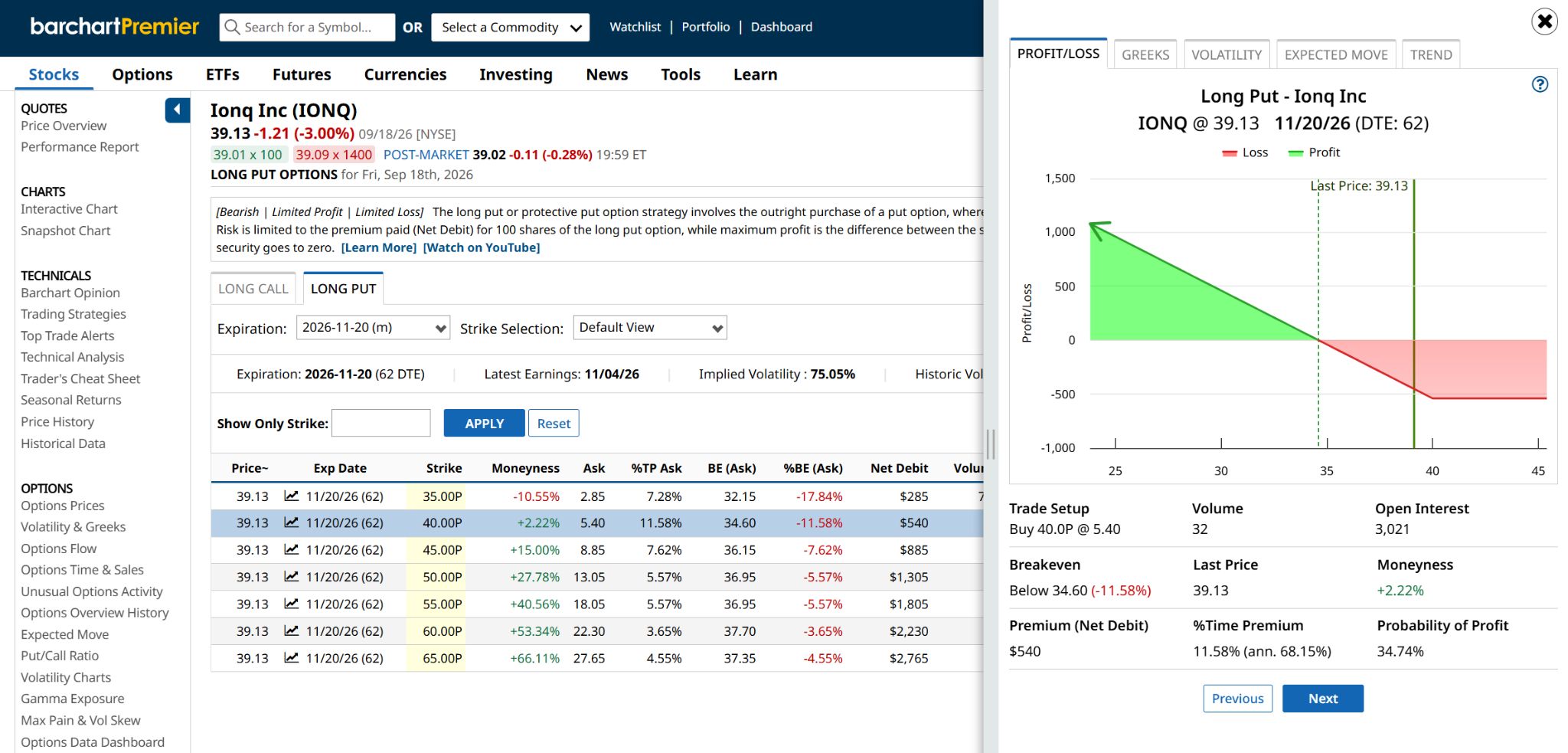 Screenshot courtesy of www.barchart.com
 According to the screener, I can buy this $40 strike long put for $5.40 per share, or $540 total. If IonQ stock trades below $34.60 per share by expiration, I’ll make money.
Now, long puts don’t typically have a high probability of profit, unlike when selling options. That’s because the stock has to move for the trade to be profitable. When selling puts, you just need it to stay above the strike.
But in favor of this trade, IonQ has an earnings release on November 4, 2026, which means implied volatility and IV rank will likely start rising as that day approaches. Market events like these tend to increase volatility due to uncertainty, which could increase the put's value beyond the stock’s own price move.
Final Thoughts
To be clear, though, a 0% IV rank doesn’t mean IV will immediately rise. It can still go lower, and the lows can last for an extended period. That’s why this strategy still depends primarily on getting the direction right, with rising volatility around earnings serving as a bonus.
In any case, always perform your due diligence, and trade within your risk tolerance.
On the date of publication, Rick Orford did not have (either directly or indirectly) positions in any of the securities mentioned in this article. All information and data in this article is solely for informational purposes. For more information please view the Barchart Disclosure Policy here.
More news from Barchart
IonQ's Options Are the Cheapest They've Been All Year. Here's the Trade That Takes Advantage. Warby Parker’s Unusual Options Activity Points to a Covered Call Bet: Bullish on Growth, Cautious on Valuation Alphabet Stock Stays Flat - Ideal for GOOGL Short Put and Put Credit Spread Plays Unusual Options Activity: Institution Bets Big on XP With Moonshot Bull Call Spread