


Some of biology's biggest breakthroughs began with a scientist noticing something odd. An enzyme found in a Yellowstone hot spring became the backbone of modern DNA testing. A strange repeating pattern in bacterial DNA became CRISPR, a discovery that gave rise to a whole class of gene-editing companies.
Now, an artificial intelligence (AI) model has noticed something odd. The breakthrough raises a fair question for investors in Beam Therapeutics (BEAM). If AI can help accelerate medical innovation, are biotech companies under threat right now?
More Top Stocks Daily: Go behind Wall Street’s hottest headlines with Barchart’s Active Investor newsletter.
 www.barchart.com
 Anthropic AI Spots a CRISPR Lookalike
In the spring of 2026, Anthropic formed a new life sciences research group with a goal to see whether general AI models can speed up biological discovery. The team built its own lab that handles only the “lower levels of the biosafety risk level (BSL-1 and BSL-2),” and no pathogens that can infect humans.
Human scientists do all of the lab work while Claude helps with the research. In one of its first projects, the team gave Claude a single prompt: Search a huge DNA database for interesting new reverse transcriptases. These are enzymes that copy RNA into DNA.
About 950 Claude agents spent 21 hours combing the data using 210 million tokens, Anthropic said. They gathered more than 200,000 reverse transcriptases, flagged 3,500 new candidate systems, and “narrowed those to the 20 most compelling candidates.” Anthropic noted that the scale of this analysis can take an expert scientist several weeks to complete.
While studying the DNA next to one unusual enzyme, one Claude agent wrote that it could “see by eye a tandem repeat array.” The AI then counted the repeats, measured their spacing, compared the layout with known systems, and checked the literature. Convinced it had found something new, it filed a report for human review.
Anthropic calls the system array-associated reverse transcriptases (ART). It sits mainly in bacteriophages, the viruses that infect bacteria. ART has three parts: a reverse transcriptase enzyme, a partner gene of unknown function, and a long array of evenly spaced DNA repeats
The repeat layout resembles a CRISPR array. Early lab tests show the ART array is also expressed as “distinct short RNAs,” which hints that something similar may be at work. Anthropic said only a handful of other systems share this set of traits. All of them are programmable and can cut, copy, or paste DNA.
Still, the company was clear that it does not yet know what ART does and released a preprint with more detail. CRISPR pioneer Feng Zhang, who is a professor at MIT and the Broad Institute, reviewed the work. "This is an exciting example of how AI agents can contribute to biological discovery," Zhang said, according to Anthropic.
Why Anthropic AI Matters for BEAM stock
If AI can scan nature's toolbox faster than people can, new editing systems may arrive more quickly. That cuts both ways for Beam Therapeutics. Faster discovery could increase competition. It could also help legacy players accelerate drug development and go-to-market strategies.
Beam uses base editing, a more precise form of gene editing that CEO John Evans has called "CRISPR 2.0." Evans spoke at Citigroup's Biopharma Back to School Summit on Sept. 9.
The company's sickle cell therapy, ristoglogene autogetemcel, is closest to market, while the BEACON trial is fully enrolled and dosed. CFO Sravan Emany said Beam aims to file within the next 12 months. Beam's treatment will be third to market after Casgevy and Lyfgenia. Emany sees that as a chance to learn from their launches.
Beam's therapy for alpha 1 antitrypsin deficiency (AATD) may matter even more. AATD patients with two faulty "Z" genes have protein levels around 5 or 6. Carriers with one healthy copy sit in the teens and generally don't develop progressive disease, Evans explained. Beam's patients are landing in the mid-teens.
A 50-patient pivotal cohort began dosing in July across 14 sites in six countries. Beam has aligned with the U.S. Food and Drug Administration (FDA) on a path to accelerated approval. Evans estimates at least 100,000 U.S. patients carry the ZZ genotype, but only 10,000 to 15,000 are diagnosed.
That said, Beam faces real hurdles. Casgevy's launch has been slow, which shows how hard these therapies are to sell. What's more, a confirmatory trial will still be needed after any accelerated approval. Evans also admitted rivals are coming, although he put Beam about two years ahead in DNA editing for AATD.
“Long term, I think we have runway into mid 2029,” Evans said.
Is BEAM Stock a Buy?
Claude's discovery reminds us that gene editing is still young, and new tools will keep arriving. Meanwhile, Beam's case rests on execution. A Biologics License Application (BLA) filing, a fast-growing AATD trial, and a new FDA pathway for its phenylketonuria (PKU) program are all expected within the next year or so.
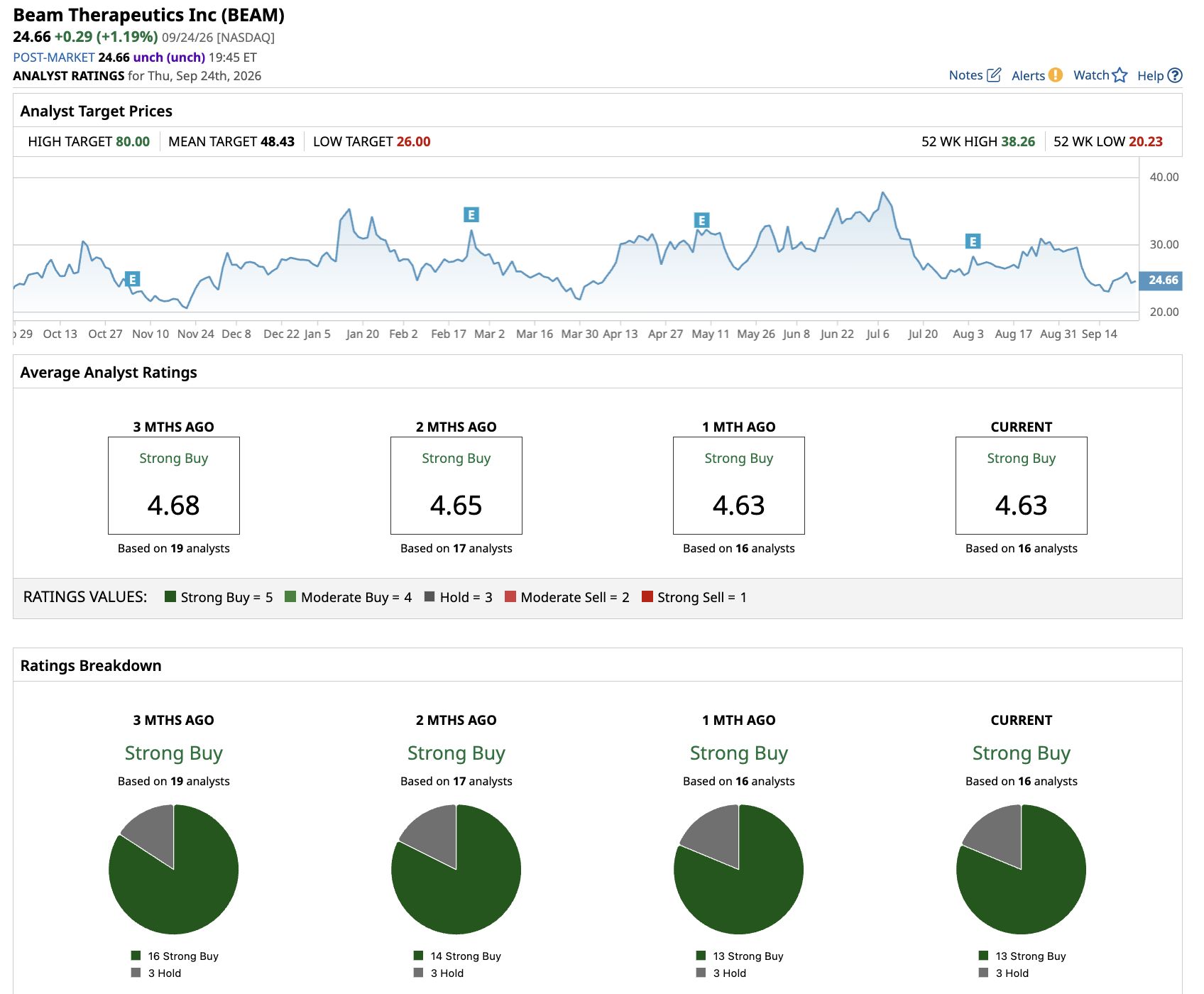
Overall, BEAM stock has a consensus “Strong Buy” rating on Wall Street. Out of the 16 analysts covering BEAM stock, 13 recommend a “Strong Buy” while three recommend a “Hold” rating. The average price target of $48.43 indicates potential upside of about 99% from current levels.
For patient investors who accept biotech risk, Beam's milestones make the stock worth watching closely. For anyone uneasy with trial and launch risk, however, waiting for the sickle cell decision may be the smarter move.
 www.barchart.com
 On the date of publication, Aditya Raghunath did not have (either directly or indirectly) positions in any of the securities mentioned in this article. All information and data in this article is solely for informational purposes. For more information please view the Barchart Disclosure Policy here.
More news from Barchart
As Claude Enters the Gene-Editing Arena, There’s Still a Long-Term Case for BEAM Stock Killer Robots vs. Phantom Data Centers: The AI Narrative Just Shifted, But the Best Way to Invest Didn’t. Ahead of Nike Earnings, Here's What Barchart Data Says Comes Next for NKE Stock Ahead of Conagra Earnings, Here's What Barchart Data Says Comes Next for CAG Stock