

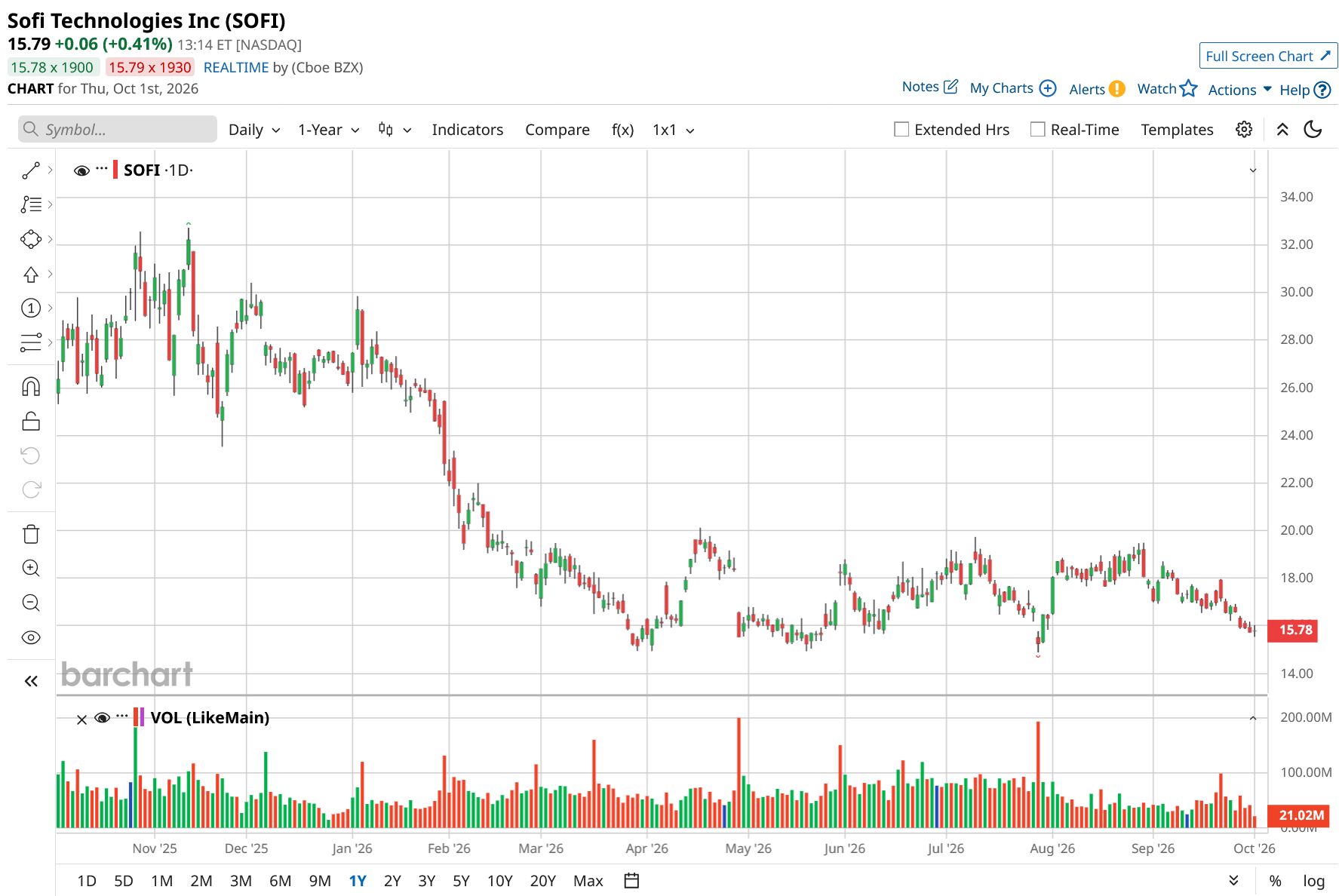
SoFi Technologies' (SOFI) stock has taken a significant hit this year. Its shares are down about 40% year-to-date (YTD) and now trade roughly 52% below their 52-week high.
A big reason behind SoFi’s weak stock performance has been concerns about its changing revenue mix. Notably, investors cheered SoFi’s focus on diversifying its revenue mix and generating solid non-lending revenue. However, over the past few quarters, the company has become increasingly dependent on its lending business.
More Top Stocks Daily: Go behind Wall Street’s hottest headlines with Barchart’s Active Investor newsletter.
Lending is an important part of SoFi’s growth story, but it requires more capital and carries greater credit risk than its other businesses. Those concerns became more noticeable in the second quarter. SoFi’s lending business continued to grow faster than its non-lending operations, which made investors more cautious about the company’s ability to diversify its revenue.
In Q2, SoFi generated $1.2 billion in adjusted net revenue, up 40% from the same period last year. Its Financial Services and Technology Platform businesses contributed $551 million, or about 46% of total adjusted net revenue. That’s a noticeable change from the end of 2025, when these non-lending businesses represented around 57% of SoFi’s total revenue.
Interest rates have become another headwind. Expectations for benchmark rate cuts have changed, with the market now considering the possibility of rates staying higher for longer or even moving higher. That creates an additional challenge for fintechs like SoFi.
Despite the notable correction in SOFI stock, its business remains solid and is booming. The company is continuing to grow at a strong pace, and its non-lending businesses have plenty of room to expand.
 www.barchart.com
 SOFI Stock Has Multiple Catalysts
SOFI stock has taken a major hit, but the company’s business continues to grow rapidly. Moreover, SoFi has multiple catalysts that could help the stock recover swiftly.
One of the biggest positives is SoFi’s continued growth in members and customer engagement. The company added 1.1 million members in Q2, taking its total membership to 15.8 million, up 35% from a year earlier. At the same time, customers opened a record 2.2 million new products, bringing the total to 24.4 million, up 42% year-over-year (YoY).
What’s especially encouraging is that customers are using more than one SoFi product. As product adoption increases, the company can generate more revenue from each customer while spending less to acquire new ones. In other words, SoFi is getting more value from its existing customers, which can improve the company’s efficiency as it grows.
Cross-selling is becoming an increasingly important part of that story. In Q2, more than 51% of new products were opened by existing members, compared with 43% in Q1. That suggests customers are becoming more engaged with the broader SoFi ecosystem and are increasingly willing to use multiple financial products from the company.
Lending remains a major revenue source for SoFi, but the company is also working to build other revenue streams. Fee-based revenue reached $472 million in Q2, accounting for 39% of total net revenue. This growth was supported by higher loan originations, the expansion of its loan platform services, increased interchange revenue, stronger trading activity, and growth in its technology platform business.
The loan platform business (LPB) is particularly interesting because it lets SoFi earn fees without keeping the loans on its balance sheet. That makes the business relatively capital-light and gives SoFi a way to generate revenue without committing as much capital as it would through traditional lending.
The LPB business also has room to grow. By adding new loan products to the platform, SoFi can create additional fee income while also giving itself more opportunities to cross-sell products to customers.
Over the long term, management expects these capital-efficient, fee-based businesses to contribute more than 50% of SoFi’s total revenue. If that happens, it could significantly change the company’s revenue mix. A greater reliance on fee income would reduce SoFi’s dependence on lending, improve capital efficiency, and potentially make its earnings less vulnerable to changes in the broader economic environment.
SOFI Stock Appears Too Good to Ignore
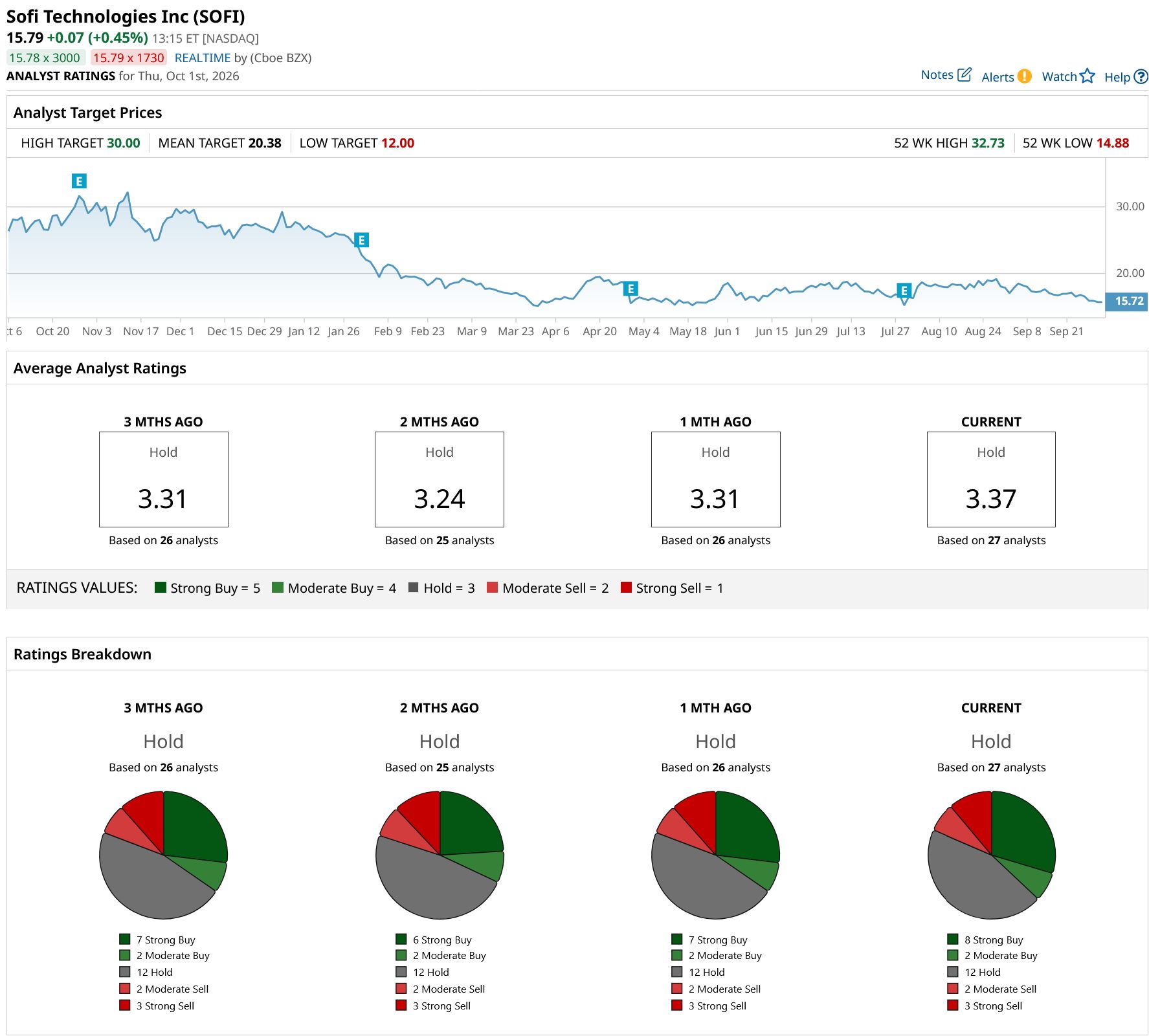
The significant decline in SOFI stock reflects concerns about its growing reliance on lending, which explains why analysts have a “Hold” consensus rating.
However, its business continues to expand rapidly, supported by strong member growth and rising product adoption. The LPB and broader cross-selling opportunities further improve capital efficiency and diversify earnings over time.
While execution and credit risks remain, the sharp correction in SOFI stock has created a more attractive risk-reward setup as the company is steadily shifting toward a more diversified, capital-light revenue model.
 www.barchart.com
 On the date of publication, Amit Singh did not have (either directly or indirectly) positions in any of the securities mentioned in this article. All information and data in this article is solely for informational purposes. For more information please view the Barchart Disclosure Policy here.
More news from Barchart
SoFi Stock: Why the Opportunity May Be Too Good to Ignore Dear Apple Stock Fans, Mark Your Calendars for October 13 A Nearly $12 Billion AI Deal Could Be Another Reason to Buy Nvidia Stock UiPath Gets Hit With Downgrade Following Investor Day. Why Analysts Weren’t Impressed.