

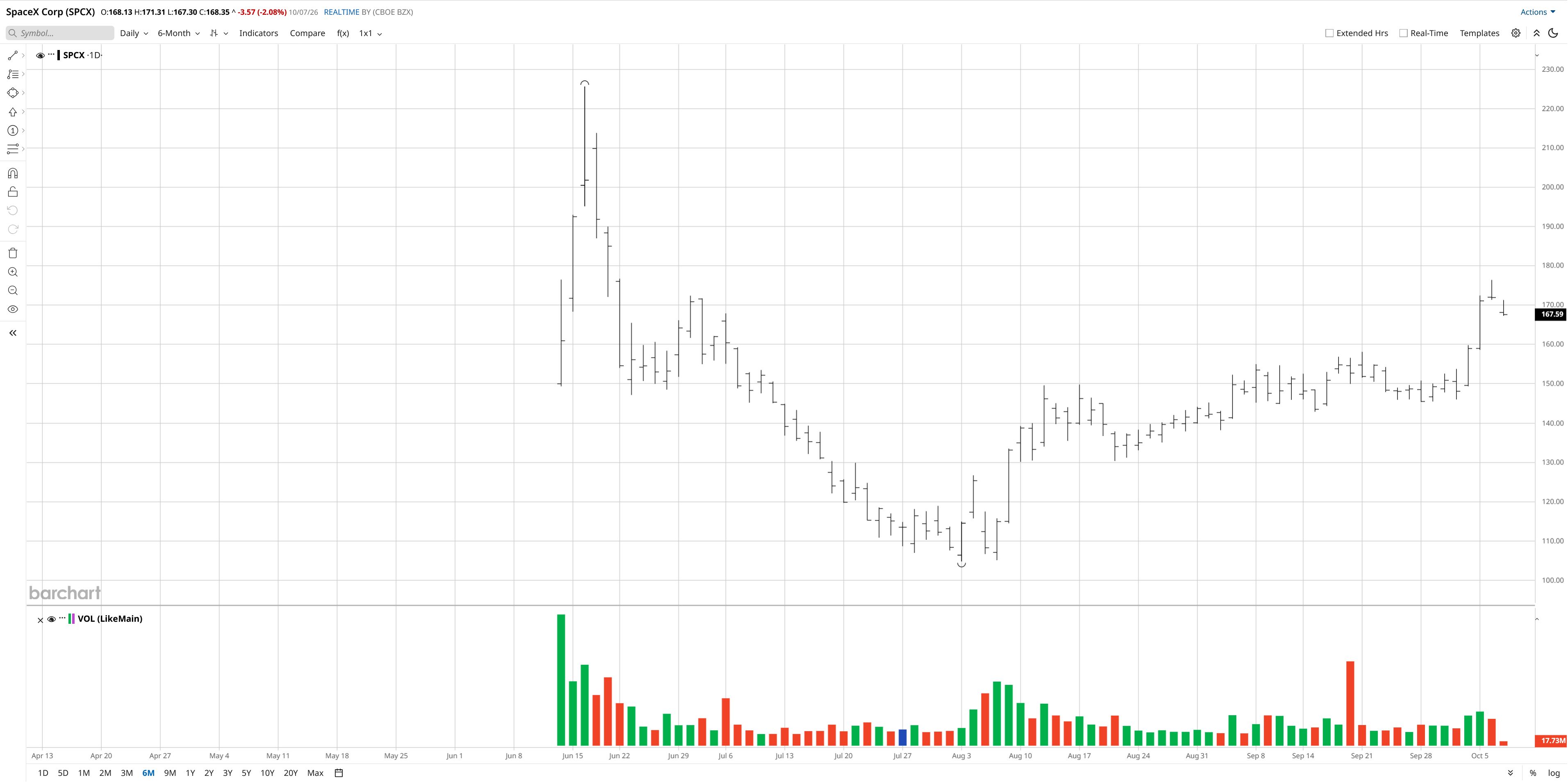
The rally of SpaceX (SPCX) stock appears to be partly based on notes from Morgan Stanley and Goldman Sachs that may be overly bullish. Specifically, Morgan Stanley seems to be meaningfully underestimating the stock's valuation, while both investment banks could be overestimating its growth outlook. Meanwhile, SpaceX CEO Elon Musk recently announced a name change that could help the company in the short-to-medium term but may slightly undermine it over the longer term.
Overall, investors may want to consider buying Amazon (AMZN) stock instead of SpaceX's shares.
More Top Stocks Daily: Go behind Wall Street’s hottest headlines with Barchart’s Active Investor newsletter.
 www.barchart.com
 The Potentially Flawed Assumptions of Morgan Stanley and Goldman Sachs
Morgan Stanley analyst Adam Jonas on Oct. 5 contended that SpaceX's shares appear to be “cheap” because their Enterprise Value/EBIT/Growth ratio, based on analysts' average 2028 estimates for the firm, is roughly 0.3 times.
But since Enterprise Value incorporates companies' cash, the ratio gives SpaceX credit for its $100 billion of cash as of the end of the second quarter. However, because the firm's businesses are rapidly burning cash (its free cash flow in the first half of 2026 came in at -$25.9 billion), its cash is likely to drop sharply over the next year.
Finally, as I've noted in the past, Tesla (TSLA), which Musk has led for many years, has failed to meet many of his targets and has been plagued by a multitude of execution issues. And as I've also pointed out, SpaceX has many competitors in both AI and the satellite-internet space. On the AI front, it has to compete directly with Anthropic, OpenAI, and Alphabet (GOOG) (GOOGL), while in the satellite sector, it is taking on Viasat (VSAT), Amazon (AMZN), Jeff Bezos' Blue Origin, and AST Spacemobile (ASTS), among others. In light of these points, the 2028 growth estimates that Jonas used for his calculations may very well be overly bullish since they may not be incorporating these factors sufficiently.
Also noteworthy is that, based on other valuation metrics, SPCX stock is extremely expensive. For example, its PEG ratio and price/sales ratios come in at the astronomical levels of 104.5x and 370x, respectively, versus 3.7 times and 1.9 times, respectively, for AMZN stock.
Meanwhile, Goldman raised its price target on SpaceX to $230 from $220, as the investment bank contended that analysts' average estimates for the company's AI businesses are conservative. Like Morgan Stanley, Goldman is likely failing to take into account SpaceX's potential execution issues and missed targets, along with its tough competition. Consequently, its growth estimates are probably overly aggressive.
Musk's Mixed-Bag Decision
On Oct. 5, the CEO indicated that SpaceX's AI business would be renamed SpaceXSI, instead of its current name, SpaceXAI. The decision appeared to be based on President Donald Trump's efforts to rebrand AI as “super intelligence.”
While Musk's move could flatter the president and consequently help SpaceX win more government contracts for the remainder of Trump's presidency, it could slightly hurt Tesla's businesses, since Trump is not popular with most potential EV consumers in the U.S. and Europe. And because there's a good chance that Tesla will merge with SpaceX at some point, SPCX may eventually be undermined to some extent by Musk's call.
Amazon Versus SpaceX
As we've seen, Amazon's price-sales ratio and PEG ratio are tremendously lower than that of SpaceX. Like SpaceX, Amazon has major satellite and AI businesses. Both firms have signed major deals with Anthropic, which appears to be the leading innovator in the space at this point in many respects. But while SpaceX is primarily selling Anthropic computing capacity that it obtained from Nvidia (NVDA), it appears that Amazon will primarily be selling its in-house chips to Anthropic.
Because Amazon will not be reselling Nvidia's pricey chips to Anthropic, Amazon's business with Anthropic is likely to be much more profitable than SpaceX's deal with the giant start-up. And unlike SpaceX, Amazon has invested billions in Anthropic, and that investment is likely to be explosively lucrative for Amazon in the medium-to-long term, as Anthropic's valuation has already reportedly reached $2 trillion. Finally, since Amazon has not had the execution issues and missed targets that have plagued Tesla, its risk is much lower than that of SpaceX.
On the date of publication, Larry Ramer had a position in: AMZN , AMZU , VSAT , ASTS . All information and data in this article is solely for informational purposes. For more information please view the Barchart Disclosure Policy here.
More news from Barchart
Toshiba Just Issued a Major Warning to Seagate Stock. How to Play STX Here. Why Morgan Stanley and Goldman Sachs May Be Too Bullish on SpaceX Stock Why Cathie Wood Is Taking Profits on AMD Stock ‘The Mission Is to Protect Retirees’: Billionaire Mark Cuban Calls a Viral Tax Post ‘Misleading,’ Because ‘Not All Investments Work’