


Building a rocket that can fly is difficult enough. Building one that can fly repeatedly, carry competitive payloads, and roll out of a factory at an attractive cost is a much bigger undertaking. For investors chasing the commercial space opportunity, those less glamorous manufacturing details can determine whether an exciting technology becomes a profitable business.
Rocket Lab (RKLB) is confronting that challenge with Neutron, its reusable medium-lift rocket. Carbon-composite construction promises a lighter vehicle and more efficient production. Yet the process meant to give Neutron an edge is now holding it back. Investors should take the setback seriously without overlooking the growing business supporting its development.
More Top Stocks Daily: Go behind Wall Street’s hottest headlines with Barchart’s Active Investor newsletter.
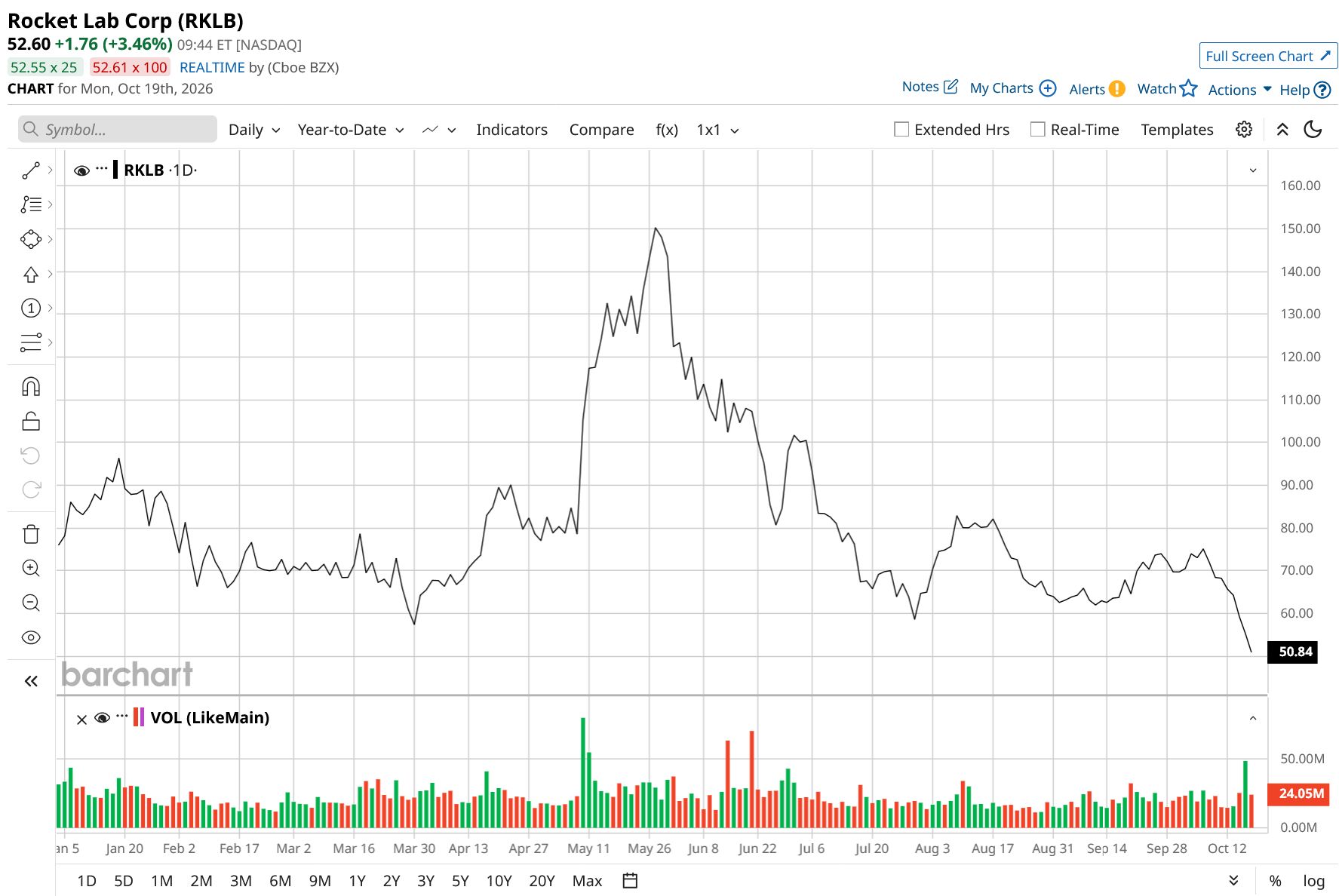 www.barchart.com
Promising Material, Production Headache
On Oct. 14, Rocket Lab said it was pushing Neutron's inaugural launch into 2027. It's not the first time the space stock has had to push back the rocket's maiden voyage. Originally scheduled for mid-2025, it was delayed until later that year, then into 2026. When Neutron's first-stage tank ruptured during testing in January, the launch was pushed to this year's fourth quarter. Now, it's been delayed again.
The latest obstacle involves the carbon-composite domes that cap its first-stage propellant tanks. CEO Peter Beck explained that engineers found tiny air pockets, or voids, between carbon-fiber layers in a newly manufactured forward dome. These defects can compromise structural strength. They appeared in thicker sections introduced after an earlier tank failed qualification testing.
The scale of Neutron complicates production. Its enormous components require specialized curing processes outside conventional autoclaves, the pressurized chambers used to manufacture many composite parts. Rocket Lab must get those processes right consistently before the promised manufacturing efficiencies become commercially useful.
Beck says a revised process produced a high-quality aft dome. A replacement forward dome still needs inspection, followed by assembly, and pressure and cryogenic testing of the full first-stage tank. The company expects the testing sequence to finish in the first quarter of 2027 before providing a more specific launch target.
Discovering defects on the ground is how testing should work. Investors should want to see a management team that tries to get it right rather than meet some arbitrary deadline. Still, for shareholders, another delay means waiting longer for Neutron's revenue contribution while development absorbs resources.
The Business Beneath the Rocket
Rocket Lab's second-quarter results show why investors shouldn't reduce the entire company to a postponed launch.
Revenue climbed 62% year-over-year (YoY) to $234.1 million, while backlog increased 137% to $2.36 billion. Its net loss narrowed to $49.3 million, or $0.08 per share, from $66.4 million, or $0.13 per share. Management projected third-quarter revenue of $250 million to $265 million.
Rocket Lab’s momentum earlier this summer extended beyond Neutron: it has secured more than $160 million in contracts to build three geostationary satellites, while its second-quarter backlog climbed 137% YoY to a record $2.36 billion. Yet, Neutron arguably offers an even larger long-term growth opportunity by allowing Rocket Lab to pursue heavier-payload missions and pair its satellite manufacturing capabilities with its own larger launch vehicle.
Those results, however, provide evidence that its existing operations can grow before Neutron enters service. The Iridium (IRDM) acquisition also gives Rocket Lab a pathway to profitability. They also give investors something tangible to weigh against the uncertainty surrounding the new rocket.
Cash and equivalents totaled $2.13 billion at June 30, providing substantial financial breathing room. However, first-half operating cash outflow reached $134.4 million, with another $53.1 million spent on property, equipment, and software. The company also raised approximately $1.53 billion through at-the-market equity offerings before issuance costs.
That financing helps fund its ambitions, but issuing more shares spreads future earnings across a larger ownership base. A strong cash balance buys development time; shareholders help pay for it.
 www.barchart.com
Wall Street Still Sees Upside for RKLB Stock
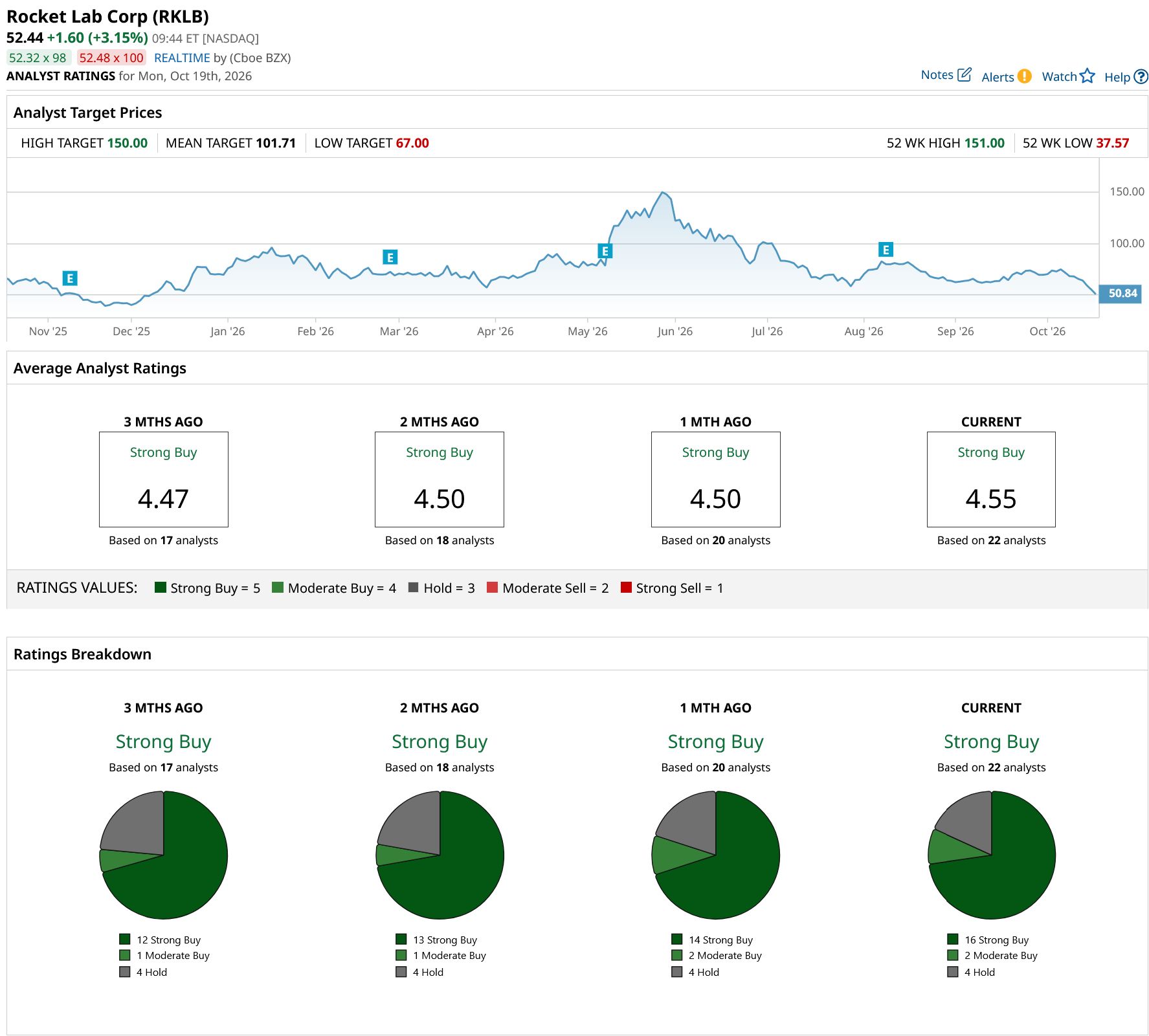
Barchart's analyst snapshot for RKLB stock shows an overall “Strong Buy” consensus among 22 analysts: 16 “Strong Buys,” two “Moderate Buys,” and four “Holds.” None recommend selling. Three months earlier, the group comprised 17 analysts, including 12 “Strong Buys.”
That is a bullish backdrop, although the snapshot does not incorporate the latest delay. It's not likely to impact the results all that much beyond the cuts to the consensus target price of $101.71. Goldman Sachs lowered its price target from $75 to $67 while maintaining a “Neutral” rating; KeyBanc reduced its price target from $135 to $100 while keeping an “Overweight” rating; and though Citizens slashed its price target 30% from $130 to $90, it held firm on its “Market Outperform” rating.
Bottom Line
Rocket Lab remains a compelling business whose most ambitious growth engine still needs to prove itself. The expanding revenue base and cash cushion support patience, but they don't make Neutron's manufacturing problems inconsequential.
For prospective buyers, successful tank qualification would provide a firmer basis for confidence than another launch forecast. Carbon composites could still become a lasting competitive advantage. But before investors reward that promise, Rocket Lab needs to demonstrate that it can manufacture the hardware reliably.
On the date of publication, Rich Duprey did not have (either directly or indirectly) positions in any of the securities mentioned in this article. All information and data in this article is solely for informational purposes. For more information please view the Barchart Disclosure Policy here.
More news from Barchart
Taiwan’s President Called on Micron and Workers to Negotiate Ahead of a Possible Strike. Here’s What to Know. Rocket Lab's Biggest Technological Advantage Is Fast Becoming Its Biggest Problem Venture Global Stock Just Secured a Data Center Win. How to Play It Here. SanDisk Stock Is Caught in the China Chip Selloff. Here’s What Investors Are Missing.