

Electric vehicles (EVs) are rewriting the automotive industry, putting decades-old automakers under pressure to reinvent themselves. However, the road to transformation is far bumpier than legacy automakers expected. Tesla (TSLA) may be dominating the EV market. But Ford Motor Company (F) and General Motors Company (GM) have also invested billions in electrification, but neither is ready to trade profits for a bigger slice of the EV market.
Both companies have just reported their third-quarter 2026 earnings. While their plans have much in common, one automaker seems to be surging ahead in this high-stakes race.
More Yield, Less Trap: Sign up free to get Barchart’s daily Dividend Investor newsletter straight to your inbox.
The Case for Ford (F)
Ford operates across traditional gasoline-powered vehicles, hybrids, and EVs through its Ford Blue, Ford Pro, and Model e divisions. Its lineup features icons like the F-Series pickups, Mustang, Bronco, Explorer, and Transit vans. Beyond building vehicles, Ford is boldly expanding into connected-car software, fleet services, and battery energy storage, signaling a dynamic shift toward a more diversified future.
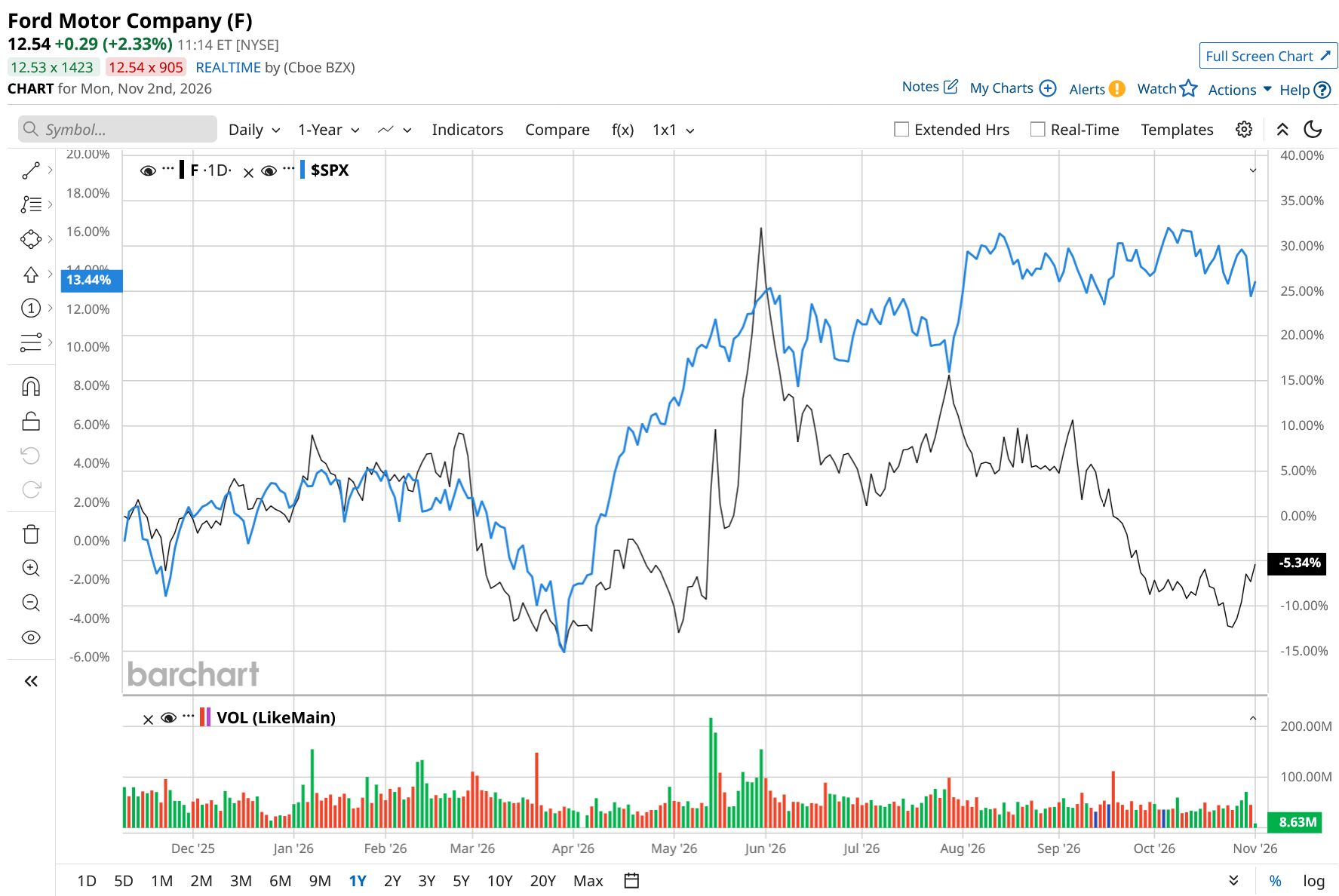
Boasting a forward dividend yield of 4.8%, Ford continues to attract income-seeking investors. Although the stock has slipped 5% this year, analysts are optimistic, projecting a 15% rebound to an average target of $14.46. If the most bullish forecasts hold, Ford could soar 35% to $20 per share.
 www.barchart.com
In the third quarter, Ford reported $49.5 billion in revenue, down 2% year-over-year (YoY). Adjusted EBIT rose 3% to $2.7 billion, and adjusted EPS reached $0.49, up from $0.45 a year earlier. Adjusted free cash flow reached $4.7 billion. The company ended September with $25.3 billion in cash and $46.4 billion in total liquidity. Its traditional operations continue to provide the financial foundation for its transformation. Ford Blue generated $27.1 billion in revenue and $1.4 billion in EBIT. Ford Pro, its commercial vehicle and fleet services business, contributed $17.8 billion in revenue and $1.7 billion in EBIT.
The real test for Ford is whether it can turn its EV business profitable. Model e posted an EBIT loss of $1.1 billion on $1.2 billion in revenue this quarter, although the loss improved by 25% compared to last year. Now, Ford is betting big on its Universal Electric Vehicle platform, trying to slash manufacturing costs and put affordable EVs within reach for more drivers. The first of these, the Fathom, is set to debut in late 2027 with a starting price under $30,000. Management stays focused on steering Model e to break even by 2029.
Ford also sees an opportunity beyond passenger EVs. Its Ford Energy business is developing grid-scale battery storage systems and plans to establish 20 gigawatt-hours of annual production capacity by the end of 2027. More than 80% of its planned 2028 capacity is already covered by signed contracts and advanced customer negotiations. For the full year, Ford expects adjusted EBIT of $10.5 billion to $11 billion and adjusted free cash flow of $6 billion to $7 billion. The opportunity is real, but Ford still needs to turn its EV investments into sustainable profits while it manages rising manufacturing and commodity costs. Its next-generation platform could improve its competitive position. However, investors will have to be patient to see how the story unfolds.
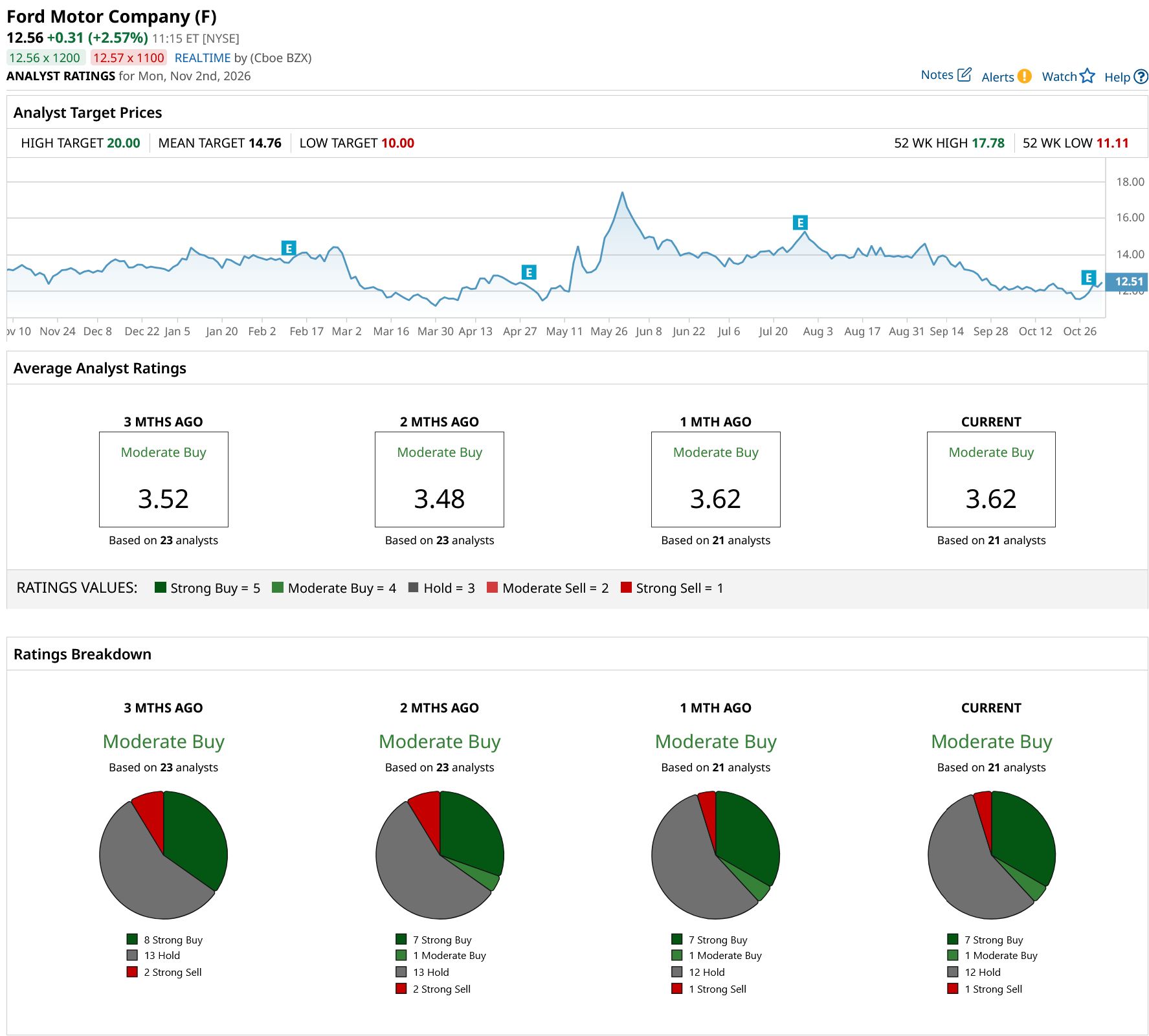
On Wall Street, Ford is a consensus “Moderate Buy.” Of the 21 analysts covering F stock, seven rate it a “Strong Buy,” one a “Moderate Buy,” 12 a “Hold,” and one a “Strong Sell.”
 www.barchart.com
The Case for General Motors (GM)
General Motors commands a powerhouse lineup with Chevrolet, GMC, Buick, and Cadillac, dominating the profitable pickup truck and SUV markets. Its EV lineup includes Chevrolet Equinox EV, Blazer EV, Cadillac LYRIQ, and the bold GMC Hummer EV. But GM is more than merely a carmaker. It drives innovation through GM Financial and is rapidly expanding its connected-car universe with OnStar and Super Cruise. As its software business accelerates, GM is positioned to unlock new streams of recurring revenue that reach far beyond traditional vehicle sales.
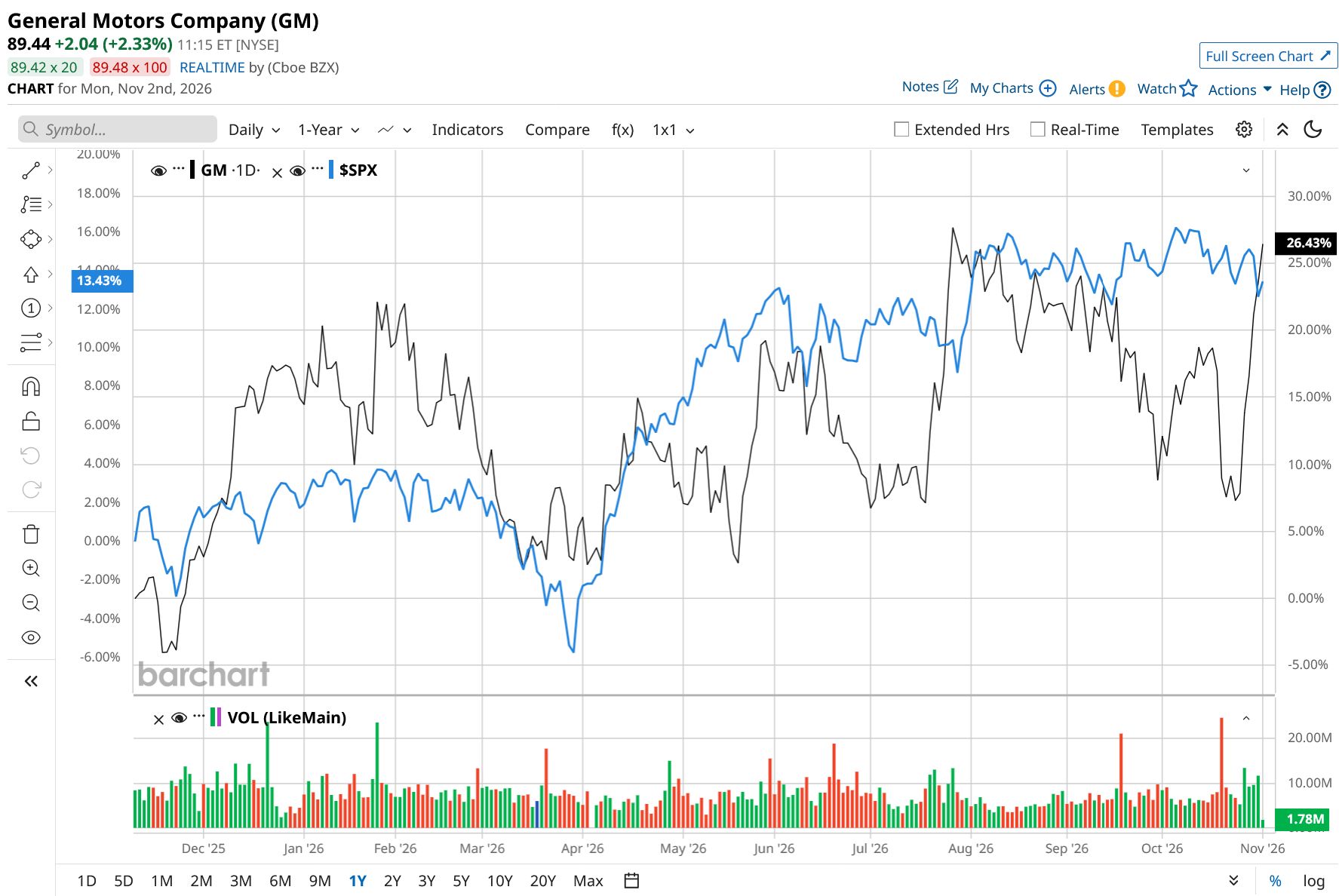
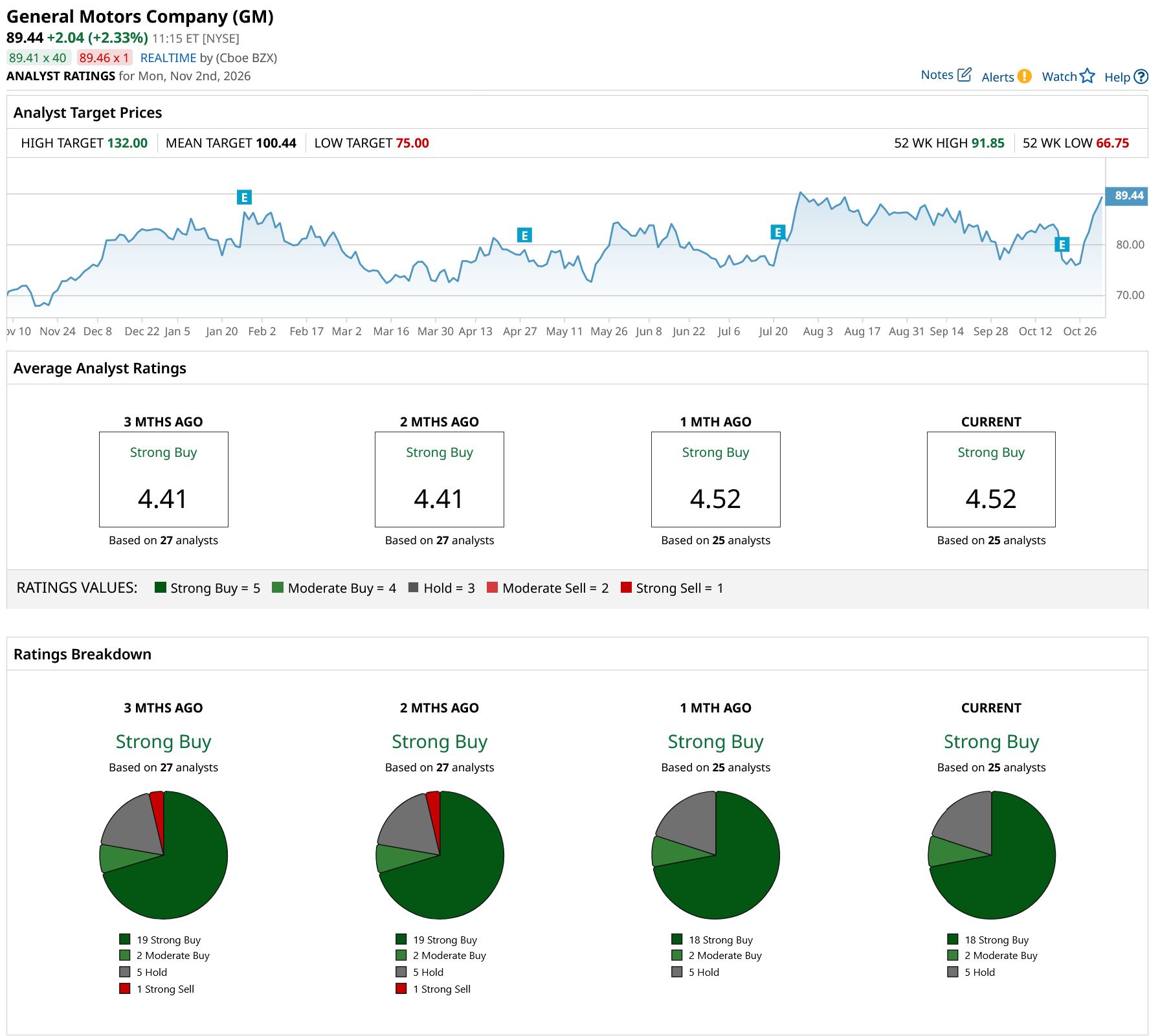
GM is also a dividend-paying stock but offers a much lower yield of 0.84%. GM stock has already climbed 10% year-to-date (YTD), and analysts are eyeing even more growth ahead. If shares reach the average target price of $100.44, that means a potential 12% jump from here. The high estimate of $132 points to an impressive 48% upside over the next year.
 www.barchart.com
In the third quarter, GM reported $50 billion in revenue, up 3% YoY. The adjusted EBIT rose 22% to $4.1 billion. Adjusted diluted EPS rose more than 30% to $3.70. Adjusted automotive free cash flow reached $5.9 billion, up $1.7 billion from the previous year. North American operations generated $3.6 billion in adjusted EBIT, with margins improving to 8.7% from 6.2%. Strong pickup sales, lower warranty expenses, and reduced EV losses helped drive the improvement.
GM's Chevrolet Silverado and GMC Sierra pickups remain important competitive advantages. With an impressive 19 straight quarters leading U.S. full-size pickup sales and a solid 9% YoY sales jump in Q3, GM is set to extend its reign and lead the segment for a remarkable seventh year in 2026. The EV business remains a challenge, but GM is making progress in reducing losses. Since the second half of 2025, GM has incurred $7.4 billion in cash restructuring charges as it reshapes production and costs to better match demand. Even so, management is hopeful, projecting that full-year EV losses will shrink by $1 billion to $1.5 billion. This renewed discipline could set the stage for stronger profitability, all while keeping GM’s EV dreams alive.
Management expects full-year realized revenue to soar past $3 billion, with deferred revenue climbing toward $7.5 billion by year-end. Adjusted EPS is projected to land between $12.75 and $13.75, while adjusted automotive free cash flow could reach as high as $12.5 billion. Should GM hit these ambitious marks, it would secure a significant financial edge over Ford.
However, inflation and upcoming truck production transitions remain risks that investors should keep an eye on.
Which Stock Races Ahead?
Ford has a potentially interesting long-term opportunity through its affordable UEV platform, Ford Pro software, and battery storage operations. Yet, its EV division continues to bleed billions, and the road to recovery will require patience since the turnaround can take years to unfold.
As a result, GM holds the upper hand for now, already posting healthy earnings growth, widening its margins, and rewarding shareholders with billions in returns. Overall, on Wall Street, GM stock is a consensus “Strong Buy.” Out of the 25 analysts who cover the stock, 18 rate it a “Strong Buy,” two suggest a “Moderate Buy,” and five rate it a “Hold.”
 www.barchart.com
On the date of publication, Sushree Mohanty did not directly have a position in any of the securities mentioned in this article. All information and data in this article is solely for informational purposes. For more information please view the Barchart Disclosure Policy here.
More news from Barchart
Ford and GM Are Taking Different Roads, but 1 Stock Races Ahead ASML vs. Applied Materials: One Is Growing Twice as Fast, but I’d Buy The Other Instead DPZ’s Dividend Yield Is a Tasty 2.5%, So Grab a Slice of Domino’s Stock Here Caterpillar Drops 10% Pre-Market Despite Q3 Beat and AI Build-Out Growth