

The semiconductor sector has been having a rough ride lately, and it’s not just one thing weighing on investor sentiment. A mix of disappointing corporate earnings, growing concerns over the enormous sums being poured into AI infrastructure, and sky-high valuations has put chip stocks under pressure.
Political uncertainty has only added to the trouble. Following Democrats’ victory in the Nov. 4 midterm elections, investors began worrying that tighter scrutiny of data center construction could slow artificial intelligence (AI) expansion.
More Top Stocks Daily: Go behind Wall Street’s hottest headlines with Barchart’s Active Investor newsletter.
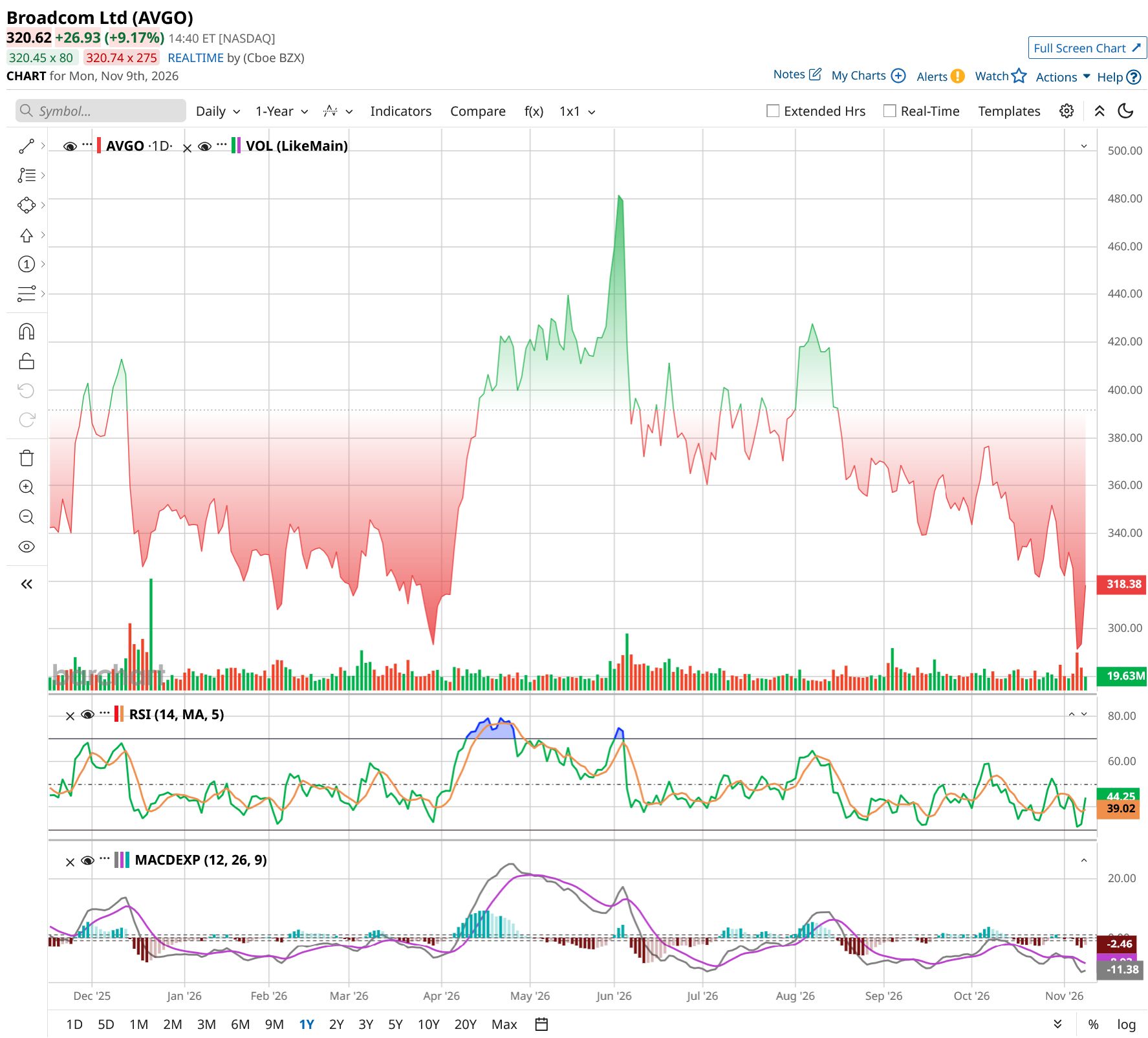
Broadcom (AVGO), a major player in the AI chip race, has felt the heat. Shares have tumbled over 25% over the past three months, recently hitting a 52-week low of $289.77 on Nov. 6, and have been slow to join the latest market rebound. Yet, the company’s AI business has not suddenly lost its appeal. Broadcom designs custom AI chips for hyperscalers looking to improve computing efficiency and expects to double its AI semiconductor revenue in 2027.
But with a handful of major customers driving this business and data center expansion facing real-world constraints, investors are wondering whether this selloff is a buying opportunity or a sign of more trouble ahead. Let’s take a closer look at AVGO stock and what the numbers say about where Broadcom stands.
About Broadcom Stock
Headquartered in San Jose, California, Broadcom operates across two major businesses—semiconductors and infrastructure software. Its products and services support a wide range of technologies, including cloud computing, data centers, wireless communications, broadband networks, and enterprise systems. While its chips handle connectivity, networking, and data processing, its software business provides tools that help companies manage critical IT infrastructure.
More recently, Broadcom has gained significant attention for its role in the AI boom. Its custom AI accelerators and networking chips help power large-scale AI data centers. With a market capitalization of approximately $1.4 trillion, it ranks among the world’s largest technology companies.
Broadcom’s AI story has been a rewarding ride for shareholders, but lately, the stock has hit a serious speed bump. AVGO shares have surged 207% over the past three years and 74% over the past two years, as booming AI infrastructure demand made the chipmaker one of the biggest winners in the semiconductor space. That rally sent shares to a record high of $495 in June.
Since then, however, the mood has changed rather quickly. A broader semiconductor selloff, disappointing earnings across the chip sector, concerns over heavy AI infrastructure spending, and fears that a Democratic majority in Congress could bring tighter scrutiny to data center expansion have weighed on investor sentiment. Broadcom has been caught in the crossfire, with shares now down 36% from their June peak. The 14-day RSI is hovering around 39, putting AVGO close to oversold territory.
 www.barchart.com
Broadcom may have taken a beating recently, but its valuation still isn't exactly cheap. AVGO trades at around 25.2 times forward non-GAAP earnings and 13.23 times forward sales, both above the broader semiconductor sector. That said, investors are paying a premium for its growth potential, particularly as management expects AI revenue to exceed $100 billion in fiscal 2027. Its strong relationships with major hyperscalers, including Meta and Alphabet’s Google, also give it a meaningful stake in the ongoing AI infrastructure buildout.
Shareholders get a little something on the income front, too. Broadcom has increased its dividend for 15 consecutive years and currently pays $2.60 annually per share, translating into a modest 0.89% yield. With a payout ratio of just 26.6%, the company has room to keep rewarding shareholders while retaining enough cash to fund future growth.
A Snapshot of Q3's Numbers
Broadcom reported its fiscal third quarter results on Sept. 2, generating revenue of $29.6 billion, an 86% year-over-year (YoY) increase that beat Wall Street's projections. Its Semiconductor Solutions business led the way, with revenue soaring 127% annually to $20.8 billion, accounting for roughly 70% of total sales. Infrastructure Software also delivered healthy growth, rising 29% YoY to $8.8 billion.
AI semiconductor revenue surged 221% YoY and 54% sequentially to $16.7 billion. XPU shipments grew more than 3.5 times from the year-ago period, while AI networking revenue more than doubled. Strong demand also translated into impressive profitability, with non-GAAP operating income climbing 92% to $20.1 billion and non-GAAP EPS jumping 96% to $3.32.
Broadcom also generated plenty of cash during the quarter. Operating cash flow nearly doubled to $14.2 billion, while free cash flow increased 95% to $13.7 billion. The company distributed $3.1 billion in dividends, reduced long-term debt by approximately $5 billion, and ended the quarter with $24 billion in cash and cash equivalents. Capital expenditures amounted to $532 million.
The company is gearing up to release its Q4 and fiscal year 2026 results and business outlook on Wednesday, Dec. 9, after the market closes. Management expects fiscal Q4 revenue of $34.8 billion, with non-GAAP operating income representing 66% of sales. Semiconductor revenue is projected at $26.1 billion, including $21.7 billion from AI chips, up 236% YoY. That would take fiscal 2026 AI semiconductor revenue to roughly $58 billion, a 186% increase and above its earlier forecast.
The longer-term targets are even more ambitious. AI semiconductor revenue is estimated to be around $115 billion for fiscal year 2027 and $230 billion in calendar year 2028. Management also says demand is already running above its fiscal 2027 outlook. The catch is that delivering on that demand will depend on data center readiness and the availability of leading-edge silicon, substrates, and memory.
For fiscal 2026, analysts see revenue reaching $106 billion, with EPS jumping 84.2% annually to $10.37. Better yet, earnings are expected to take another big step higher in fiscal 2027, rising 68.3% YoY to $17.45 per share.
What Do Analysts Expect for AVGO Stock?
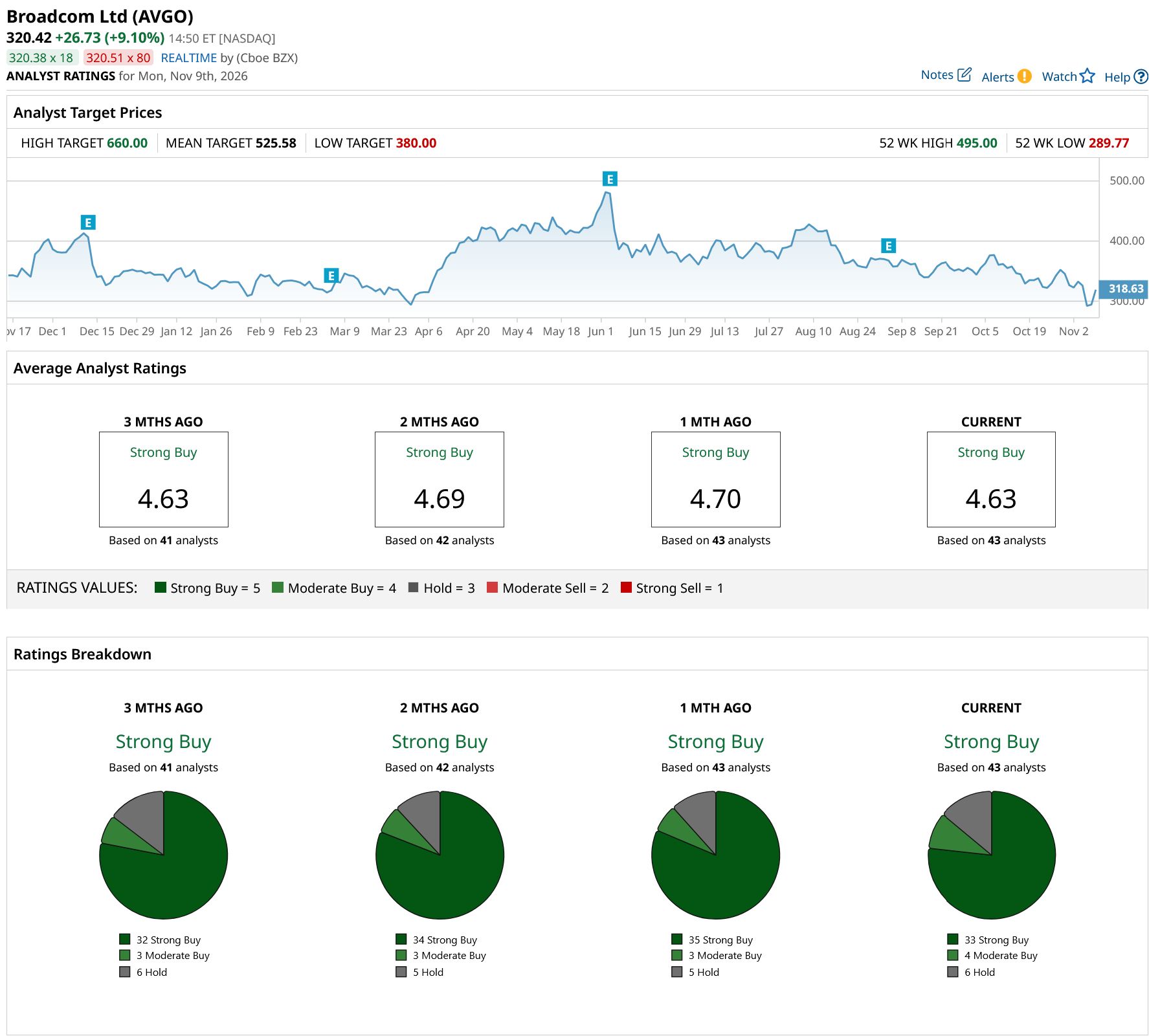
Wall Street remains upbeat on AVGO stock, with the shares carrying an overall “Strong Buy” rating. Of the 43 analysts tracking the stock, 33 back it with a “Strong Buy,” and four have a “Moderate Buy,” while just a handful of six sit on the sidelines with a “Hold” rating.
AVGO’s average target price of $525.58 suggests 64% upside potential from here. Yet the Street’s highest $660 price target hints that the stock could rise as much as 106%.
Questions around huge AI spending and competition are not going away anytime soon, which may keep AVGO stock volatile. Still, strong customer relationships, rising demand for custom AI chips, and ambitious revenue targets give investors reasons not to write off AVGO just yet.
 www.barchart.com
On the date of publication, Sristi Suman Jayaswal did not directly have a position in any of the securities mentioned in this article. All information and data in this article is solely for informational purposes. For more information please view the Barchart Disclosure Policy here.
More news from Barchart
AMD Stock Surges on Expanded Partnership With Google. What Comes Next. Broadcom Stock Is Down Over 25% in 3 Months. How to Play the Selloff Here. Following Constellation Energy Earnings, Here's What Barchart Data Says Comes Next for CEG Stock ‘Don’t Fall for It’: Mark Cuban Says the CVS Breakup Is ‘Great for Shareholders’ but ‘Changes Nothing for Patients’