

For more than a century, legacy automaker General Motors (GM) called the New York Stock Exchange (NYSE) home. As of Nov. 17, 2026, that era is over. The Detroit automaker is officially moving its primary listing to Nasdaq, with its existing ticker symbol, GM, staying the same. The NYSE relationship dates back to 1911, and GM returned to the exchange after its 2010 bankruptcy. Still, the move isn’t as surprising as it might seem.
A growing number of companies are aligning themselves with the tech-heavy exchange, chasing proximity to tech stocks as investors rush to back the AI buildout. Walmart (WMT), Hilton (HLT), and Palantir (PLTR) are among the names that have recently made the shift. GM, however, adds a first of its own. It is set to become the first legacy automaker on the Nasdaq. Finance chief Paul Jacobson said that GM’s customer-focused, technology-driven strategy is creating value for its stockholders, which makes Nasdaq a natural home for the listing as the company grows.
More Top Stocks Daily: Go behind Wall Street’s hottest headlines with Barchart’s Active Investor newsletter.
The company has been backing that sentiment with money, injecting capital into modern technology, including “eyes-off” autonomous driving on some models, as it looks for fresh revenue streams beyond its traditional products. It is also developing a new software backbone for future vehicles, built to deliver the automated-driving system and other digital features, in the expectation that drivers will be willing to pay for them. The backdrop makes the timing even more interesting.
Legacy automakers, squeezed by higher costs, have been trying their hand at cheaper, software-heavy vehicles to keep up with Chinese rivals, and a Nasdaq listing helps GM present itself as a technology company as much as a carmaker. There is also potential financial upside. The exclusive Nasdaq listing makes GM eligible for future inclusion in the Nasdaq-100 Index, which could drive passive capital inflows and purchases from index-tracking mutual funds and ETFs.
So, with the switch now underway, here’s a closer look at GM as it settles into its new Nasdaq home.
About General Motors Stock
Founded in 1908, General Motors is one of the world’s largest automakers, with a legacy spanning more than a century and ambitions that extend well beyond traditional car manufacturing. Headquartered in Detroit, Michigan, the company designs, manufactures, and sells cars, trucks, SUVs, and electric vehicles, while increasingly investing in autonomous driving, connected-car technology, and software-driven mobility.
Its portfolio features iconic brands, including Chevrolet, Buick, GMC, and Cadillac, catering to a broad spectrum of customers, from mainstream car buyers to luxury and performance enthusiasts. While General Motors is steadily transforming itself through investments in electrification, advanced driver-assistance systems, autonomous driving, and software-driven vehicle services, its stock performance in 2026 has been relatively subdued.
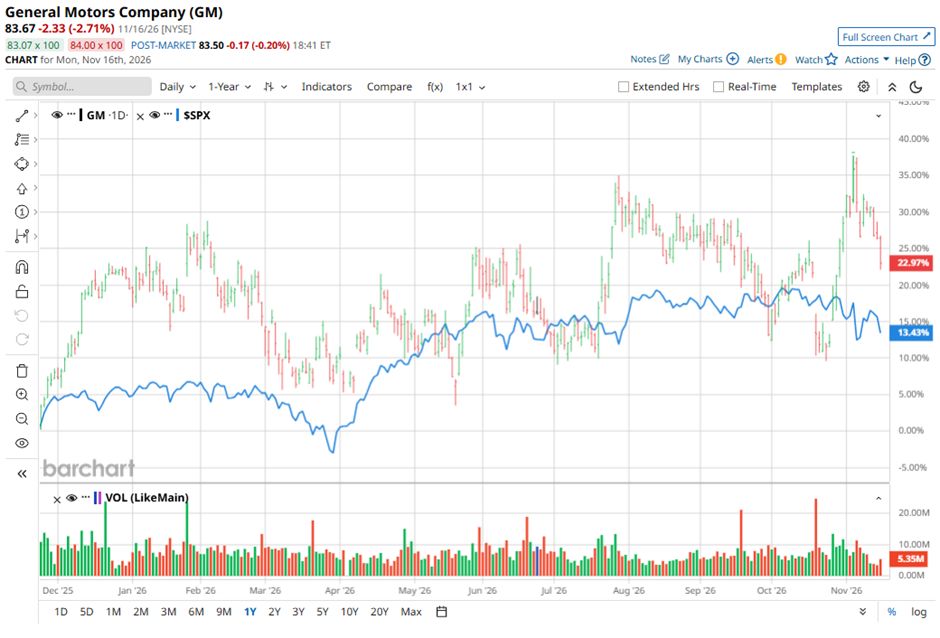
Despite delivering solid returns over the past year, shares have struggled to sustain their upward momentum in recent months. A combination of trimmed full-year profit guidance, mounting supply chain and input costs, and broader macroeconomic uncertainties has weighed on investor sentiment, leaving the stock vulnerable to periodic bouts of volatility. Currently boasting a market capitalization of approximately $70.58 billion, GM has gained about 18.7% over the past 12 months, comfortably outperforming the broader S&P 500 Index ($SPX), which has advanced 10.1% over the same period.
However, the picture looks less impressive year to date. General Motors shares have risen just 2.9% so far in 2026, falling behind the broader market's 8.3% gain as concerns over profitability and operating costs continue to cloud the outlook. The stock did manage to touch a fresh 52-week high of $93.70 in early November, reflecting a period of renewed optimism, but has since retreated approximately 10.7% from that peak.
 www.barchart.com
Inside General Motors’ Q3 Earnings Report
General Motors delivered a strong third-quarter earnings performance on Oct. 20, 2026, comfortably beating Wall Street’s expectations on both the top and bottom lines while announcing an ambitious new share repurchase program. Revenue for the quarter reached $50.02 billion, marking a 3% increase from the year-ago period and surpassing analysts’ consensus estimate of $48.69 billion. The bottom line was equally impressive.
Net income attributable to stockholders came in at $3.34 billion. At the same time, adjusted diluted earnings per share (EPS) surged to $3.70 from $2.80 in the same quarter last year, comfortably exceeding the Street’s forecast of $3.63. Operational performance also provided plenty of reasons for optimism. GM’s adjusted operating profit climbed 21.6% year over year to $4.12 billion, highlighting the resilience of its core automotive business.
However, beneath the headline growth lies a notable concentration risk. North America contributed approximately $3.6 billion of the quarter’s adjusted operating profit, supported by robust demand for higher-margin pickup trucks and SUVs. The region’s operating margin reached 8.7%, underscoring the strength of GM’s most profitable market.
Yet, with nearly 90% of adjusted operating profit originating from North America, the company’s earnings remain heavily dependent on a single region, leaving it exposed to shifts in domestic demand, pricing, and operating conditions. Capital returns are another major part of GM’s investment story. The automaker announced a fresh $20 billion share repurchase authorization, building on an aggressive buyback strategy that has already substantially reduced its outstanding share count.
Following the completion of its previous $6 billion repurchase program in 2026, GM’s diluted share count declined to approximately 849 million as of Sep.30, down from 904 million at the end of 2025. Shares outstanding totaled 995 million at the end of 2024 and 1.2 billion at the end of 2023. A shrinking share base means that profits are distributed across fewer shares, potentially boosting per-share earnings even when overall net income remains unchanged.
For shareholders, the new authorization signals management’s confidence in the company’s cash-generating capacity while reinforcing its commitment to returning capital. GM’s cash flow generation was equally striking. Adjusted automotive free cash flow soared 40% year over year to $5.88 billion, providing substantial financial flexibility to fund investments, strengthen its balance sheet, and return capital to shareholders. However, despite the impressive quarterly results, management struck a somewhat more measured tone on its full-year outlook.
After raising its guidance earlier in the year, GM opted against another upward revision and instead narrowed its full-year adjusted EBIT forecast to a range of $14.5 billion to $15.5 billion, compared with its previous guidance of $14 billion to $16 billion. The company also tightened its adjusted EPS outlook to $12.75 and $13.75, versus the earlier range of $12 and $14.
How Do Analysts View General Motors Stock?
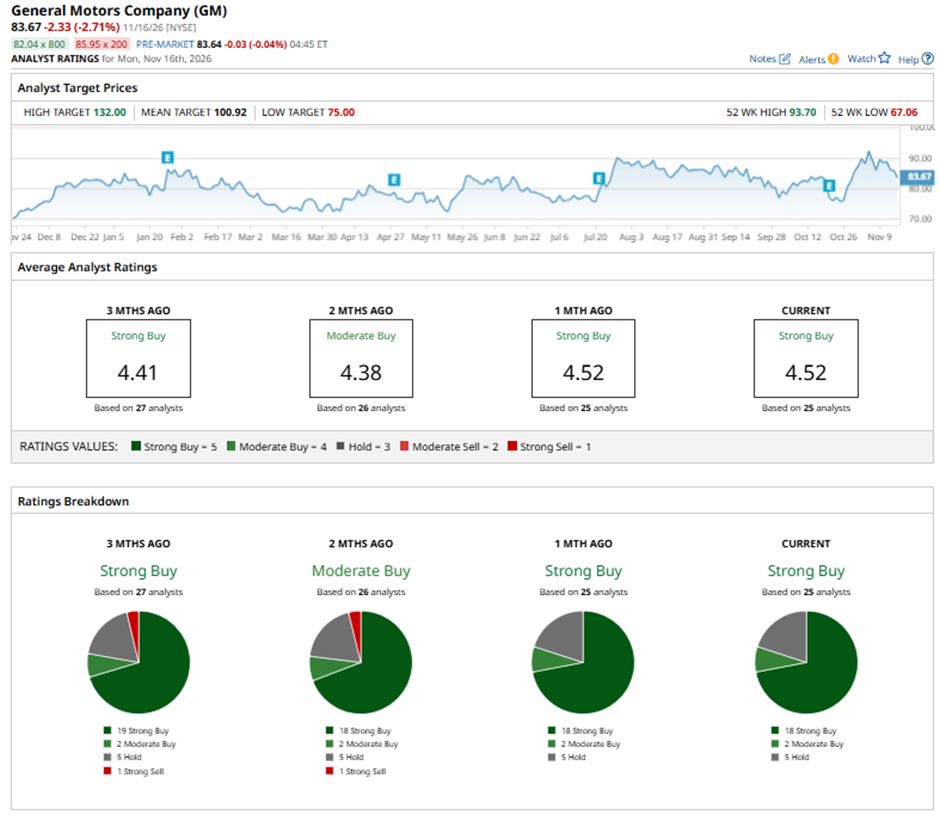
Wall Street is firmly bullish on General Motors, with analyst sentiment pointing to considerable upside potential despite the stock’s recent pullback. GM currently commands a consensus “Strong Buy” rating, reflecting confidence in its earnings strength, cash flow generation, and longer-term growth prospects. Of the 25 analysts covering the stock, 18 recommend a “Strong Buy,” two assign a “Moderate Buy,” and the remaining five maintain a “Hold” rating.
The optimism is also reflected in analysts’ price targets. The average target of $100.92 points to approximately 20.6% upside from current levels, while the Street-high target of $132 signals a potential rally of as much as 57.8%.
 www.barchart.com
On the date of publication, Anushka Mukherji did not directly have a position in any of the securities mentioned in this article. All information and data in this article is solely for informational purposes. For more information please view the Barchart Disclosure Policy here.
More news from Barchart
‘I Would Be Honored to Answer These Calls and Return as CEO,’ Jensen Huang Says as Employees, Fellow Tech Leaders Rally Behind the Nvidia Founder Billionaire Charlie Munger Called Robinhood ‘A Gambling Parlor Masquerading As a Respectable Business’ and Now They Hold 70 Million Trump Accounts A Strong Q3 Puts Nvidia (NVDA) Stock on Track for a Quick 194% Options Payout As Netflix Stock Hovers Near Its 52-Week Low, Analyst Sentiment Remains Mixed. Here's Why.