

On November 17, Nvidia (NVDA) reported $115.8 billion in third-quarter revenue, up 103% from a year ago, and then guided for $130 billion in the fourth quarter. Normally, Wall Street would cheer numbers like these, but the stock closed 2.9% lower the very next day, leaving it roughly 37% off its October high.
To be fair, some of that selling makes sense, since Nvidia lost its founder and CEO just days before the report and its quarterly filing is now running late.
More Top Stocks Daily: Go behind Wall Street’s hottest headlines with Barchart’s Active Investor newsletter.
Personally, though, I think the market has drifted away from what the business actually delivered. That's because the same quarter showed a record product debut, along with a balance sheet risk that most of the coverage seems to have missed, and I'll walk through both below. But first, it's worth looking at why the CEO exit rattled investors so badly.
Huang Is Out for Good, and Congress Calls Him In on December 1
The news that really shook the stock came on November 12, when Nvidia announced that Jensen Huang had stepped down as president, CEO and board member, effective immediately. Colette Kress is now running things on an interim basis while keeping her role as CFO, and the board made it clear on the November 17 call that Huang won't be coming back.
Most of the headlines have focused on Huang's affair, but I think investors should look more closely at who the woman is. Her name is Alice Huang, and from what we know, she used to be a key player at Megaspeed, a Singapore-based data center company that was once the largest buyer of Nvidia chips in Southeast Asia.
On top of that, U.S. officials "suspect" she was spying for China, and the Commerce Department has been investigating Megaspeed since 2024 over whether it helped move restricted chips into China.
That's why Congress is now involved. On December 1, Huang sits down for closed-door interviews with three House committees, and the chairs have said they want to hear about his role in a potential breach of national security. The panels include the Intelligence Committee and the Select Committee on the Chinese Communist Party.
From there, general counsel Tim Teter follows on December 2, and personally, I think his session is the one to watch. As Nvidia's top lawyer, he can speak to what the company knew about where its chips were going.
So far, though, the paper trail looks better than the headlines suggest. The Commerce and Justice departments have said investigators asked Nvidia for records on its sales to Megaspeed in May 2025, and Nvidia put Megaspeed on its no-sell list the very next month. Plus, Nvidia's board has said it has no reason to believe national security or company secrets were compromised, so if the December interviews back that up, I think the worst version of this story gets much harder to tell.
One piece is still missing, though.
Nvidia has delayed its 10-Q, which is the detailed quarterly report companies file with regulators. Management tied the delay to the investigation and to whether new risk factors need to be added, and the board has also created a new committee focused on national security and export rules.
That move makes sense. With China already at zero for data center chips in the fourth-quarter outlook, Nvidia's main exposure now is its standing with Washington, and that standing decides how freely the company can sell everywhere else.
All of this unfolded just days before earnings, and honestly, the way the stock reacted to those results is where things get even stranger.
Nvidia Stock Now Trades at About 14x Its Earnings Pace
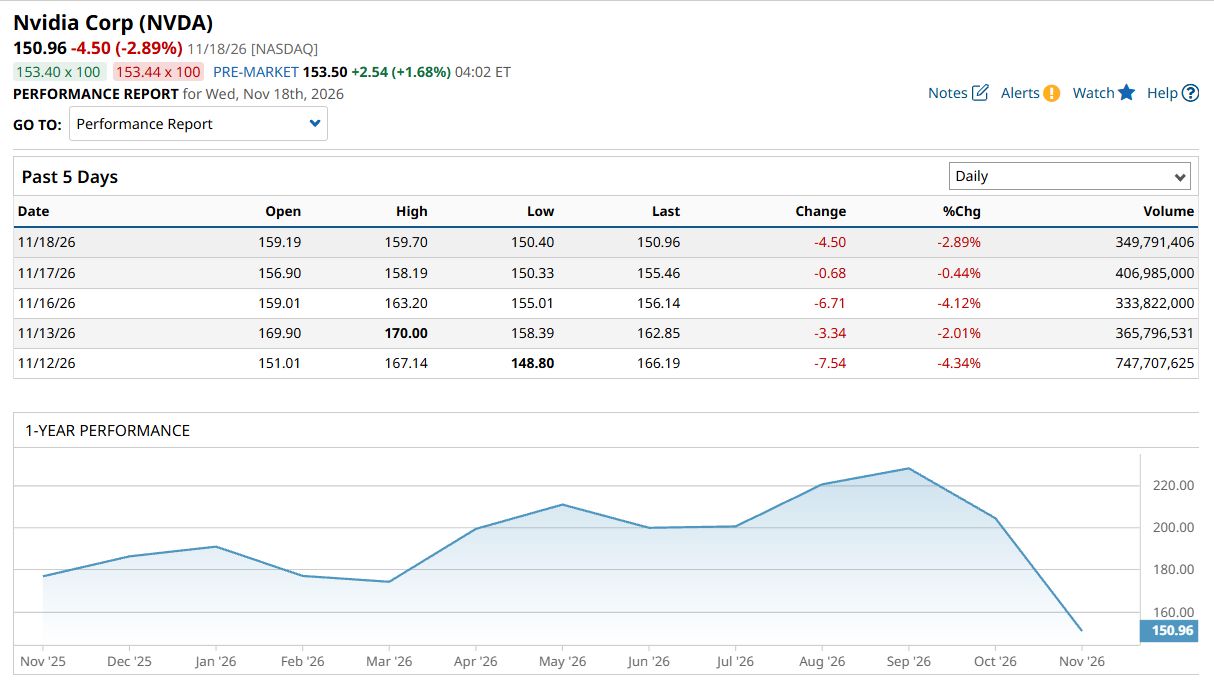
The morning after earnings actually started well, as shares opened at around $159 on November 18, up about 2.4%.
However, that glow faded quickly, and the stock slid for the rest of the day before closing at around $151. At that price, Nvidia sits about 13% below its November 11 close of around $174, which was the last trading day before Huang's exit. It's also about 37% below the record close of around $239 on October 6, which works out to roughly $2.1 trillion in lost market value.
 Screenshot courtesy of: www.barchart.com
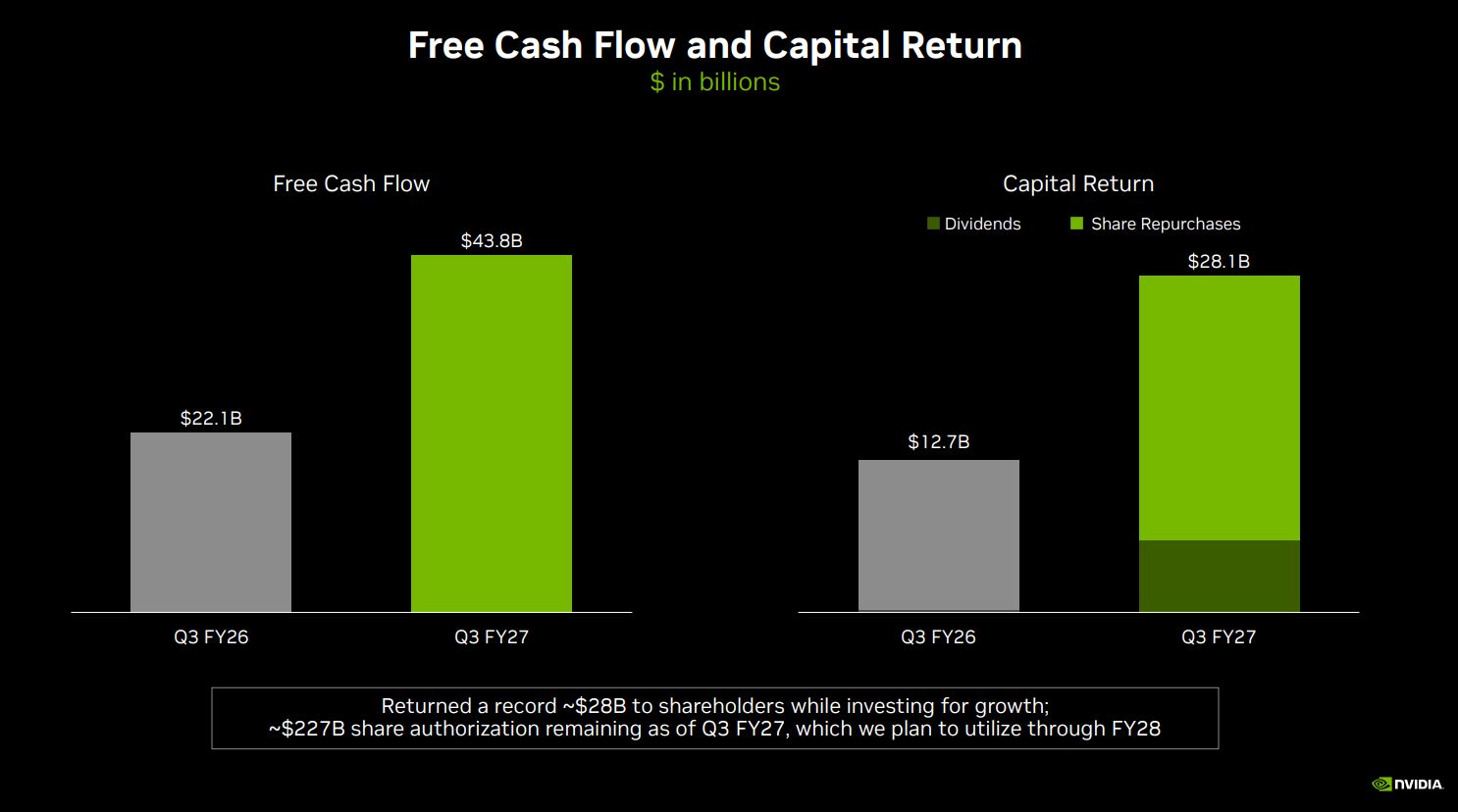
Now, if the business were cracking, I'd expect the numbers to show it, and so far they're pointing the other way. For example, earnings per share came in at $2.70 for the third quarter, more than double the $1.30 from a year ago, and the $130 billion fourth-quarter guide landed about 4% above what Wall Street expected.
If I annualize that $2.70, I get $10.80, so the stock now trades at about 14x its current earnings pace. And on the past 12 months of earnings, it's at about 16x.
 Screenshot courtesy of: www.nvidia.com
Personally, I see this as multiple compression. Investors are now paying less for each dollar of profit even as that profit keeps growing, and the discount seems to be about Nvidia alone. On the same day Nvidia fell 2.9%, AMD (AMD) rose 5.3%, and Broadcom (AVGO) gained 3.6%, so investors stayed in AI and simply shifted their money toward chipmakers without a high-stakes CEO search or a late filing hanging over them.
As a long-term thinker, I can live with this. After all, a broken business usually shows up in orders, margins or guidance, but since none of those moved the wrong way this quarter, I think the discount can fade once the open questions from December get answered.
Speaking of the business, the part of this story I think the market is underappreciating most is how quickly Nvidia's newest product is selling.
Vera Rubin Brought In Nearly $20 Billion in Its First Quarter
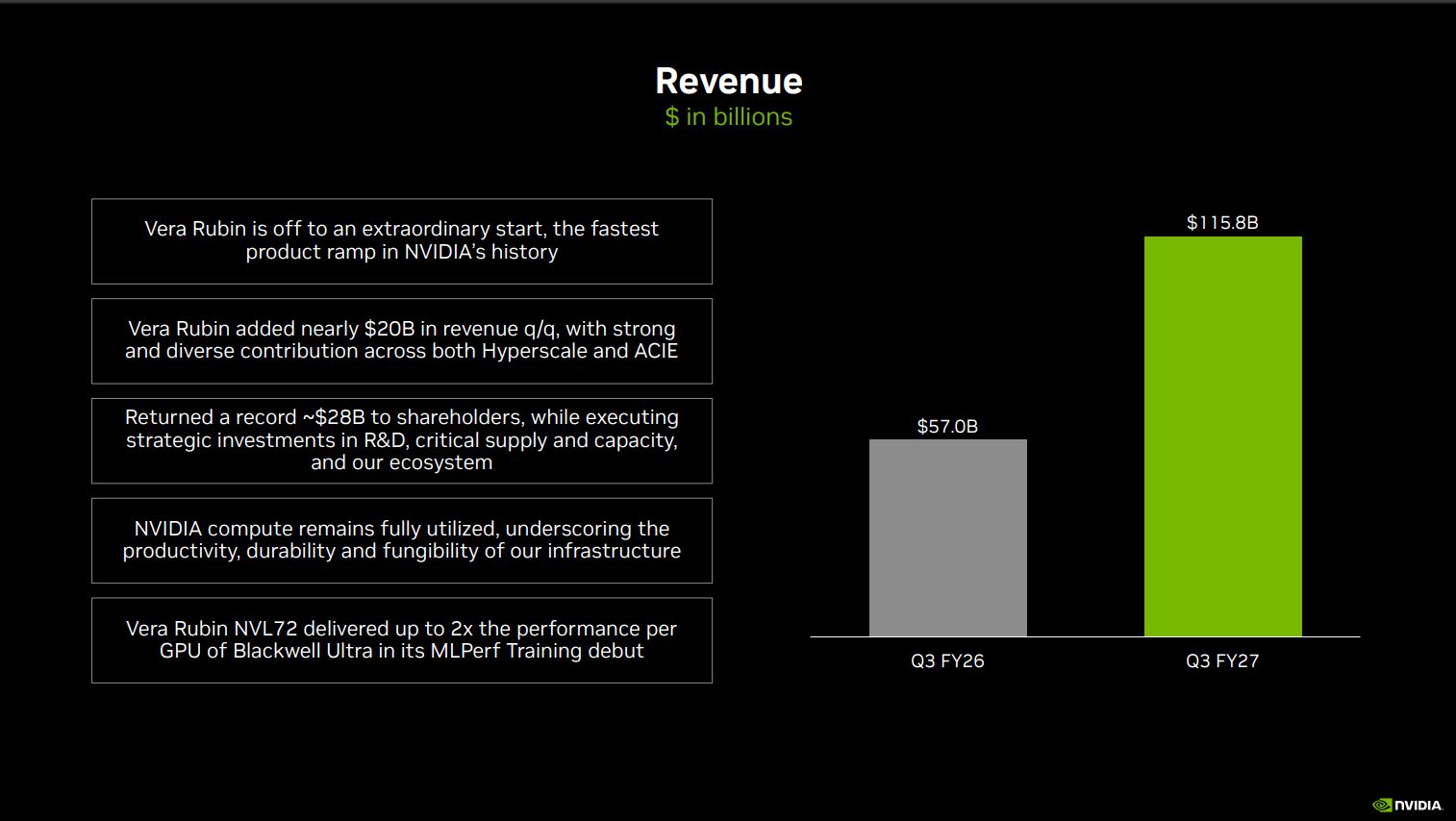
I think the Vera Rubin launch went better than most investors realize. On the call, Kress said Rubin brought in nearly $20 billion in its first quarter of production shipments, which is close to double the $11 billion Blackwell made in its first quarter back in the fourth quarter of fiscal 2025.
At the time, Nvidia called Blackwell's launch the fastest in its history, so Rubin set a new record, and it did so without any sales to China.
 Screenshot courtesy of: www.nvidia.com
But the more telling part, to me, came after the quarter closed. Much of the recent selling seems to assume Nvidia's customers were buying from Huang as much as from the company, since he led every major product launch and customer pitch. If that were true, I'd expect management to turn cautious after his exit – yet just days later, it guided for another record quarter and raised its longer-term outlook.
That's also why I think the market is underrating the new outlook. Kress now expects revenue to grow about 75% in fiscal 2028, up from a previous 70% forecast, and that fiscal year ends in January 2028. Nvidia should finish fiscal 2027 with roughly $423.6 billion in revenue if it hits its $130 billion fourth-quarter guide, so 75% growth would take that to about $741 billion.
That means Nvidia would add about $318 billion in revenue in a single year, which is nearly 1.5x what it sold in all of fiscal 2026.
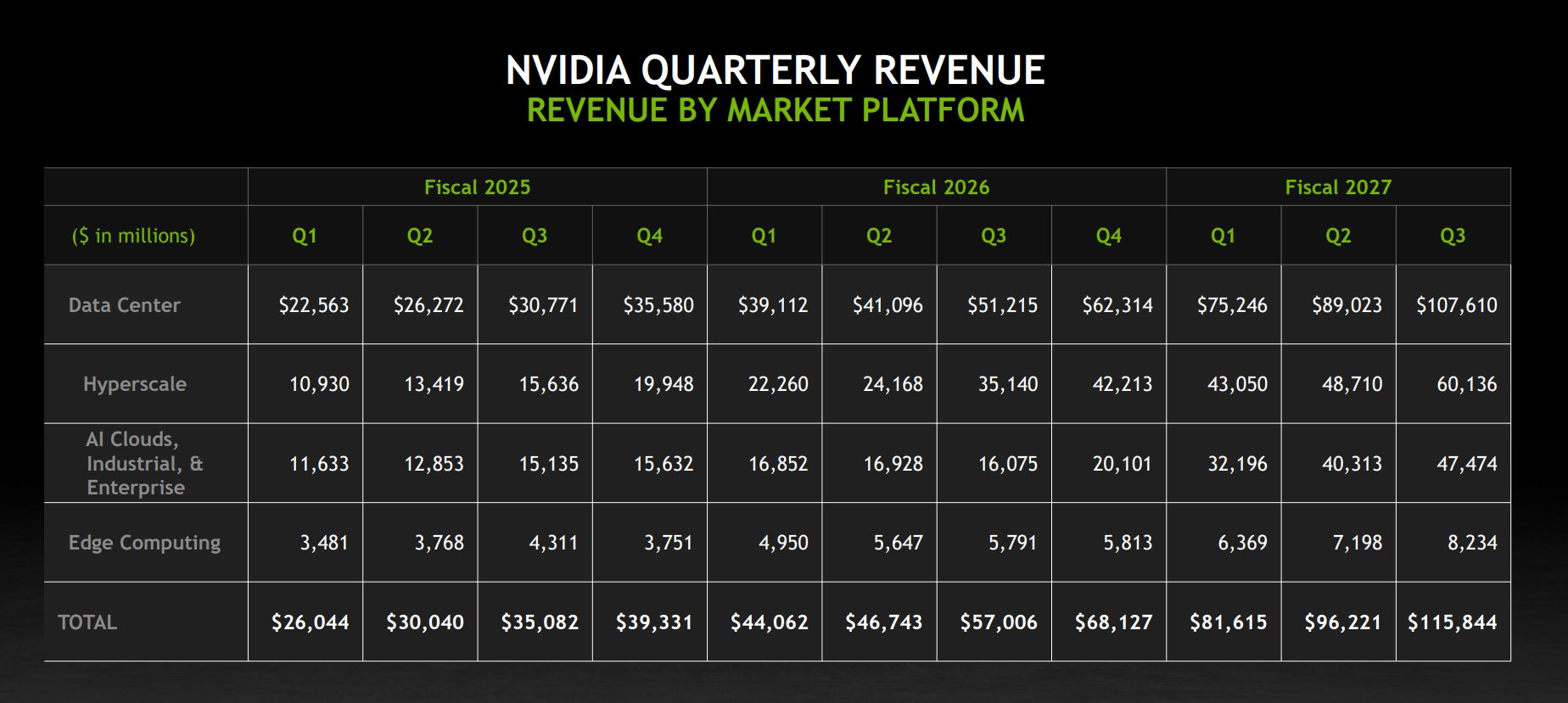 Screenshot courtesy of: www.nvidia.com
Profit should grow right along with it. Nvidia kept about 56% of its third-quarter revenue as profit; I lowered that to 54% to account for higher memory chip costs. On $741 billion of revenue, that comes to about $400 billion in profit, or roughly $16.60 per share, so at $150.96, the stock trades at about 9x that estimate.
Now, even if investors valued Nvidia at a modest 15x earnings, today's price would imply fiscal 2028 earnings of only about $10 per share. But Nvidia earned $2.70 per share last quarter, which works out to $10.80 over a full year. In other words, today, the stock is priced as if profits will fall from here, while Rubin is selling faster than any product Nvidia has launched before.
My estimate also leaves room for a miss. For example, if revenue grows only 50% in fiscal 2028, earnings per share would come in near $14.20, and the stock would still trade at less than 11x. And on my 75% growth estimate, a 15x multiple would put the stock at about $249, slightly above its October record.
Of course, growth like this needs someone to pay for it, and the same report shows Nvidia is increasingly covering part of that cost itself.
Nvidia's $518 Billion in Commitments Works Out To Nearly 10x Its Cash
Nvidia's CFO commentary says many of its fastest-growing customers are expanding faster than their finances can support, especially neoclouds and frontier labs. Neoclouds are newer cloud companies that rent out AI computing power, like CoreWeave (CRWV), and frontier labs are the companies building advanced AI models.
So to keep those customers buying, Nvidia has been taking on more of the risk itself. For example, its supply and capacity commitments jumped to $390 billion from $279 billion in just one quarter, mostly because the company agreed to buy memory chips years in advance. Once leases and investments are added, total future commitments come to $518 billion.
On top of that, Nvidia carries up to $118 billion in guarantees, which means it has agreed to pay if certain partners can't. Most of that is tied to a data center campus SB Energy is building in Ohio, where the buildings will be leased to OpenAI for 20 years to house Nvidia hardware.
Now, let's put all of that next to Nvidia's $53.5 billion in cash and marketable securities. That means the commitments add up to nearly 10x the company's cash, and the guarantees alone are larger than the $115.8 billion in revenue Nvidia brought in last quarter.
To be fair, Nvidia hasn't paid a cent under these guarantees, and the Ohio ones only start kicking in building by building in fiscal 2029.
Personally, I'm more concerned about what happens if AI spending slows down. Customers can cut orders within a quarter or two, but Nvidia would still be on the hook for memory it locked in at today's high prices, right when its most aggressive customers would be struggling to raise money.
That's the risk that could make Nvidia's valuation less of a bargain than it looks, and it's the first thing I'll check when the delayed 10-Q comes out. So with both sides of the ledger on the table, here's how I'm weighing it.
Why I'm Sticking With Nvidia Despite the Risks
Over the years, I've noticed that when leadership changes and the product cycle holds, the product cycle usually wins for patient investors. Today, Vera Rubin is ramping faster than anything Nvidia has sold before, Rubin Ultra follows as the next upgrade in the second half of 2027, and none of the customers lining up for either one resigned on November 12.
From here, I think a permanent leader with strong ties to both customers and Washington could erase much of this discount on its own. On the other hand, a messy 10-Q would make me tap the brakes, though I'd need to see weaker orders before changing my mind.
For now, I'd be happy owning a company growing this fast at roughly 14x its earnings pace. The share price may have lost more than a third of its value, but the earnings haven't flinched, and while the boardroom still needs a new boss, the order book looks perfectly happy without one. So with everything above in mind, risks included, I'm sticking with Nvidia.
On the date of publication, Rick Orford did not directly have a position in any of the securities mentioned in this article. All information and data in this article is solely for informational purposes. For more information please view the Barchart Disclosure Policy here.
More news from Barchart
Nvidia Stock Is 37% Off Its High as Earnings More Than Doubled. From Here, the Product Cycle Matters More Than the C-Suite. Insiders Rarely Do This. Intel’s CEO Just Bought Millions in INTC Stock After the Crash. ‘Use It for Repurchases’: Warren Buffett Said Steve Jobs Called Him Asking What to Do With an ‘Undervalued’ Apple’s Cash, Then ‘Didn’t Do Anything’ Costco Stands to Benefit as Shoppers Rush to Stock Up Amid Multiple Tech Outages