

Researchers at CertiK and Columbia University have discovered 38 bugs in software that performs some of the most fundamental calculations behind modern AI.
Among them are two bugs in DeepSeek’s DeepGEMM library and 23 in FlashAttention, a widely used technology that makes AI models run faster.
One of these bugs went undetected through 17,760 runs of relevant software tests. Under certain conditions, it could cause an AI model to overlook information it was supposed to process.
The findings raise an uncomfortable question for an industry spending billions of dollars on computing power: how much confidence do AI companies have in the calculations their machines perform?
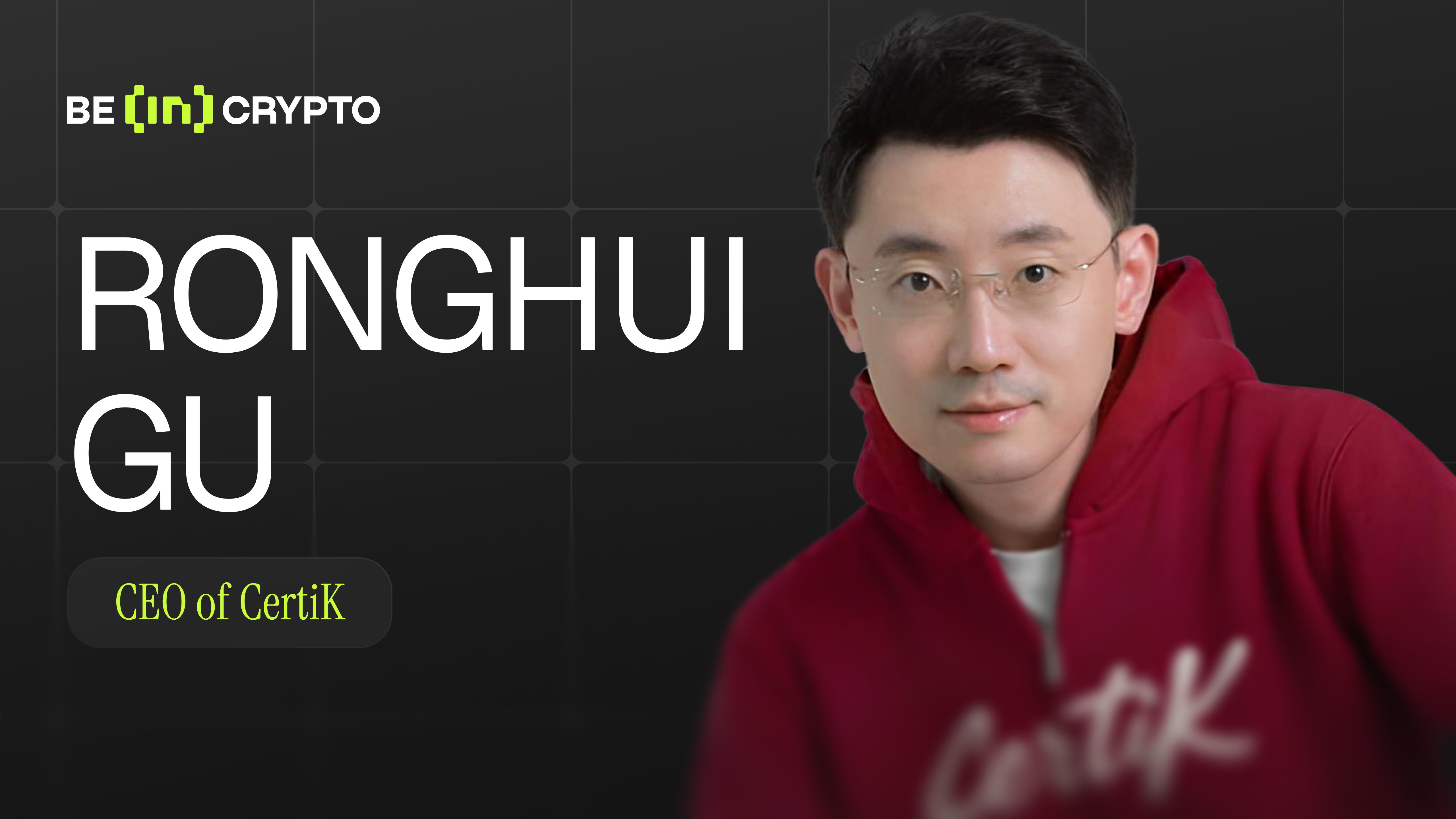
In an interview with BeInCrypto, CertiK CEO and Columbia University computer science professor Ronghui Gu explained the discovery, its potential economic consequences, and how a mathematical breakthrough could change the way AI models are developed.
“Right now, the AI industry is racing to make models faster and more sophisticated. Our work is a reminder that raw speed means very little if we can't trust the underlying math,” Gu said.
The Hidden Problem Inside Modern AI Models
Every time someone asks an AI chatbot a question, an enormous number of mathematical calculations take place. Much of this work is performed by small programs called GPU kernels.
Developers constantly modify these programs to make calculations faster and reduce computing costs. Some changes involve running several operations simultaneously or using less precise arithmetic.
These optimizations can introduce errors that are exceptionally difficult to notice.
In August 2025, some Claude users began receiving strange responses. English prompts occasionally produced unexpected Thai or Chinese characters. Generated computer code contained obvious syntax errors.
In its subsequent postmortem, Anthropic identified a performance optimization that caused incorrect probability calculations when Claude was generating responses.
“What makes these errors particularly concerning is that the software may continue running normally while producing incorrect computational results,” Gu explained.
Sometimes, an incorrect response may appear perfectly reasonable to the person reading it. That makes computational errors particularly difficult to identify.
“While there is no industry-wide estimate of how often these bugs go unnoticed, what we saw in our TensorLean research shows that silent errors are a real blind spot—one that conventional testing alone can't reliably catch.”
Is a faster AI kernel still correct?
— Ronghui Gu (@RonghuiGu) November 20, 2026
We built TensorLean with researchers at @CertiK and @ColumbiaCompSci , the first framework to formally verify production GPU kernels with complex optimizations.
149 GPU kernel instances verified
38 bugs in total
2 in @deepseek_ai ’s… pic.twitter.com/EQK3E0z3uu
Inside the 38 Bugs CertiK Discovered
On November 20, CertiK and Columbia University announced TensorLean, a framework for mathematically verifying the correctness of production GPU kernels.
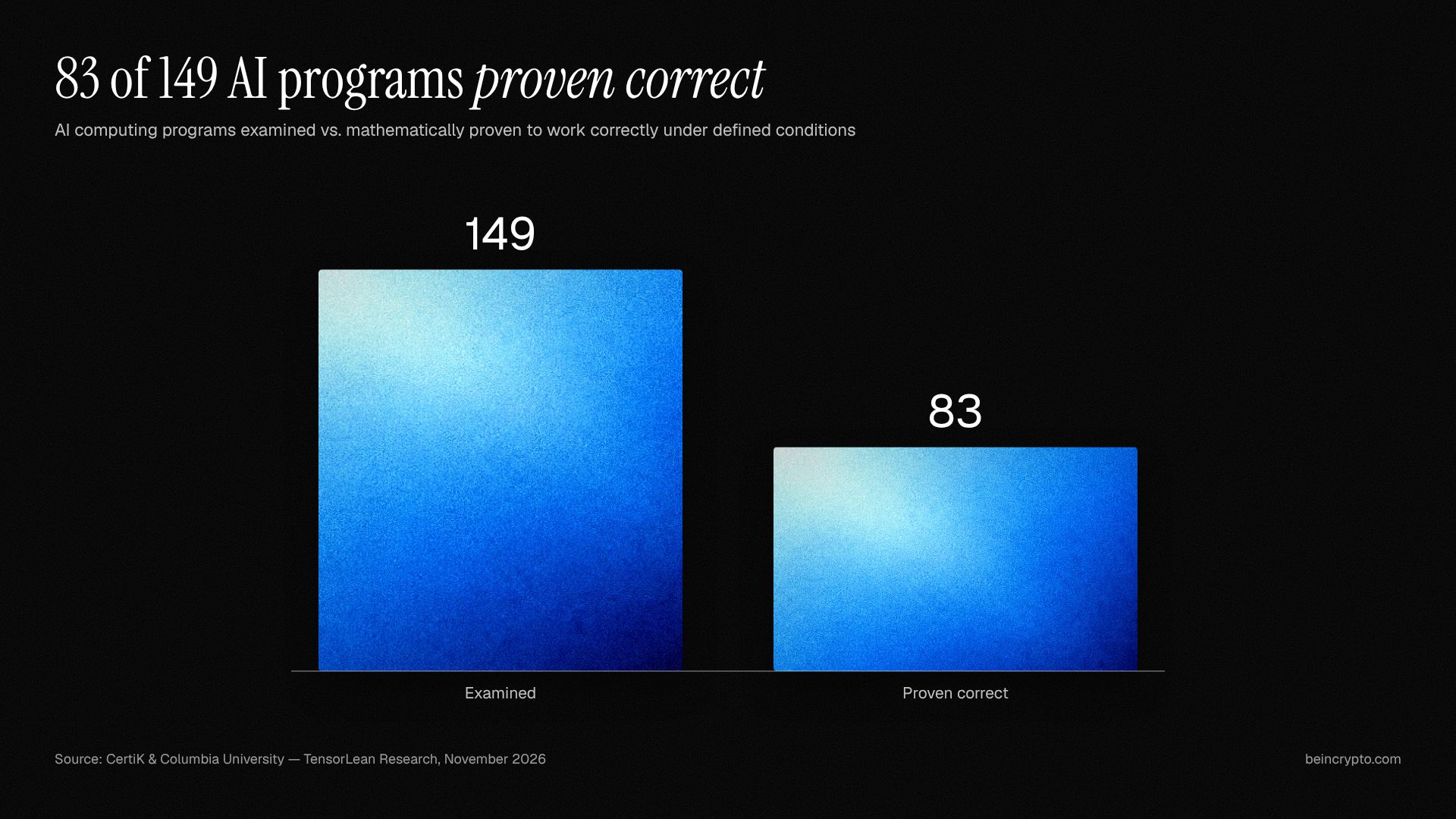
The researchers evaluated 149 compiled kernel instances. They proved that 83 satisfied their mathematical specifications and discovered 38 distinct bugs across six software libraries.
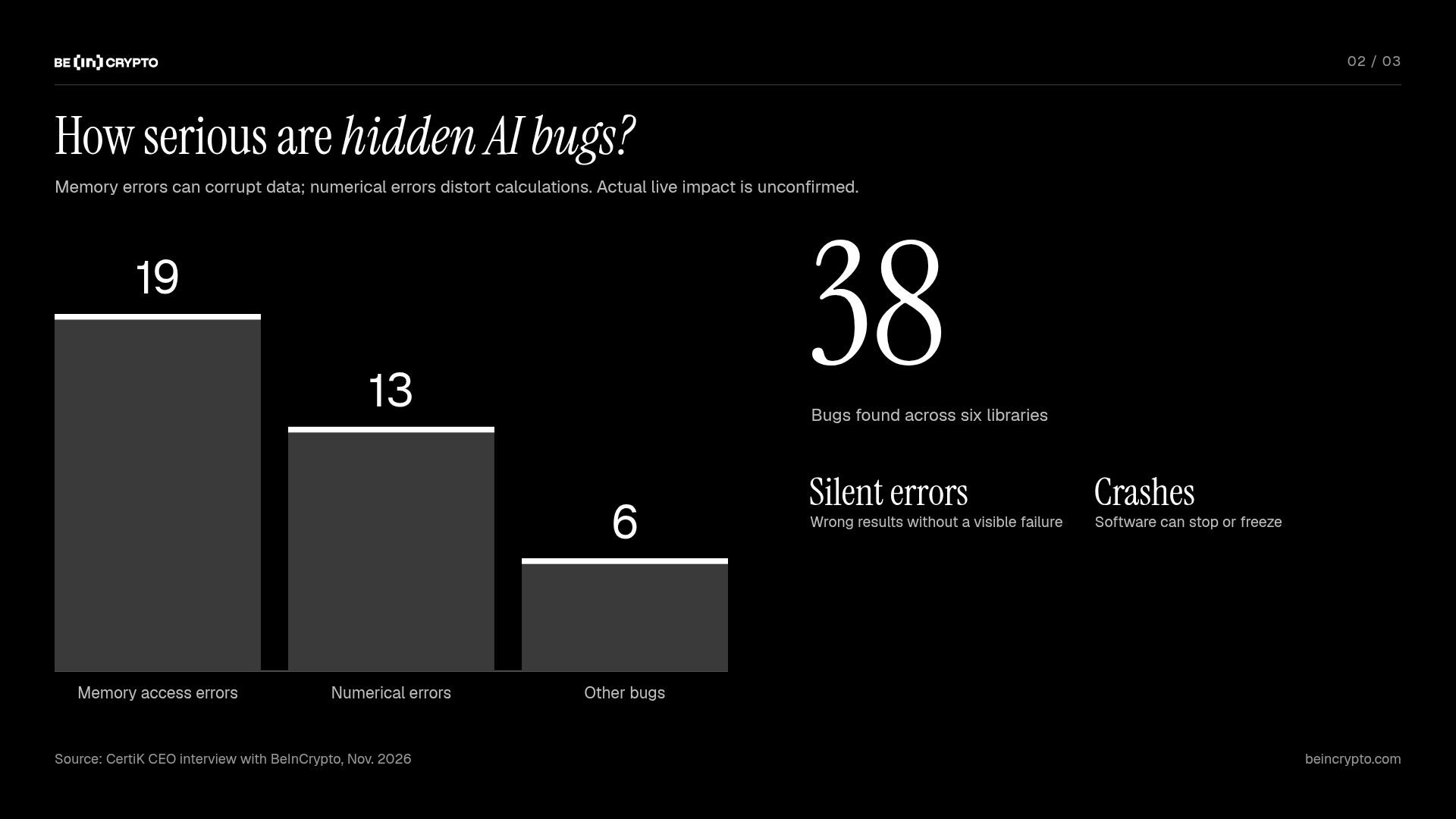
Among the findings were 19 memory access errors and 13 numerical bugs.
One particularly revealing discovery involved FlashAttention-4, part of a library that helps AI models process information more efficiently.
The researchers found that some computing operations could overwrite information before others had finished reading it.
Gu described the consequences as “essentially making the AI 'blind' to parts of the context it is supposed to be reading.”
The bug escaped 17,760 runs of relevant tests.
Furthermore, 19 of the 23 FlashAttention bugs appeared only under specific combinations of input shapes and software features.
“The same kernel may behave differently depending on input sizes, sequence lengths, hardware architectures, and execution configurations,” Gu explained.
Some of the discovered bugs could cause software to crash. Others could silently generate incorrect calculations.
However, CertiK has yet to establish whether these specific bugs affected commercial AI training or actual chatbot responses.
The Potential Million-Dollar Cost of a Computing Error
For AI companies, computational reliability is also an economic problem.
Training advanced AI models requires substantial investments in hardware, electricity and engineering. An undetected error could compromise expensive computations before developers realize something has gone wrong.
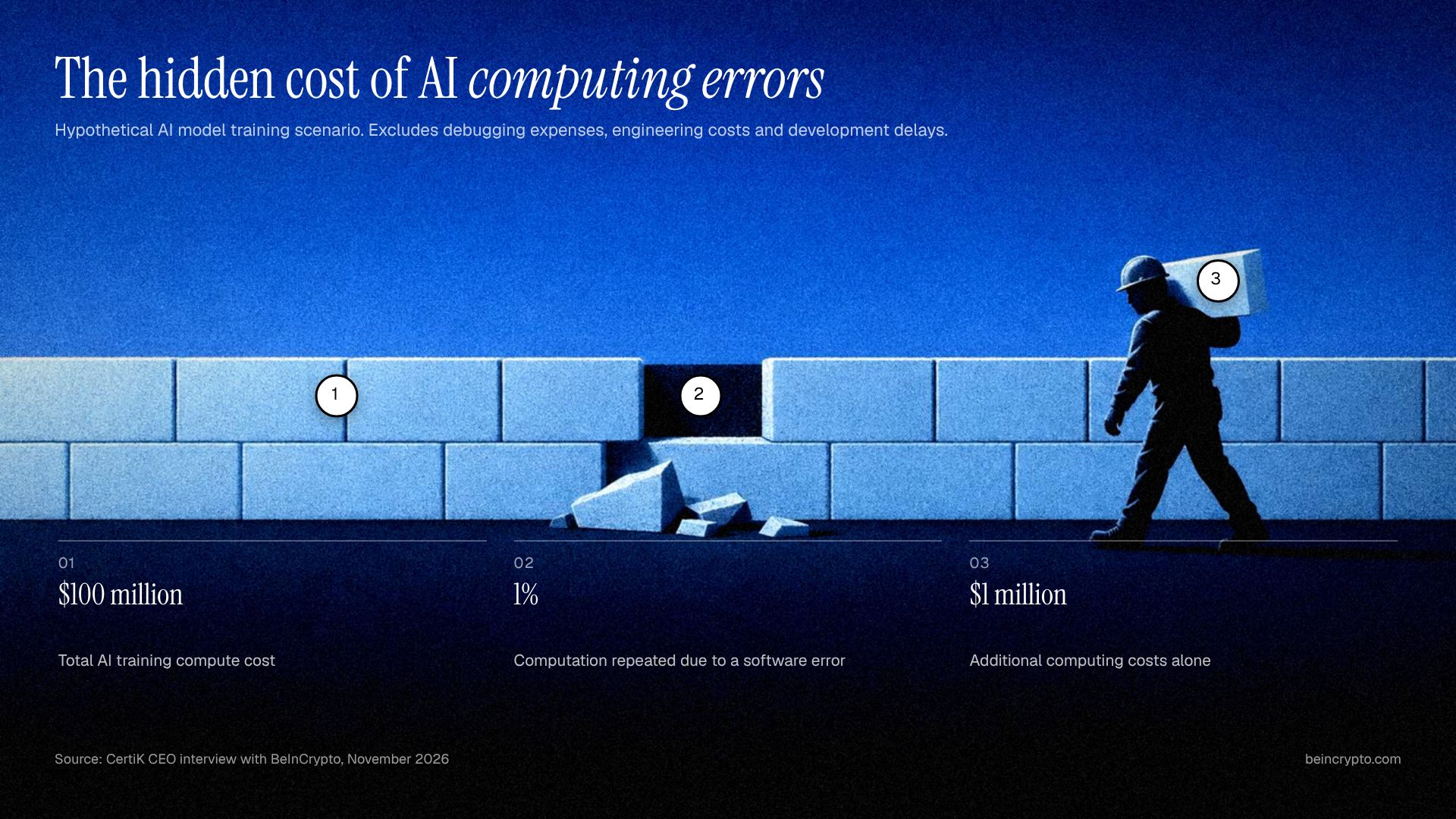
“Consider a hypothetical training run with $100 million in computing costs. If a computational error requires the equivalent of just 1% of that computation to be repeated, the additional compute cost alone would be $1 million,” Gu said.
“This does not account for engineering time, debugging efforts, or delays in model development.”
There is growing research into how small mathematical errors can disrupt AI training.
In October 2026, Google DeepMind researchers identified two numerical bugs in widely used mathematical operations. Their experiments demonstrated how these errors could cause a smaller AI model to drift away from the larger model it was learning to imitate.
As investors scrutinize AI companies' enormous infrastructure spending, computational accuracy could become an increasingly important factor in managing costs.
The actual savings TensorLean could deliver at commercial scale remain unquantified.
Can Mathematics Make AI More Reliable?
Conventional software testing works by running a program under different scenarios and checking the results. Even thousands of successful tests cannot cover every possible execution.
TensorLean uses a technique called formal verification.
Imagine testing a calculator with thousands of equations. Each correct answer increases confidence in the calculator. A mathematical proof goes further by establishing that its calculation method works across an entire defined range of numbers.
TensorLean applies a similar principle to AI computing software. It examines compiled GPU code and creates mathematical proofs using Lean, a language that allows computers to independently check the validity of mathematical reasoning.
“The central challenge is that the same optimizations that make modern AI software fast also make it extremely difficult to verify,” Gu said.
The breakthrough allows researchers to examine complex, high-performance computing code under realistic execution conditions.
Developers could potentially repeat this verification whenever they update their software.
The guarantees have limits. They apply to specific calculations under defined conditions and numerical tolerances. They cannot eliminate AI hallucinations or guarantee that an entire model produces factually accurate answers.
Major AI Companies Are Already Showing Interest
The research is also opening a new business opportunity for CertiK, a company primarily known for securing blockchain infrastructure.
“We have already been approached by leading AI companies seeking to verify their GPU kernels, especially when their new models rely on newly designed kernels,” Gu revealed.
CertiK plans to open-source TensorLean and release its full research paper in December 2026.
Gu believes mathematical verification could eventually become a routine part of AI software development, allowing companies to check computational accuracy whenever they introduce performance improvements.
“Our goal is to make rigorous mathematical verification keep pace with performance optimization, so that AI developers can improve computing efficiency without compromising computational correctness.”
For an industry investing heavily in making artificial intelligence more powerful, establishing whether its underlying calculations are correct could become a fundamental part of making those investments pay off.
Read the Original story CertiK Finds 38 Hidden AI Bugs That Could Cost the Industry Millions by Mohammad Shahid at beincrypto.com