


AST SpaceMobile, Inc. ASTS and Space Exploration Technologies Corp. SPCX are two leading communications services providers aiming to develop low-Earth orbit (LEO) satellite networks to deliver broadband and direct-to-device mobile connectivity. AST SpaceMobile is building the world’s first and only global cellular broadband network in space, accessible directly by standard smartphones (4G-LTE/5G devices) for commercial and government use, leveraging its extensive Intellectual Property and patent portfolio. The SpaceMobile Service is provided by a constellation of high-powered, large phased-array satellites in LEO using low-band and mid-band spectrums controlled by Mobile Network Operators (MNOs) in areas lacking terrestrial network coverage.
Operating a fleet of about 9,600 satellites in LEO (as of March 31, 2026), SpaceX's Starlink offers satellite Internet directly to consumers and business enterprises. The network served about 10.3 million Starlink subscribers across 164 countries and other markets. SpaceX reported a median residential download speed of 225 Mbps during peak hours.
Let us delve a little deeper into the companies’ competitive dynamics to understand which of the two is relatively better placed in the industry.
The Case for ASTS
AST SpaceMobile is likely to strengthen its position as one of the leading space-based cellular broadband service providers in the market with the proposed deployment of three satellites in its direct-to-device (D2D) constellation in August. The company is slated to launch BlueBird 11, 12, and 13 satellites from Cape Canaveral, FL.
Utilizing large phased array antennas measuring approximately 2,400 square feet, AST SpaceMobile's technology is backed by more than 3,800 patents and patent-pending claims. This design aims to deliver global cellular coverage by eliminating dead zones and providing space-based connectivity to areas without broadband service. By connecting directly to standard smartphones at broadband speeds, these advanced phased arrays eliminate the need for special equipment, enhancing current mobile networks while ensuring seamless use of existing mobile phones. The SpaceMobile service is compatible with all major brands available in the market and connects directly to everyday mobile phones.
AST SpaceMobile has partnered with leading carriers, such as AT&T Inc. T and Verizon Communications Inc. VZ, to tap into a pre-existing pool of cell customers and raise funds to help build a worldwide satellite network. This has enhanced cellular coverage in the United States, essentially eliminating dead zones and empowering remote areas of the country with space-based connectivity.
However, unfavorable macroeconomic conditions, including rising inflation, higher interest rates, capital market volatility, tariff imposition and geopolitical conflicts, are negatively impacting the company’s operations. These have led to continued fluctuations in satellite material prices, resulting in increased capital costs and pressure on the company’s financial performance. In addition, AST SpaceMobile faces severe competition from existing and new industry leaders like SpaceX’s Starlink and Globalstar, which are developing satellite communications technology using LEO constellations. To combat such competitive pressure, ASTS has to continuously customize its network offerings, enhance the cost-effectiveness of its products and services and boost the satellite data networks, which increases operating costs and reduces margins.
The Case for SPCX
SpaceX has transformed the launch industry through its reusable Falcon 9 rockets, significantly reducing launch costs and increasing mission frequency. The company now conducts more launches annually than any of its global competitors, giving it a commanding share of the commercial launch market. In addition, Starlink provides recurring subscription income and potentially higher long-term margins. The business also benefits from a powerful competitive advantage. SpaceX can launch its own satellites at a fraction of the cost of its competitors, allowing Starlink to expand its network faster and more efficiently. As global demand for reliable broadband connectivity increases, Starlink's prospects become solid.
The Elon Musk-led company is aiming to evolve into a vertically integrated artificial intelligence (AI) infrastructure company by combining advanced AI models, large-scale computing capabilities and satellite connectivity under one umbrella. The transformation is likely to unlock a significantly larger addressable market while diversifying the company's revenue base beyond launch services and Starlink. As part of the transition, xAI's flagship chatbot, Grok, will now operate under the SpaceXAI brand. The integration is expected to strengthen collaboration between the company's AI software, computing infrastructure and satellite network, creating a differentiated ecosystem that few competitors can match.
The company plans to deploy AI compute satellites as early as 2028, effectively creating space-based data centers capable of delivering large-scale computing capacity. This initiative leverages SpaceX's leadership in satellite deployment while addressing the growing demand for AI computing resources. Alongside its satellite ambitions, SpaceX continues to expand its Colossus data center platform, strengthening its position in AI infrastructure. SpaceX has also entered into a definitive agreement to acquire Anysphere in an all-stock deal valued at $60 billion. The buyout of a startup firm behind the rapidly growing AI coding assistant Cursor is primarily aimed at gaining a firmer footing in the enterprise AI market.
However, SpaceX is scaling several capital-intensive platforms simultaneously. The company is investing heavily in COLOSSUS, COLOSSUS II, Grok, enterprise offerings, compute services and future orbital AI compute. Management expects a multi-year investment cycle until sustained positive segment adjusted EBITDA is realized. The strategy may create a cost advantage if compute, energy and launch assets integrate as planned. Until then, AI adds uncertainty to margins, capital needs and consolidated earnings quality.
How Do Zacks Estimates Compare for ASTS & SPCX?
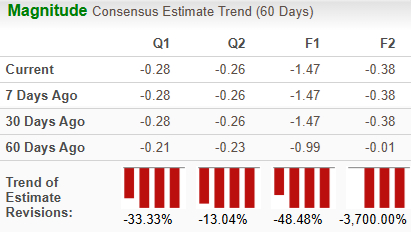
The Zacks Consensus Estimate for AST SpaceMobile’s 2026 sales implies year-over-year growth of 132.3%, while EPS estimates suggest a decline of 9.7%. EPS estimates have trended southward (down 48.5%) over the past 60 days.
Image Source: Zacks Investment Research
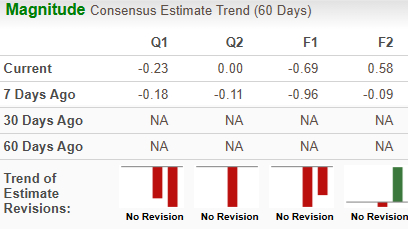
The Zacks Consensus Estimate for SpaceX’s fiscal 2026 sales implies year-over-year growth of 179.5%. EPS estimates have declined 28.1% over the past seven days.
Image Source: Zacks Investment Research
Price Performance & Valuation of ASTS & SPCX
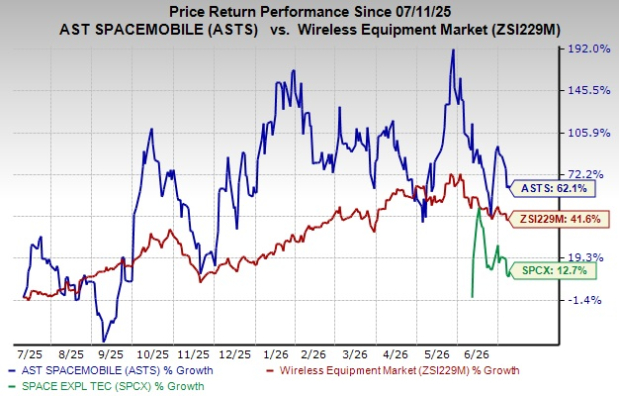
Over the past year, AST SpaceMobile has gained 62.1% compared with the industry’s growth of 41.6%. SpaceX is up 12.7% since its IPO.
Image Source: Zacks Investment Research
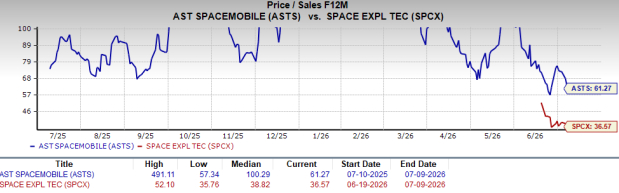
SpaceX looks more attractive than AST SpaceMobile from a valuation standpoint. Going by the price/sales ratio, SpaceX’s shares currently trade at 36.57 forward sales, significantly lower than AST SpaceMobile’s 61.27.
Image Source: Zacks Investment Research
ASTS or SPCX: Which is a Better Pick?
SpaceX carries a Zacks Rank #3 (Hold), while AST SpaceMobile carries a Zacks Rank #4 (Sell).
You can see the complete list of today’s Zacks #1 Rank (Strong Buy) stocks here.
Both companies expect their sales to improve in 2026. SpaceX is steadily transforming from a pure-play aerospace company into a diversified AI infrastructure leader. Its aggressive investments in AI computing, the integration of SpaceXAI, expanding enterprise partnerships and plans for space-based data centers underscore management's conviction that AI will be a key driver of future growth. With relatively healthy fundamentals and a better Zacks Rank, SpaceX appears to be a better investment proposition at the moment.
Zacks' Research Chief Names "Stock Most Likely to Double"
Our team of experts has just released the 5 stocks with the greatest probability of gaining +100% or more in the coming months. Of those 5, Director of Research Sheraz Mian highlights the one stock set to climb highest.
This top pick is a little-known satellite-based communications firm. Space is projected to become a trillion dollar industry, and this company's customer base is growing fast. Analysts have forecasted a major revenue breakout in 2025. Of course, all our elite picks aren't winners but this one could far surpass earlier Zacks' Stocks Set to Double like Hims & Hers Health, which shot up +209%.
Free: See Our Top Stock And 4 Runners UpWant the latest recommendations from Zacks Investment Research? Today, you can download 7 Best Stocks for the Next 30 Days. Click to get this free report
Space Exploration Technologies Corp. (SPCX): Free Stock Analysis Report
AST SpaceMobile, Inc. (ASTS): Free Stock Analysis Report
AT&T Inc. (T): Free Stock Analysis Report
Verizon Communications Inc. (VZ): Free Stock Analysis Report
This article originally published on Zacks Investment Research (zacks.com).