


Citigroup Inc. C and Wells Fargo & Company WFC delivered better-than-expected second-quarter 2026 results, reflecting improving revenue trends, disciplined expense management and healthy capital positions. Despite these similarities, the two banking giants are at different stages of their growth journeys.
Citigroup is gaining momentum as its multi-year restructuring begins to translate into stronger revenue growth, improved operating leverage and enhanced shareholder returns. Wells Fargo, conversely, is entering a phase of expansion after the Fed lifted its long-standing asset cap, giving the bank greater flexibility to grow its balance sheet and capitalize on improving net interest income (NII).
Against this backdrop, a closer look at their business outlooks, earnings prospects, capital deployment plans and valuations helps determine which stock offers the more compelling opportunity.
Strategic Transformation: Citigroup vs. Wells Fargo
C and WFC are taking different approaches to strengthen their operations and unlock growth opportunities.
Citigroup has strong global franchises across institutional banking, services, cards, wealth management and cross-border corporate finance. However, the bank has historically lagged peers in profitability, efficiency and shareholder returns. Its second-quarter 2026 results suggested that the multi-year turnaround is beginning to strengthen its earnings power and create room for additional investment.
Under CEO Jane Fraser, Citigroup has been working to simplify the organization. This includes exiting several international consumer markets, reducing management layers, cutting costs and focusing on higher-return businesses. Driven by these initiatives, Citigroup is targeting a return on tangible common equity (ROTCE) of 10-11% in 2026.
Conversely, Wells Fargo has been exiting non-core, lower-return businesses to sharpen its focus on consumer banking, commercial lending, and other high-return areas. Under CEO Charlie Scharf since 2019, the strategy targets up to $10 billion in annual cost cuts and capital reallocation to core franchises. The removal of asset cap in 2025 eliminates a long-standing constraint on balance-sheet expansion, allowing the company to grow deposits, increase loan balances and expand securities holdings, thereby unlocking its full operating potential. With greater strategic flexibility and improved earnings visibility, WFC expects its medium-term ROTCE target of 17-18%, indicating stronger profitability prospects over the next few years.
C vs. WFC: Comparing Revenue Growth Prospects
Citigroup’s restructuring is beginning to translate into stronger operating performance. The company’s second-quarter 2026 revenues rose 14.3%, marking its highest quarterly revenues in a decade. The breadth of this growth is important. Citigroup is not relying solely on expense reductions to improve earnings. Stronger performance across multiple businesses suggests that the bank’s simplified structure and focused investments are also supporting organic revenue expansion. Citigroup expects revenues to see a 4-5% compound annual growth rate through 2026.
The favorable operating backdrop should provide an additional tailwind. Management expects NII, excluding Markets, to increase 5-6% in 2026, supported by stabilizing funding costs, improving loan demand and asset repricing. Non-interest revenue growth will likely to be driven by continued fee momentum in Services, Banking and Wealth businesses.
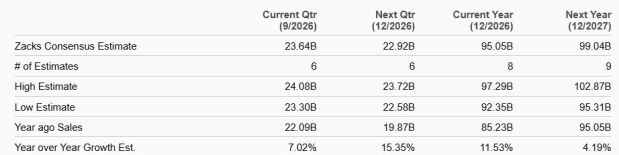
The Zacks Consensus Estimate for C's 2026 and 2027 revenues indicates a year over year growth of 11.5% and 4.2%, respectively.
Revenue Estimates
Image Source: Zacks Investment Research
Wells Fargo’s revenue trends have also improved. After revenues declined, seeing a 0.3% compound annual rate between 2019 and 2025, they increased 8.6% year over year in the second quarter of 2026 on higher NII and fee revenues.
With removal of assset cap, the bank can now expand deposits, increase lending and grow its securities portfolio without the balance-sheet restriction, efforts that will help in an increase in NII. Management expects NII to approach $50 billion in 2026, up from $47.5 billion in 2025. The bank also gains room to scale fee-based businesses like payment services, asset management, and mortgage origination, enhancing its revenue mix and supporting future top-line growth.
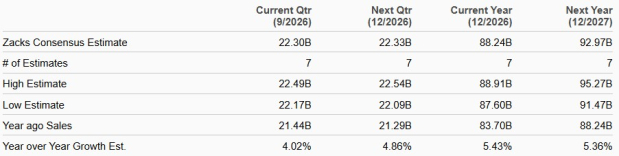
The Zacks Consensus Estimate for WFC's 2026 and 2027 revenues indicates a year over year growth of nearly 5.4%.
Revenue Estimates
Image Source: Zacks Investment Research
WFC & C’s Expense Management Strategies
As the banking industry adapts to rising expenses, shifting customer preferences and ongoing digital disruption, Citigroup and Wells Fargo are sharpening their focus. However, their approaches to expense management reflect two different paths.
Citigroup is not just trimming around the edges; it is undergoing a full-fledged transformation under the leadership of CEO Jane Fraser. The company is overhauling its operating model, simplifying reporting structures, reducing headcounts and streamlining operations. Driven by these efforts, management expects to achieve $2-$2.5 billion in annualized run rate savings by 2026.
In contrast, Wells Fargo is adopting a more balanced strategy that combines cost discipline with targeted investments. While the bank continues to optimize operations through workforce reductions and process improvements, it is also investing in its branch network and enhancing its digital capabilities to improve customer experience. This approach enables Wells Fargo to control expenses while strengthening customer service and accessibility.
As part of its efficiency initiatives, Wells Fargo reduced its branch network by 1.4% year over year to 4,079 locations at the end of the second quarter of 2026. The bank also lowered its workforce by 7% year over year during the same period. Despite these cost-saving measures, WFC expects noninterest expense to increase to $55.7 billion in 2026, compared with $54.8 billion in 2025, reflecting continued investments in strategic growth initiatives.
C vs. WFC: Capital Strength & Shareholder Returns
On the capital front, both C and WFC remain well above the current regulatory requirement. At the end of second-quarter 2026, C’s CET1 ratio was 12.8% while WFC’s CET1 ratio was 10.3%.
Post successful completion of this year’s stress test, WFC announced its intention to increase its third-quarter 2026 common stock dividend 11% to 50 cents per share, subject to board approval. It also has a share repurchase program in place. As of March 31, 2026, the company had remaining authority to repurchase up to $25.7 billion of common stock.
Similarly, post clearing the Fed’s 2026 stress test, C announced a 12% quarterly common stock dividend increase beginning in the third quarter of 2026. The company has also initiated a $30-billion multi-year common stock repurchase program.
C & WFC Earnings Estimates
The earnings outlook further highlights the difference in the growth trajectories of the two banks.
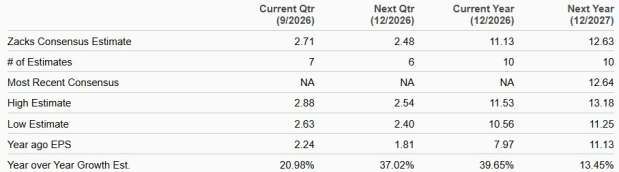
The Zacks Consensus Estimate projects Citigroup's earnings to grow 39.7% in 2026, followed by an additional 13.5% increase in 2027, reflecting the early benefits of its restructuring initiatives, improving operating leverage and stronger business momentum.
Earnings Estimates
Image Source: Zacks Investment Research
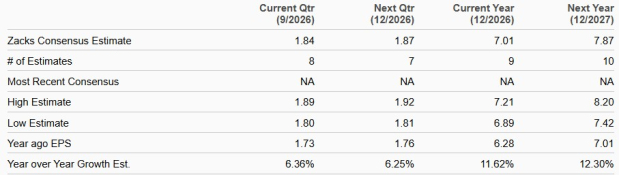
By comparison, Wells Fargo's earnings are expected to rise 11.6% in 2026 and 12.3% in 2027. While these estimates point to steady earnings expansion, the pace is considerably slower than Citigroup's, as the bank's post-asset-cap growth strategy is likely to unfold more gradually.
Earnings Estimates
Image Source: Zacks Investment Research
C & WFC’s Stock Performance & Valuation
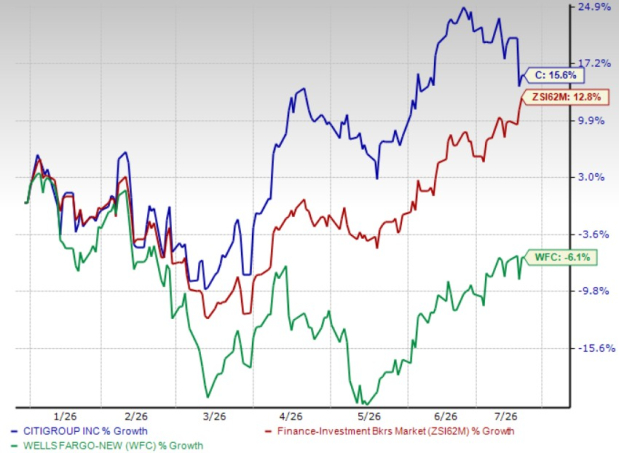
Year to date, Wells Fargo shares have fallen 6.1%, whereas Citigroup’s stock has gained 15.6%. In comparison, the industry has risen 12.8%.
Price Performance
Image Source: Zacks Investment Research
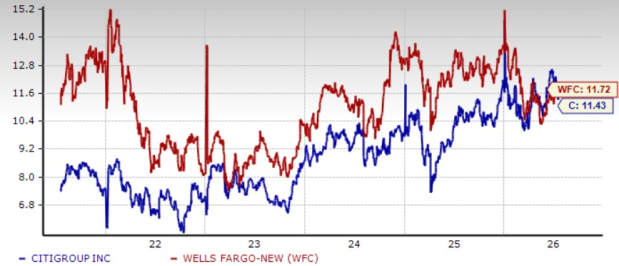
In terms of valuation, Citigroup’s trailing 12-month price-to-earnings (P/E) ratio is 11.43X, while Wells Fargo’s is 11.72X. Both stocks are trading at a discount compared with the industry’s trailing 12-month P/E ratio of 14.76X, but the C stock is cheaper than WFC.
Price-to-Earnings F12M
Image Source: Zacks Investment Research
C or WFC: Which Stock Offers Greater Upside Potential?
Citigroup appears more compelling for both growth and value-focused investors. Its restructuring efforts are driving stronger revenues, positive operating leverage, lower credit costs and faster earnings growth than Wells Fargo. Despite this improving outlook, Citigroup trades at a slightly lower forward P/E, offering stronger growth at a more attractive valuation.
Its solid CET1 ratio also supports higher dividends and a $30-billion share repurchase program, strengthening total shareholder returns. Wells Fargo remains a solid long-term option following the removal of the asset cap, but the benefits of renewed balance-sheet expansion may take longer to materialize.
Therefore, supported by accelerating turnaround momentum, superior near-term earnings growth, substantial capital returns and a more attractive valuation, Citigroup emerges as the bank with better upside potential.
At present, both C and WFC carry a Zacks Rank #3 (Hold). You can see the complete list of today’s Zacks #1 Rank (Strong Buy) stocks here.
Zacks' Research Chief Names "Stock Most Likely to Double"
Our team of experts has just released the 5 stocks with the greatest probability of gaining +100% or more in the coming months. Of those 5, Director of Research Sheraz Mian highlights the one stock set to climb highest.
This top pick is a little-known satellite-based communications firm. Space is projected to become a trillion dollar industry, and this company's customer base is growing fast. Analysts have forecasted a major revenue breakout in 2025. Of course, all our elite picks aren't winners but this one could far surpass earlier Zacks' Stocks Set to Double like Hims & Hers Health, which shot up +209%.
Free: See Our Top Stock And 4 Runners UpWant the latest recommendations from Zacks Investment Research? Today, you can download 7 Best Stocks for the Next 30 Days. Click to get this free report
Wells Fargo & Company (WFC): Free Stock Analysis Report
Citigroup Inc. (C): Free Stock Analysis Report
This article originally published on Zacks Investment Research (zacks.com).