


JPMorgan JPM and Morgan Stanley MS crushed expectations and delivered blockbuster second-quarter results, supported by resilient trading activity, improving investment banking (IB) revenues and solid wealth management performance. However, differences in business mix, valuation, earnings momentum and capital-return prospects could determine which banking giant offers stronger upside potential for investors following their impressive quarterly performances.
Against this backdrop, let us examine the growth prospects of JPM and MS and determine which stock appears to be the better investment at present.
The Case for JPMorgan
JPMorgan posted the highest quarterly profit ever recorded by a U.S. bank, reporting record net income of $21.2 billion or $7.70 per share for the second quarter. This was fueled by a huge boom in IB deals and heavy stock trading, and also included certain significant one-time items.
Supported by a healthy deal pipeline and resilient M&A demand, IB momentum is expected to remain favorable. Additionally, JPM raised its 2026 net interest income (NII) outlook to approximately $105.5 billion from $103 billion, reflecting a favorable balance sheet mix, loan growth and higher revolving card balances.
Its expanding branch and digital network should strengthen primary banking relationships, cross-selling opportunities and long-term deposit share gains. Continued investments in AI, technology, branches and front-office talent are expected to improve efficiency, service quality and risk controls. JPMorgan also retains flexibility for selective acquisitions and partnerships in areas such as asset management, data and technology, while prioritizing organic growth and capital returns.
However, expenses are likely to stay elevated as the company invests in technology, marketing and growth initiatives. The bank raised its non-interest income outlook for 2026 to $107.5 billion from $106 billion. JPM’s mortgage business remains exposed to rate-sensitive customer behavior and housing activity and is a less dependable growth contributor compared with cards, payments and wealth management. Also, credit quality remains a watch item amid a tougher, more uncertain macro environment.
The Case for Morgan Stanley
Like JPM, Morgan Stanley posted solid second-quarter results, driven by robust client engagement and strength in IB and trading activities. Wealth management also performed well, driven by record asset management revenues and strong client activity, with total client assets crossing the $10 trillion mark. The company’s net income soared 58% year over year to $5.58 billion.
Morgan Stanley’s expanding global M&A pipeline, improving regulations, healthier IPO activity and pent-up demand should support IB growth. Moreover, the company’s workplace pipeline, adviser referrals and enhanced capabilities should support asset retention, net new asset growth and Wealth Management revenues.
This reinforces the success of Morgan Stanley’s efforts to diversify its operations and reduce its reliance on the capital markets and create a more balanced revenue stream across market cycles. Increased focus on investment and wealth management, along with strategic alliances and acquisitions (Eaton Vance, E*Trade Financial, Shareworks and EquityZen), also offers support. The company remains open to selective acquisitions but maintains a high bar, prioritizing strategic fit, cultural alignment and organic opportunities.
Morgan Stanley’s partnership with Mitsubishi UFJ Financial Group, Inc. will keep supporting profitability and solidify its position in Japan’s market. The company’s Asia region revenues jumped 23% year over year to $9.42 billion in 2025, with momentum continuing this year. In the first six months of 2026, revenues from the region surged 57%.
Despite Morgan Stanley’s restructuring and streamlining efforts, overall expenses have been increasing. Expenses are expected to remain elevated due to the steady increase in revenues (leading to higher compensation costs) and inflation, as well as the company’s investments in franchise, technology and inorganic expansion efforts.
JPM & MS: Price Performance & Valuation Analysis
So far this year, shares of JPMorgan and Morgan Stanley have gained 6.5% and 23.1%, respectively.
JPM & MS YTD Price Performance
Image Source: Zacks Investment Research
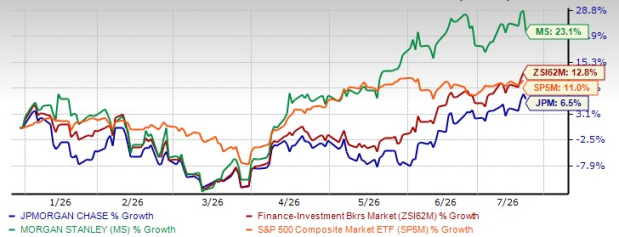
JPM lagged the Zacks Investment Bank industry and the S&P 500 Index, while MS has fared better than the broader index and the industry.
In terms of valuation, JPMorgan is currently trading at a 12-month forward price-to-earnings (P/E) of 14.65X. MS stock, on the other hand, is currently trading at a 12-month forward P/E of 17.72X.
P/E F12M
Image Source: Zacks Investment Research
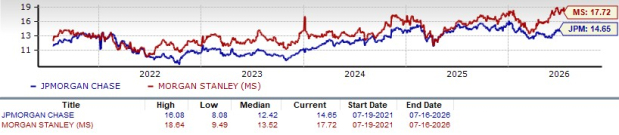
JPM is trading at a discount and Morgan Stanley is trading at a premium compared with the industry average of 14.85X. So, JPMorgan stock is inexpensive.
How Do Estimates Compare for JPM & MS?
The Zacks Consensus Estimate for JPM’s revenues implies a 11.4% and 2.9% year-over-year rise for 2026 and 2027, respectively. The company’s earnings are expected to grow 12.4% in 2026 and 5.7% in 2027. Earnings estimates for both years have moved higher over the past week.
Estimate Revision
Image Source: Zacks Investment Research

The consensus mark for Morgan Stanley’s revenues suggests a year-over-year jump of 9.9% for 2026 and 4.3% for 2027. Also, the consensus estimate for earnings suggests a 17.3% and 5.3% increase for 2026 and 2027, respectively. Over the past seven days, earnings estimates have remained unchanged.
Estimate Revision
Image Source: Zacks Investment Research

Post Q2 2026 Earnings: JPMorgan or Morgan Stanley?
After a robust second-quarter performance, JPMorgan and Morgan Stanley both offer compelling growth prospects, but their strengths differ. MS benefits from faster earnings momentum, an improving IB backdrop and a powerful Wealth Management franchise supported by workplace channels, adviser referrals and $10 trillion in client assets. Its expanding presence in Asia and strategic partnerships further enhance its long-term growth potential.
Nonetheless, JPMorgan appears better positioned for portfolio inclusion. Its unmatched scale, diversified earnings base, rising NII, broad deposit franchise and disciplined capital allocation provide greater earnings visibility and resilience across economic cycles. The bank’s expanding branch network, strong cross-selling capabilities and investments in AI and technology should support sustained growth and operating efficiency. Moreover, JPM’s lower valuation relative to Morgan Stanley strengthens its risk-reward appeal.
At present, JPMorgan sports a Zacks Rank #1 (Strong Buy), while Morgan Stanley carries a Zacks Rank #2 (Buy). You can see the complete list of today’s Zacks #1 Rank stocks here.
7 Best Stocks for the Next 30 Days
Just released: Experts distill 7 elite stocks from the current list of 220 Zacks Rank #1 Strong Buys. They deem these tickers "Most Likely for Early Price Pops."
Since 1988, the full list has beaten the market more than 2X over with an average gain of +23.9% per year. So be sure to give these hand picked 7 your immediate attention.
See them now >>Want the latest recommendations from Zacks Investment Research? Today, you can download 7 Best Stocks for the Next 30 Days. Click to get this free report
JPMorgan Chase & Co. (JPM): Free Stock Analysis Report
Morgan Stanley (MS): Free Stock Analysis Report
This article originally published on Zacks Investment Research (zacks.com).