


Pfizer's PFE business mix has changed significantly over the past few years. During the pandemic, the company became heavily dependent on COVID-19 products, Comirnaty (COVID-19 vaccine) and Paxlovid (oral antiviral). However, the company is gradually diversifying its portfolio through a combination of internal product launches, strategic acquisitions and the continued growth of several established brands.
Pfizer’s non-COVID portfolio is increasingly becoming the company’s primary engine of growth, helping offset the sharp decline in Comirnaty and Paxlovid revenues. The latest second-quarter 2026 results provide particularly strong evidence of this transition. Pfizer’s revenues excluding Comirnaty and Paxlovid increased 5% operationally, while its launched and acquired products grew 18% operationally. Pfizer also raised the midpoint of its 2026 revenue guidance by $500 million, with the company attributing roughly $1.5 billion of the improvement to better-than-expected performance of non-COVID products.
Established Brands & New Products Drive PFE’s Non-COVID Growth
A key driving factor behind growth in non-COVID revenues has been the continued rise in sales of several established brands like Vyndaqel and alliance revenues from partner Bristol-Myers BMY for Eliquis.
Some internally developed product launches are also contributing to its top-line growth. Key recent product launches include Abrysvo, the first RSV vaccine approved for older adults and for maternal immunization to protect infants; Zavzpret, a nasal spray CGRP antagonist for acute migraine treatment; Hympavzi, a once-weekly treatment for hemophilia A and B with inhibitors; Elrexfio, a BCMA-targeted bispecific antibody for relapsed or refractory multiple myeloma, and Litfulo for severe alopecia areata.
PFE’s Acquisitions Complement Internal R&D
The company is also trying to rebuild its pipeline through acquisitions. Seagen, Metsera and Biohaven are the most significant strategic acquisitions in recent years and could turn out to be transformative opportunities for the company. A key acquired product that has become a significant contributor to revenue growth is Padcev, added from Seagen.
In the second quarter, revenues from Pfizer’s acquired products like Padcev, Nurtec (added from Biohaven) and others grew 25% operationally, when excluding the impact of certain one-time items in the same quarter a year ago.
Pfizer’s Pipeline Provides a Second Wave of Growth
Pfizer is rebuilding its pipeline in oncology and obesity, which it believes can drive growth in 2028 and beyond. In obesity, Pfizer plans an extensive phase III program for berobenatide, its monthly GLP-1 receptor agonist added from last year’s Metsera acquisition, in 2026. Pfizer plans to start more than 20 obesity studies in 2026, including 10 phase III studies for berobenatide for obesity and obesity-related comorbidities, including knee osteoarthritis and obstructive sleep apnea. Pfizer is targeting the first of a series of potential approvals for berobenatide in 2028. However, in the obesity space, Pfizer lags behind leaders like Eli Lilly LLY and Novo Nordisk NVO.
The currently available and highly popular weight loss GLP therapies, Eli Lilly’s Zepbound and Novo Nordisk’s Wegovy, are weekly injections. On the other hand, Pfizer’s berobenatide starts off as a weekly injection and then switches to a monthly injection. Berobenatide is designed for monthly maintenance dosing.
Pfizer is also advancing its oncology clinical pipeline across areas such as breast, thoracic, gastrointestinal and blood cancer. Several oncology candidates have entered late-stage development. Pfizer plans to start four pivotal studies for PF-08634404, a dual PD-1/VEGF inhibitor in-licensed from Chinese biotech 3SBio in 2025. Besides obesity and oncology, Pfizer is advancing candidates in migraine, hemophilia, vaccines, inflammation and immunology. Several of these programs could create additional growth opportunities over the next several years.
Conclusion
Although Pfizer’s 2026 sales guidance indicates minimal growth, the company expects a high single-digit revenue CAGR for five years, starting from year-end 2028. Pfizer expects its recently launched and acquired products, along with a strong pipeline, to help it return to growth from 2029 onward.
The key question is therefore shifting from “How quickly will Pfizer recover from the decline in COVID revenues?” to “Can its newer products grow rapidly enough to deliver sustainable overall growth amid an approaching patent cliff and continued pricing pressures?” So far, the outlook appears increasingly encouraging. Established growth drivers such as Eliquis, Vyndaqel, Padcev and Lorbrena are already generating meaningful growth, while newer launches, obesity programs and a broader pipeline could provide additional growth opportunities over the next several years.
PFE’s Price Performance, Valuation and Estimates
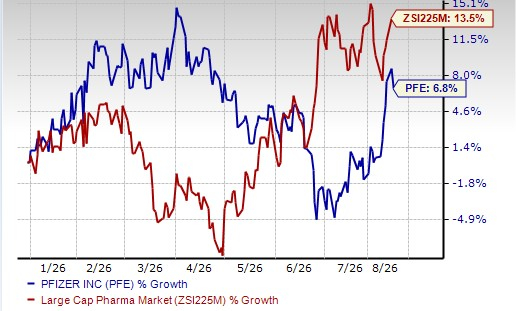
Pfizer’s stock has risen 6.8% so far this year compared with an increase of 13.5% for the industry.
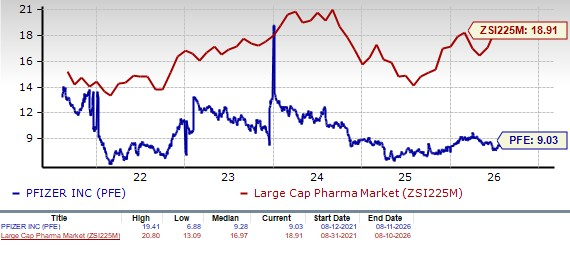
From a valuation standpoint, Pfizer appears attractive relative to the industry and is trading below its five-year mean. Going by the price/earnings ratio, Pfizer’s shares currently trade at 9.03 forward earnings, significantly lower than 18.91 for the industry and slightly below the stock’s five-year mean of 9.28. The stock is also trading below most large drugmakers like Lilly, Novo Nordisk, AstraZeneca, AbbVie, J&J and others.
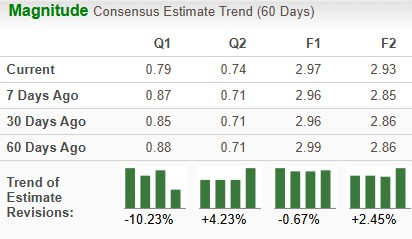
The Zacks Consensus Estimate for 2026 earnings has risen from $2.96 per share to $2.97 per share, while that for 2027 has risen from $2.86 per share to $2.93 per share over the past 60 days.
Pfizer has a Zacks Rank #3 (Hold) at present. You can see the complete list of today’s Zacks #1 Rank (Strong Buy) stocks here.
Beyond Nvidia: AI's Second Wave Is Here
The AI revolution has already minted millionaires. But the stocks everyone knows about aren't likely to keep delivering the biggest profits. AI’s second wave is moving from infrastructure to implementation and these companies are at the forefront of this transition, positioned to become what Amazon and Google were to the internet era.
See Stocks Now >>Want the latest recommendations from Zacks Investment Research? Today, you can download 7 Best Stocks for the Next 30 Days. Click to get this free report
Pfizer Inc. (PFE): Free Stock Analysis Report
Bristol Myers Squibb Company (BMY): Free Stock Analysis Report
Novo Nordisk A/S (NVO): Free Stock Analysis Report
Eli Lilly and Company (LLY): Free Stock Analysis Report
This article originally published on Zacks Investment Research (zacks.com).