


Bloom Energy BE and FuelCell Energy FCEL are two fuel-cell and hydrogen power companies focused on clean energy applications, including distributed power and transportation/power-generation markets.
As clean energy gains importance and new technologies emerge to produce it, companies like Bloom Energy and Plug Power are attracting attention. Both companies are advancing clean energy generation through innovative technologies.
Bloom Energy is a global leader in on-site power generation, gaining from increasing demand for clean energy from AI-driven data centers, as well as from customers increasingly adopting distributed energy solutions to bypass transmission and distribution constraints.
FuelCell Energy is a clean energy company that develops and provides stationary fuel cell systems for on-site, continuous power generation. It is increasingly aligning with the fast-growing AI and high-density data center market.
Let's delve deeper to find out which stock among BE and PLUG is better positioned for sustainable growth.
The Case for BE
Bloom Energy is expanding its onsite power platform to help customers address power shortages, grid bottlenecks, long deployment timelines and rising electricity costs. The company stands to benefit from the rapid buildout of AI infrastructure, growing demand for reliable and affordable electricity, and government support for energy independence and domestic manufacturing.
Its Energy Server generates electricity at the customer’s location and connects directly to onsite electrical systems, reducing reliance on transmission infrastructure. Using Bloom Energy’s proprietary solid oxide technology, the platform produces power through an efficient electrochemical process. This approach provides dependable and cleaner electricity for commercial and utility customers. Its adoption could accelerate among AI data centers, cryptocurrency miners, advanced manufacturers and other power-intensive businesses.
Management’s latest outlook points to a sharp acceleration in growth. Bloom Energy took 21 years to achieve its first $1 billion revenue year in 2022 and another three years to double that figure. The company now expects revenues to double again within just one year.
Bloom Energy and Brookfield also expanded their strategic partnership, increasing planned investment in AI-focused power infrastructure from $5 billion to $25 billion. The fivefold increase highlights the growing need for quickly deployable power solutions as hyperscale AI data centers expand worldwide.
At the same time, Bloom Energy continues to invest in research and development to improve system performance, reduce manufacturing costs and support stronger margins. Over the long term, it aims to make solid oxide fuel-cell technology a leading onsite power solution for data centers, critical infrastructure and other energy-intensive applications.
The Case for FCEL
FuelCell Energy is targeting attractive growth opportunities in AI-driven data centers, where rising electricity demand and grid constraints are increasing the need for reliable on-site power. In the second quarter of 2026, the company reported a 4-GW sales pipeline, up 267% sequentially, with roughly 89% linked to potential data-center customers. It also introduced a standardized 12.5-MW fuel-cell power block designed to accelerate deployment for AI facilities facing lengthy grid-interconnection delays.
South Korea provides better near-term revenue visibility, supported by scheduled module shipments to Gyeonggi Green Energy and upcoming deliveries for CGN Yulchon. Meanwhile, FuelCell Energy is expanding production capacity at its Torrington, CT, facility. Management believes that an annual output of at least 100 MW would provide the scale required to achieve adjusted EBITDA profitability.
The company’s collaboration with ExxonMobil Technology and Engineering on carbon-capture modules offers another potential growth avenue as industrial customers seek lower-carbon power and emissions-reduction solutions.
However, the investment case remains highly speculative. FuelCell Energy is still unprofitable, and its rapidly growing pipeline primarily consists of proposals rather than firm contracts. Backlog has declined, production remains below the level needed to support durable earnings improvement, and the timing and conversion rate of data-center opportunities remain uncertain.
Estimates for BE and FCEL
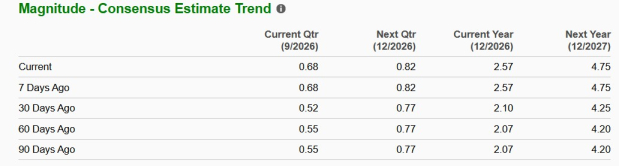
The Zacks Consensus Estimate for BE’s 2026 revenues implies a 103.4% increase, and that for EPS suggests a 238.2% year-over-year increase. EPS estimates for 2026 have moved 22.4% north in the last 30 days. It has a Growth Score of A. The expected long-term earnings growth rate is pegged at 38%.
Image Source: Zacks Investment Research
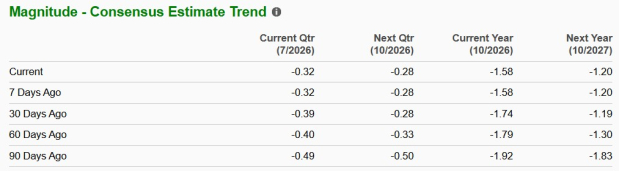
The Zacks Consensus Estimate for FCEL’s fiscal 2026 revenues implies a 2.8% decrease, while that for EPS indicates a 64.2% increase. The consensus estimate for fiscal 2026 earnings witnessed a 10% northbound movement in the last 30 days. The company has a Growth Score of B.
Image Source: Zacks Investment Research
Price Performance of BE and FCEL
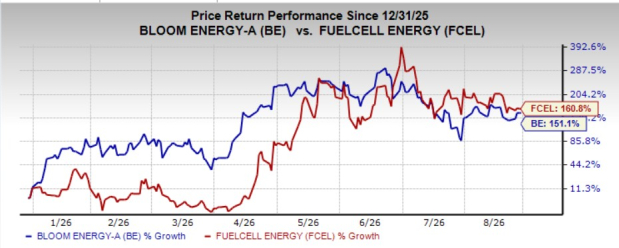
BE shares have gained 151.1% year to date, while FCEL shares have gained 160.8% in the same time.
Image Source: Zacks Investment Research
Are BE and FCEL Shares Expensive?
BE is trading at a forward 12-month price-to-sales multiple of 11.32, higher than its median of 2.95 over the past three years. FCEL’s forward 12-month price-to-sales multiple sits at 6.39, higher than its median of 2.07 over the past three years.
Image Source: Zacks Investment Research
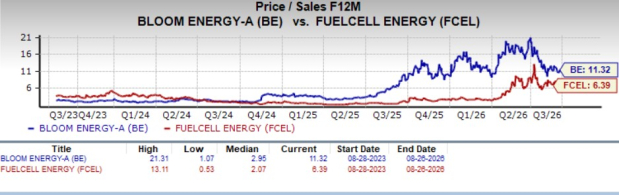
FCEL is cheaper than BE presently.
Conclusion
Bloom Energy continues to demonstrate resilient performance, supported by rising demand for clean energy and its ability to provide rapid and dependable power solutions. Demand for the company’s offerings is expected to grow further as it delivers customized clean energy solutions directly to customers, reducing reliance on traditional transmission and distribution infrastructure.
FuelCell Energy is increasingly aligning with the fast-growing AI and high-density data center market. However, it has been incurring losses, and a turnaround is not expected soon.
BE sports a Zacks Rank #1 (Strong Buy) while FCEL carries a Zacks Rank #3 (Hold), giving Bloom Energy an edge over FuelCell.
You can see the complete list of today’s Zacks #1 Rank stocks here.
7 Best Stocks for the Next 30 Days
Just released: Experts distill 7 elite stocks from the current list of 220 Zacks Rank #1 Strong Buys. They deem these tickers "Most Likely for Early Price Pops."
Since 1988, the full list has beaten the market more than 2X over with an average gain of +23.9% per year. So be sure to give these hand picked 7 your immediate attention.
See them now >>Want the latest recommendations from Zacks Investment Research? Today, you can download 7 Best Stocks for the Next 30 Days. Click to get this free report
FuelCell Energy, Inc. (FCEL): Free Stock Analysis Report
Bloom Energy Corporation (BE): Free Stock Analysis Report
This article originally published on Zacks Investment Research (zacks.com).