

In the global athletic footwear and apparel market, few rivalries are as entrenched as the battle between NIKE, Inc. NKE and adidas AG ADDYY. Both operate at the intersection of performance sports, lifestyle fashion and consumer culture, competing through footwear, apparel and accessories across wholesale, owned retail and digital channels. Yet their market positions are evolving differently: NIKE is leaning harder into sport-led innovation to reinforce its leadership credentials, while adidas is using a revitalized performance portfolio and locally tailored brand strategy to expand its relevance across markets.
NIKE still demonstrates considerable competitive muscle, particularly in running. The company delivered five consecutive quarters of double-digit growth in NIKE Running, added roughly $1 billion to the business and gained five percentage points of running market share in statement footwear across North America and Western Europe in fiscal 2026. adidas, meanwhile, says it is becoming the No. 1 brand in many markets outside the United States, while acknowledging that it remains well behind the U.S. market leader and has considerable ground to cover there.
That sets up a compelling contrast. NIKE enters the face-off with enormous sporting credibility, a broad athlete ecosystem and a marketplace network it is actively rebuilding, but it is also managing weakness in Sportswear and Jordan Streetwear. adidas arrives with stronger current sales momentum, rapidly expanding direct-to-consumer demand and rising visibility in performance sports, yet still faces a sizable competitive gap in the United States.
The Case for NKE
NIKE’s investment case is increasingly centered on the momentum building across its performance-sport portfolio. Running remains a major bright spot, supported by sustained double-digit growth and meaningful market-share gains in statement footwear across North America and Western Europe. Wholesale trends have also improved, reflecting stronger relationships with retail partners and continued investments in elevating NIKE’s presence across physical marketplaces. However, portfolio performance remains uneven, with NIKE Sportswear and Jordan Streetwear continuing to face softer demand and challenging sell-through trends.
The company’s turnaround strategy revolves around its Sport Offense, which organizes product creation, marketing and marketplace execution around individual sports and their consumers. NIKE is using its deep roster of athletes, creators and sporting partnerships to strengthen connections with sport-specific communities while rebuilding the performance halo around the wider brand. Its World Cup strategy highlights this approach, combining athlete storytelling, innovative products, collaborations, local events and elevated retail experiences. NIKE is also reducing promotional activity across digital channels and repositioning NIKE Direct as a more premium platform while continuing to introduce new performance products across running, football, basketball and training.
Financially, NIKE remains in a rebuilding phase as stronger performance categories offset weakness in lifestyle-oriented businesses. Fiscal-year revenues were broadly stable on a reported basis, while underlying profitability remained pressured by softer demand, restructuring costs and marketplace adjustments. NIKE Direct and Digital continued to decline, though wholesale trends were comparatively healthier. Importantly, the company is prioritizing full-price selling over promotional volume, particularly in markets where discounting has become elevated. Tighter inventory management, supply-chain restructuring and lower promotions are intended to improve marketplace health and margins, while sustained momentum in Running and Global Football provides support for the broader recovery strategy.
The Case for ADDYY
adidas enters the comparison with strong operating momentum and broad-based demand across major regions. The company continues to strengthen its competitive position in markets outside the United States, while acknowledging that it still has considerable ground to cover in the country. Its marketplace performance also reflects healthy consumer demand, with direct-to-consumer channels, including owned retail and e-commerce, growing faster than wholesale. This combination of geographic expansion and stronger sell-through supports adidas’ efforts to deepen its presence across the global athletic footwear and apparel market.
The company’s strategy remains firmly rooted in being a sports brand first, using performance credibility to strengthen the broader Lifestyle business. Running, football, training and motorsport are important growth areas, supported by innovation platforms such as Adizero and Hyperboost. adidas is also extending performance technologies into more commercial and lifestyle-oriented products to broaden its appeal. At the same time, the company is tailoring assortments and marketing to different consumer groups, including women, premium shoppers and locally relevant audiences. Its “global brand with a local mindset” approach allows stores, digital platforms and product launches to reflect market-specific demand.
The financial backdrop also reflects improving execution. Profitability has benefited from disciplined promotions, a greater mix of direct-to-consumer sales and stronger full-price selling, even as adidas continues to invest heavily in marketing and brand visibility. Management remains focused on sustaining revenue growth, improving operating efficiency and expanding margins over time. Lifestyle footwear remains an area of relative softness, particularly amid elevated discounting in the broader market, but momentum in performance categories and strong consumer demand across direct channels continue to support adidas’ broader business recovery and market-positioning strategy.
How Does the Zacks Consensus Estimate Compare for NKE & ADDYY?
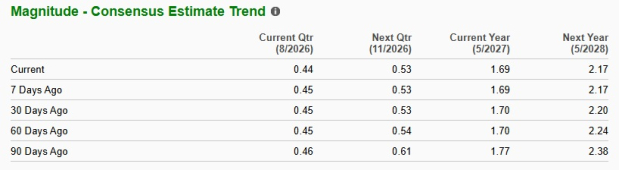
The Zacks Consensus Estimate for NIKE’s fiscal 2027 sales implies a year-over-year decline of 1%, while EPS indicates growth of 6.7%. The EPS estimate has moved down by a penny in the past 30 days.
NKE’s Estimate Revision Trend
Image Source: Zacks Investment Research
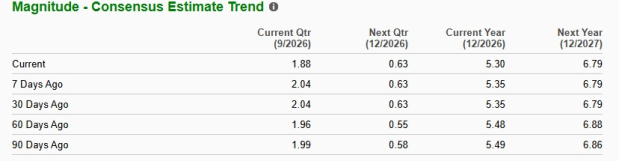
The Zacks Consensus Estimate for adidas’ 2026 sales and EPS suggests year-over-year growth of 10.8% and 25.6%, respectively. The EPS estimate has moved down 0.9% in the past 30 days.
ADDYY’s Estimate Revision Trend
Image Source: Zacks Investment Research
Price Performance & Valuation of NKE & ADDYY
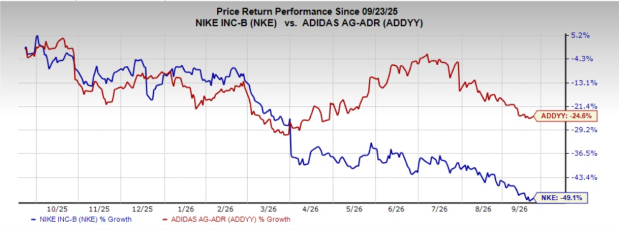
In the past year, NIKE shares have declined 49.1%, whereas adidas has lost 24.6%
Image Source: Zacks Investment Research
NIKE is trading at a forward price-to-sales (P/S) multiple of 1.15X, below its median of 2.70X in the last five years. adidas’ forward P/S multiple sits at 0.90X, below its median of 1.40X in the last five years.
Image Source: Zacks Investment Research
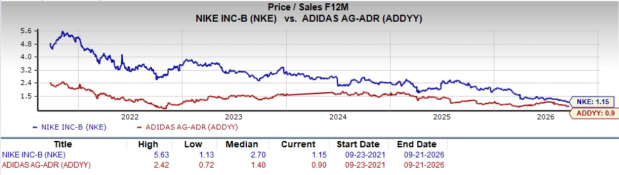
NIKE appears relatively expensive at first glance, with its forward P/S multiple remaining above adidas’. However, its valuation reflects investor expectations around the company’s ongoing transformation efforts. The brand is repositioning its product pipeline, distribution strategy and innovation focus to strengthen competitiveness and restore profitable growth. Continued progress in stabilizing sales, improving marketplace health and rebuilding margins could provide support for its valuation over time.
adidas’ forward P/S multiple, meanwhile, presents a relatively lower valuation, with the stock also trading below its historical median. This comes alongside improving brand momentum, strengthening performance categories and broad-based international demand. The combination of operating recovery and a lower sales multiple gives investors another valuation angle when comparing the two athletic-wear leaders.
NKE vs. ADDYY: Which Is the Better Bet Now?
adidas appears better positioned at present, supported by stronger operating momentum, healthier sales trends and a comparatively lower valuation. The company is benefiting from broad-based demand across key regions, strong direct-to-consumer growth and improving traction in performance categories such as running, football and training. Its forward P/S multiple also remains below NIKE’s, while consensus estimates point to stronger sales and earnings growth. These factors suggest that adidas currently offers a more favorable combination of growth momentum, improving profitability and valuation support.
NIKE, meanwhile, continues to carry substantial brand strength, market leadership in key performance categories and meaningful long-term recovery potential. However, weakness in Sportswear and Jordan Streetwear, softer NIKE Direct trends and pressure on near-term sales keep the investment case more dependent on successful turnaround execution. Although its valuation is well below its historical median, NIKE still trades at a premium to adidas on a forward P/S basis. Given adidas’ stronger earnings outlook, broader operating momentum and lower relative valuation, ADDYY appears to have the more compelling setup at this stage.
ADDYY currently has a Zacks Rank #3 (Hold), whereas NKE carries a Zacks Rank #4 (Sell).
You can see the complete list of today’s Zacks #1 Rank (Strong Buy) stocks here.
Radical New Technology Could Hand Investors Huge Gains
Quantum Computing is the next technological revolution, and it could be even more advanced than AI.
While some believed the technology was years away, it is already present and moving fast. Large hyperscalers, such as Microsoft, Google, Amazon, Oracle, and even Meta and Tesla, are scrambling to integrate quantum computing into their infrastructure.
Senior Stock Strategist Kevin Cook reveals 7 carefully selected stocks poised to dominate the quantum computing landscape in his report, Beyond AI: The Quantum Leap in Computing Power .
Kevin was among the early experts who recognized NVIDIA's enormous potential back in 2016. Now, he has keyed in on what could be "the next big thing" in quantum computing supremacy. Today, you have a rare chance to position your portfolio at the forefront of this opportunity.
See Top Quantum Stocks Now >>Want the latest recommendations from Zacks Investment Research? Today, you can download 7 Best Stocks for the Next 30 Days. Click to get this free report
NIKE, Inc. (NKE): Free Stock Analysis Report
Adidas AG (ADDYY): Free Stock Analysis Report
This article originally published on Zacks Investment Research (zacks.com).