


Pagaya Technologies PGY is steadily broadening its funding base, which could make its capital model more resilient. In second-quarter 2026, it raised $3.7 billion across six asset-backed securities (ABS) transactions and added 11 new institutional investors, taking the total to 174. At the same time, the company is expanding committed-capital structures outside traditional securitization markets, improving funding flexibility and visibility.
Recent transactions reinforce this shift. Pagaya secured up to $700 million in auto funding from Neuberger Specialty Finance, a nearly $700-million Variable Funding Note facility with ATLAS SP Partners and a $460-million revolving personal-loan facility expected to support about $850 million in capital deployment. It also expanded its ALPF receivables facility to $100 million. Together, these arrangements broaden funding flexibility and reduce reliance on the timing of public securitizations.
That flexibility could become increasingly important as Pagaya scales across personal loans, auto and point-of-sale financing. Its auto business reached an annualized network-volume run rate of $4.8 billion in the second quarter, while total quarterly network volume was $3.5 billion. Management has indicated that a growing portion of funding now comes through non-prefunded structures, including forward-flow and revolving arrangements. A broader mix of committed funding sources could help Pagaya better match different asset classes with different pools of institutional capital and reduce execution risk during periods when securitization spreads widen or investor demand weakens.
However, the company is not moving away from ABS in any meaningful sense yet. A few days ago, Pagaya completed a $600-million AAA-rated personal-loan securitization, lifting 2026 ABS issuance to more than $9 billion, including more than $6 billion tied to personal loans. The transaction drew 47 investors, including three new participants, underscoring continued demand for Pagaya-backed assets. Importantly, some of the newer funding structures are designed to bridge loans into eventual securitizations, meaning they can support the ABS model rather than substitute for it.
Hence, Pagaya appears to be building a more diversified funding architecture rather than replacing securitization. Forward-flow agreements, revolving facilities and warehouse-style structures should improve capital availability and reduce funding concentration risk, which is constructive for growth and execution. Still, record ABS issuance shows that securitization remains a core funding engine.
Comparing Pagaya’s Business Model With Peers
Like PGY, Upstart Holdings, Inc. UPST is an artificial intelligence (AI)-based lending platform that aspires to become capital-light but often holds loans on its balance sheet temporarily. The company’s core business model involves finding financing for loans after its network of bank and institutional partners originates them.
Upstart partner banks can finance the loan by keeping it on their balance sheet. The bank can sell the whole loan on Upstart’s platform or use forward flow agreements from institutions that commit to buying a specific volume or type of loan originated on the Upstart platform in the future.
Upstart also uses securitization, wherein pools of loans are bundled together and sold as ABS to institutional investors. However, the firm frequently reverts to a balance-sheet-heavy model, especially in tight liquidity markets, making it more volatile and exposed to macro cycles.
Another close competitor of PGY is LendingTree TREE. But unlike PGY, LendingTree is a marketplace platform, not a lender. It matches consumers with financial product providers like mortgages, personal loans, credit cards and insurance.
LendingTree does not underwrite, originate or hold loans. Hence, its balance sheet is not credit-heavy. TREE’s balance sheet is detached from revenue generation. The company is primarily structured to support a fee-based digital marketplace, not balance sheet lending.
PGY’s Price Performance, Valuation & Estimate Analysis
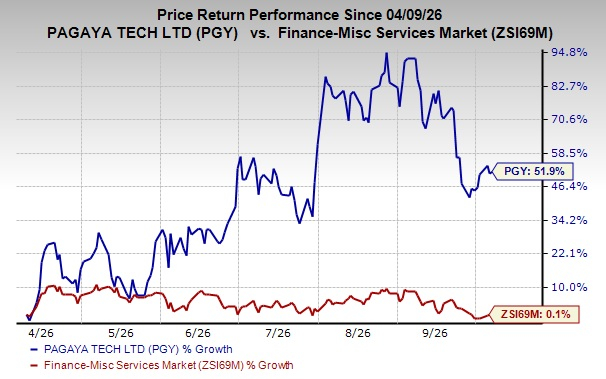
Over the past six months, Pagaya shares have gained 51.9%, outperforming the industry’s growth.
Image Source: Zacks Investment Research
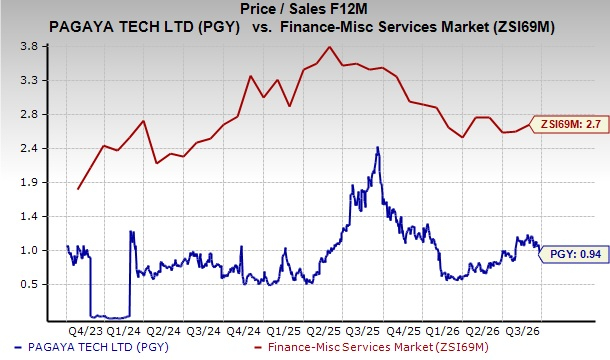
The stock is currently trading at a 12-month forward price-to-sales of 0.94X, which is below the industry average of 2.70X.
Image Source: Zacks Investment Research
Over the past seven days, the Zacks Consensus Estimate for PGY’s 2026 and 2027 earnings has been unchanged at $3.68 and $4.13, respectively. The consensus estimate indicates 11.2% and 12.2% year-over-year growth for 2026 and 2027, respectively.
Image Source: Zacks Investment Research

Currently, Pagaya carries a Zacks Rank #4 (Sell).
You can see the complete list of today’s Zacks #1 Rank (Strong Buy) stocks here.
Beyond Nvidia: AI's Second Wave Is Here
The AI revolution has already minted millionaires. But the stocks everyone knows about aren't likely to keep delivering the biggest profits. AI’s second wave is moving from infrastructure to implementation and these companies are at the forefront of this transition, positioned to become what Amazon and Google were to the internet era.
See Stocks Now >>Want the latest recommendations from Zacks Investment Research? Today, you can download 7 Best Stocks for the Next 30 Days. Click to get this free report
Pagaya Technologies Ltd. (PGY): Free Stock Analysis Report
LendingTree, Inc. (TREE): Free Stock Analysis Report
Upstart Holdings, Inc. (UPST): Free Stock Analysis Report
This article originally published on Zacks Investment Research (zacks.com).