


AI chip stocks have been on a tear. Nvidia Corporation (NVDA), Advanced Micro Devices (AMD), and Broadcom (AVGO) have all ridden the artificial intelligence wave to staggering valuations. But this month, a new name burst onto the scene and stole the spotlight. Cerebras Systems (CBRS), the company behind the world’s largest computer chip, went public on May 14 in the biggest IPO of 2026. The news came on after S&P Dow Jones Indices said it would fast-track the stock into eligible indices. CBRS shares opened well above the offer price as investors rushed to get in on the action.
With an S&P Index inclusion now set for May 25, Cerebras is suddenly moving from a hot IPO to a must-watch AI stock. Here’s what that could mean for investors.
Don’t Miss a Day: From crude oil to coffee, sign up free for Barchart’s best-in-class commodity analysis.
Cerebras Redefines AI Chips With Massive Wafer-Scale Architecture
Cerebras builds a chip the size of a dinner plate. It packs four trillion transistors and 900,000 AI cores onto a single wafer. The company says its chip runs AI workloads 15 times faster than the competition. That kind of speed has won over OpenAI and Amazon (AMZN) as customers. Cerebras isn’t just another Nvidia wannabe. It’s betting on a fundamentally different architecture to win the AI inference race.
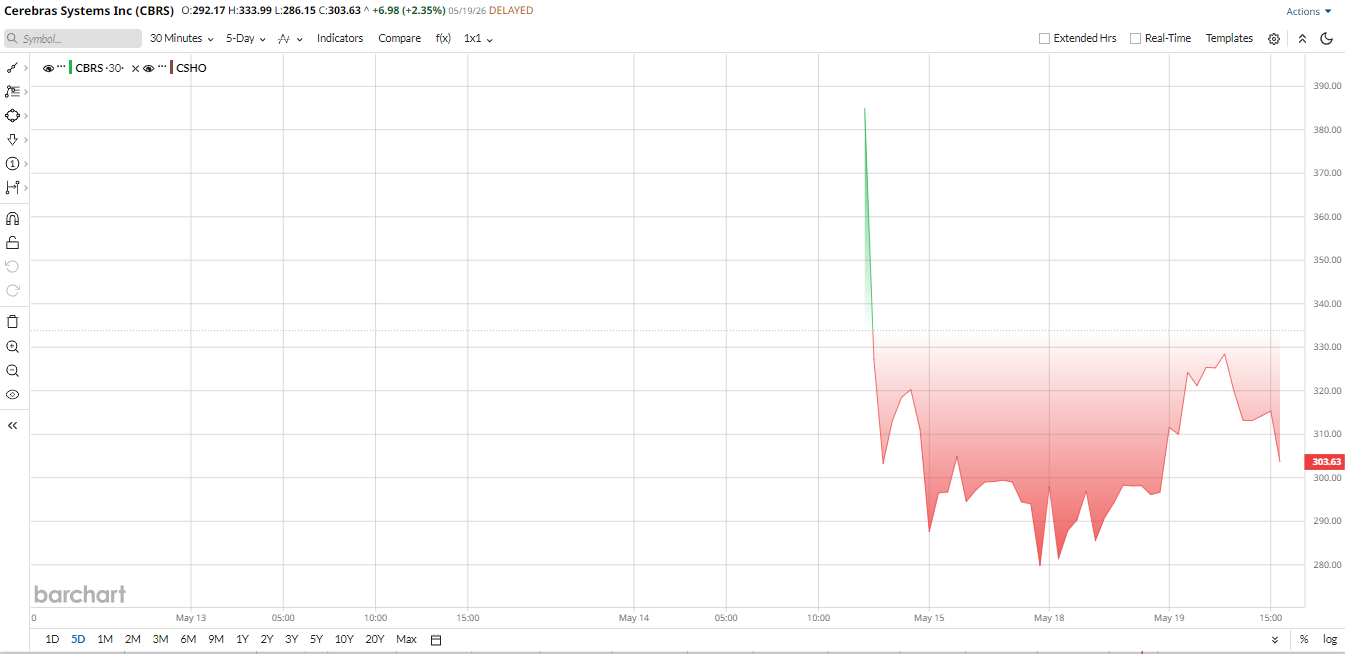
Cerebras priced its IPO at $185 a share. It opened at $350 and hit an intraday high of $386.34. The stock closed its first day at $311.07, giving the company a market cap of roughly $69 billion. Since then, shares have pulled back to around $300 before bouncing on the index news.
Cerebras trades at roughly 130 times trailing sales of $510 million. The semiconductor sector median price-to-sales ratio sits around 4. That’s a staggering premium. But bulls point to the $24.6 billion backlog, which includes a $200 billion compute deal with OpenAI. On a forward basis, revenue is expected to roughly double in 2026. Investors are not paying for what Cerebras earned last year. They are paying for what it might earn in 2028 and beyond.
 www.barchart.com
 What the Index News Means
S&P Dow Jones Indices approved Cerebras for early entry into its indexes, effective May 25. Passive funds and ETFs that track the S&P 500 Index ($SPX) will be forced to buy the stock. This creates automatic demand regardless of valuation.
The market liked the news, and shares jumped more than 7% while other AI chip stocks traded lower on Tuesday, May 19. Inclusion also brings legitimacy. Index membership signals that Cerebras is no longer a speculative upstart. It’s a recognized player in the semiconductor industry.
Cerebras Growth Accelerates on Strong Revenue
Cerebras hasn’t reported a full quarter as a public company yet. But its S-1 filing gives us a clear picture of the business. Revenue for fiscal year 2025 hit $510 million, up 76% from $290 million the year before. That’s the kind of growth that gets Wall Street excited.
Revenue comes from two main buckets. Hardware sales of its wafer-scale systems make up the bulk. Cloud services are a smaller but rapidly growing piece. The company’s own data centers now sell AI compute directly to developers. That recurring revenue stream could be a game changer.
Net income flipped to positive territory. Cerebras posted $237.8 million in net profit compared to a loss of $481.6 million in 2024. However, a big chunk of that profit came from a one-time accounting gain tied to a restructured deal with G42 in Abu Dhabi.
Free cash flow was negative as the company poured money into data center infrastructure. Cash and equivalents stood at $701.7 million at year-end 2025. Although a decent cushion, Cerebras expects to burn roughly $3 billion across 2026 and 2027 as it scales to meet the OpenAI contract.
CEO Andrew Feldman put it bluntly in an interview. “We built a chip the size of a dinner plate. It’s 58 times larger than any chip previously built,” he said. “In AI, bigger chips are faster.” That’s the pitch. Execution is now the test.
For 2026, management guided to revenue of $900 million to $1 billion. That’s roughly double the 2025 figure. Analysts expect full-year revenue around $950 million and an adjusted loss per share as the company invests aggressively in growth.
What Cerebras Is Doing in 2026
Cerebras is moving fast. The company recently launched its first AI model running entirely on its own chips in partnership with OpenAI. Cathie Wood of ARK Innovation ETF (ARKK) bought $46 million worth of shares within days of the IPO. Cerebras is also lobbying Washington to tighten chip restrictions on China while simultaneously pushing the Trump administration to open Chinese markets for its products.
Meanwhile, the company rejected a pre-IPO acquisition offer from Arm Holdings (ARM) and SoftBank (SFTBY). Cerebras wants to stand alone. That takes guts, and it tells you management believes the best is yet to come.
The Bottom Line
Wall Street is still warming up to Cerebras. Because the stock is so new, formal analyst coverage is non-existent on Barchart.
But in my opinion, Cerebras is still a young stock, but its huge chip, strong demand, and S&P 500 Index entry make it one to watch. The valuation is rich, yet the growth story is real. Investors now need to see solid execution.
On the date of publication, Nauman Khan did not have (either directly or indirectly) positions in any of the securities mentioned in this article. All information and data in this article is solely for informational purposes. For more information please view the Barchart Disclosure Policy here.
More news from Barchart
As AI Infrastructure Heats Up, Stay on the Sidelines With CoreWeave Stock Eco Wave Power Stock Got a Major Nvidia AI Catalyst. Brace for More Volatility Ahead. Cerebras Just Got Fast-Tracked Into the S&P 500. Here’s What It Means for Investors PayPal Stock Just Got a Vote of Confidence From Michael Burry. That Doesn’t Change Its Broader, Lumpy Trajectory.