


In today’s commentary about unusual options activity, I’m going to continue where I left off yesterday, discussing possible options strategies for ETFs from Wednesday’s trading.
Yesterday, I recommended three long-term ETFs that hit new 52-week highs. Today, I’ve got three other ETFs that are worth owning for the long haul. Only today, I’ll be suggesting multi-leg options strategies for each of them.
Can’t Get Enough Options?: Join the list for Barchart’s daily unusual options report, delivered free.
The three ETFs in question are the Invesco QQQ Trust (QQQ), iShares Russell 2000 ETF (IWM), and the iShares MSCI Emerging Markets ETF (EEM).
All three have high 30-day average options volume: 6.03 million, 1.65 million, and 213,344, respectively.
In yesterday’s trading, IWM had the two top Vol/OI (volume-to-open-interest) ratios at 68.14 and 63.08, respectively. The small-cap ETF had a third in the top 10 at 26.36, while QQQ had one in the 10th spot at 25.45. The QQQ Dec. 18 $660 put also had the top volume of ETF options expiring in seven days or more. EEM had the 11th highest Vol/OI ratio at 23.05, just outside the top 10. I’ve got plenty to work with.
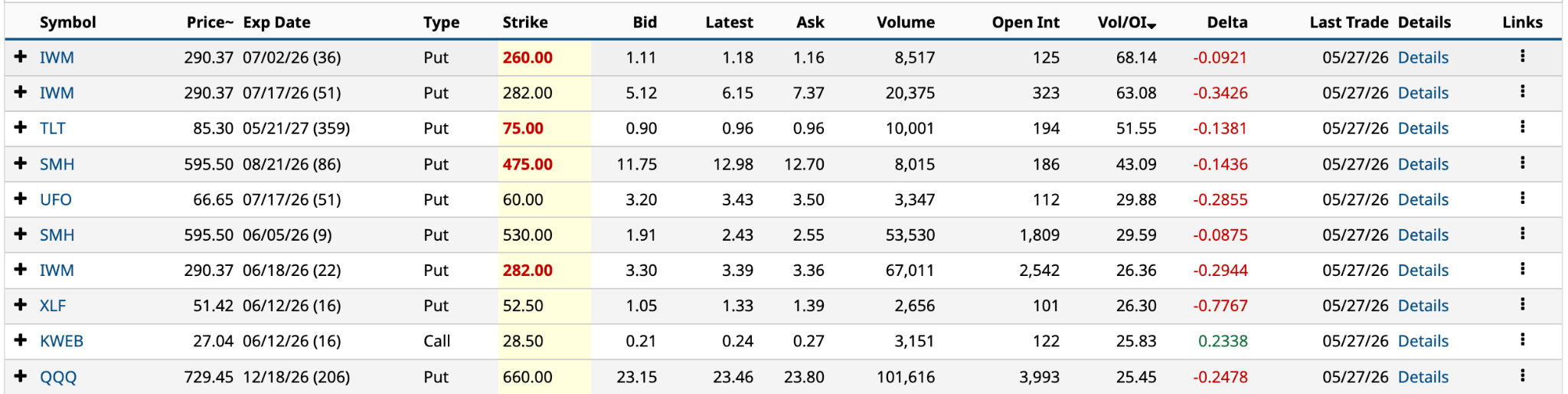
Based on these and other unusually active options for QQQ, IWM, and EEM, I’ll recommend three options strategies to use following yesterday’s action.
Invesco QQQ Trust - Bull Call Spread

The information above is from trading late Thursday morning as I write this. In yesterday’s trading, the $729 call had a Vol/OI ratio of 2.86, while the $734 call’s was 3.58. Not significantly unusual but within the criteria.
The Bull Call Spread is a bullish bet where you expect QQQ to increase in value over the next week. It comes with a limited profit and loss. It involves buying one call and selling another call at a higher strike price. Both have the same expiration date.
In this example, the $729 long call is ITM (in-the-money) while the $734 short call is OTM (out-of-the-money). The net debit or cost of the trade is $2.81 [$9.38 ask price - $6.57 bid price]. That’s also the maximum loss. The maximum profit is $2.19 [$734 short call - $729 long call - $2.81 net debit].
The attractiveness of this bet is that the $731.81 breakeven point is virtually on top of the current share price, so it has a better-than-50% chance of making money. While I like to see a risk/reward ratio of less than 1, it’s still reasonable, given that the $2.81 outlay is just 0.4% of QQQ’s share price.
The maximum profit of 77.94% [$2.19 maximum profit / $2.81 maximum loss] on an annualized basis is 4,064% [77.94% * 365 / 7].
iShares Russell 2000 ETF - Bear Put Spread

In yesterday’s trading, the $282 put had a Vol/OI ratio of 63.08, the second-highest, as you can see from the top 10 in the introduction. I would have liked to use the $260 put as the short put, but its expiration date didn’t match, so I’ve gone with the $264 put, which had a Vol/OI ratio of 1.60.
The Bear Put Spread is a bearish bet in which you expect IWM to decline over the next 50 days. It also comes with a limited profit and loss. It involves buying one put and selling another put at a lower strike price. Both have the same expiration date.
In this example, the $282 long put is OTM, and the $264 short put is deep OTM (out of the money). The net debit and maximum loss of the trade is $3.76 [$5.97 ask price - $2.21 bid price]. The maximum profit is $14.24 [$282 long put - $264 short put - $2.21 net debit].
The attractiveness of this bet is that the $278.24 breakeven point is just 3.88% below the $289.48 share price. With an expected move of 5.59%, there is a reasonable chance of making money. To maximize profit, the share price must be $264 at expiration. That’s unlikely.
However, the risk/reward of 0.26 to 1 makes the bet an easy one to make when you consider how volatile the small-cap index can be. The annualized return for the bear put spread isn’t quite as high as the bull call spread from earlier, but it’s still high at 2,765% [378.72% * 365 / 50].
iShares MSCI Emerging Markets ETF - Short Strangle

EEM had five unusually active options yesterday. While I’d like to use the June 5 $68 put because it had the highest Vol/OI ratio, I’ve already used this DTE (days to expiration), so I’m going to use the June 17/2027 $75 call along with the June 17/2027 $70 put for a Short Strangle.
The short strangle strategy is used when you believe the share price will remain in a tight range until expiration. The longer duration of the two options makes this last strategy the riskiest of the three.
The strategy involves selling the June 17/2027 $75 call and selling the June 17/2027 $70 put for a net credit of $10.55. That’s 15.4% of EEM’s $68.39 share price. That’s the good news.
The bad news is that the share price at expiration in 386 days must be between $70 and $75 for you to generate the maximum profit of $10.55. If the DTE were in 30-45 days, it would be a slam dunk. The year-plus duration means both options possess considerable extrinsic value (time value and volatility pricing), which could make the next year very choppy.
Forget maximum profit here and focus on the trade being successful. For this to happen, the share price at expiration needs to be between the upside breakeven of $85.55 and the downside breakeven of $59.45. That’s 25.1% on the upside and 13.1% on the downside.
The expected move for EEM is 19.1% in either direction over the next 385 days. As a result, the bigger concern is the downside. Up nearly 50% over the past year, EEM now trades within pennies of its all-time high.
If you think the emerging markets bet is over for now, this could be profitable, but the duration makes it tough to follow through.
On the date of publication, Will Ashworth did not have (either directly or indirectly) positions in any of the securities mentioned in this article. All information and data in this article is solely for informational purposes. For more information please view the Barchart Disclosure Policy here.
More news from Barchart
Unusual Options Activity in Key ETFs Unveils 3 Trade Ideas Here Amazon Max Pain Points to a Price of $235 by June 18th Investors Love Lam Research Stock - Shorting OTM Puts in Huge, Unusual Volume How Traders Can Play Broadcom Stock’s Bull Run With Less Upfront Money