


Shares of electronic design automation Cadence Design Systems (CDNS) found themselves back in the spotlight on June 8 after the company announced an expanded partnership with Intel (INTW) Foundry that could help shape the next generation of chip technology. The new multi-year collaboration centers on Design Technology Co-Optimization (DTCO) for Intel’s upcoming process nodes, beginning with Intel 14A, and brings together Cadence’s agentic AI-powered EDA and Design IP solutions with Intel’s advanced manufacturing expertise.
The partnership is focused on optimizing tools, design flows, and methodologies to deliver industry-leading performance, power, and area (PPA) improvements. As part of the effort, Cadence and Intel will work closely to refine Intel 14A and deliver production-ready process design kits (PDKs). The collaboration will also tap into Cadence’s agentic AI-driven workflows and core product portfolio to accelerate time-to-market while reducing design complexity and risk.
More Top Stocks Daily: Go behind Wall Street’s hottest headlines with Barchart’s Active Investor newsletter.
Cadence occupies a unique position in the semiconductor ecosystem as one of only a handful of companies that provide the sophisticated software chip designers rely on to create next-generation semiconductors. As chip architectures become increasingly complex and the number of chipmakers continues to expand, demand for these tools has only grown stronger. Investors clearly welcomed the latest Intel partnership, sending Cadence shares up 4.8% on June 8.
With Wall Street growing increasingly optimistic about the opportunities this collaboration could unlock, it’s worth taking a closer look at what could be next for Cadence stock.
About Cadence Design Stock
Cadence has established itself as a key player in the technology ecosystem, using artificial intelligence (AI), digital twins, and advanced computational software to help engineers design everything from semiconductor chips to complex system-level products. Its solutions are widely used by leading semiconductor and technology companies developing next-generation innovations across high-growth markets such as hyperscale computing, mobile communications, automotive, aerospace, industrial automation, life sciences, and robotics.
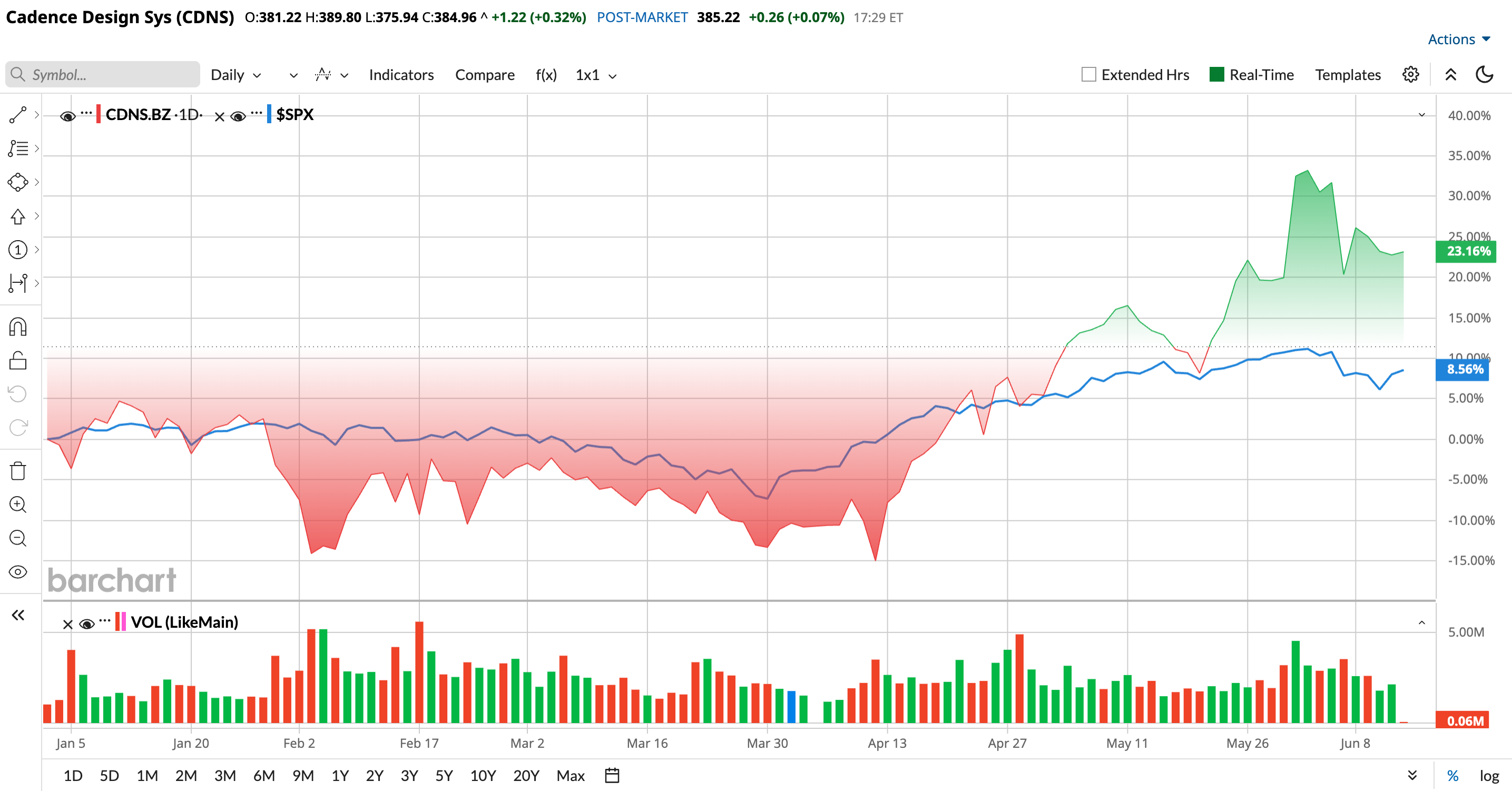
Sporting a market capitalization of approximately $105.84 billion, Cadence has delivered impressive returns while continuing to ride the wave of AI and semiconductor demand. The stock has gained 25% over the past 12 months, slightly outperforming the S&P 500 Index’s ($SPX) 22.9% advance. In 2026, however, Cadence has pulled way ahead of the broader market, with shares soaring 23.16% year-to-date (YTD) compared to the index’s 8.56% gain. The rally pushed the stock to a record high of $416.69 on June 2, and while shares have eased 7.62% from that peak, they remain near historic highs after a remarkable run.
 www.barchart.com
 A Look Inside Cadence’s Q1 Earnings Report
Cadence kicked off fiscal 2026 with a standout first quarter published on April 27, delivering results that comfortably exceeded Wall Street’s expectations on both revenue and earnings. Revenue climbed 19% year-over-year (YOY) to $1.47 billion from $1.24 billion in the prior-year quarter, topping analysts’ forecasts of $1.45 billion. Profitability was equally impressive, with non-GAAP earnings per share rising 25% YOY to $1.96, ahead of the consensus estimate of $1.89.
The company’s core Electronic Design Automation (EDA) business remained a major growth engine, with revenue increasing 18% from a year ago. Growth was fueled by rising adoption of Cadence’s AI-driven design solutions and continued strength in advanced digital implementation, custom design, and verification products among leading AI infrastructure and semiconductor customers.
Meanwhile, the hardware segment delivered a record quarter, benefiting from robust demand tied to AI and high-performance computing applications, as well as expanding adoption across the automotive and robotics industries. Cadence’s IP business also turned in a strong performance, posting 22% YOY growth.
Demand remained particularly healthy from AI infrastructure, high-performance computing, and automotive customers, while the company continued to gain traction with its Star IP portfolio, including HBM, LPDDR, PCIe, SerDes, and foundation IP solutions. The momentum extended to the System Design and Analysis segment, where revenue rose 18% YOY.
Following the completion of its Hexagon D&E acquisition, Cadence added industry-leading structural and multibody dynamics technologies to its portfolio, strengthening its position to capitalize on the emerging Physical AI opportunity. Beyond revenue growth, Cadence continued to demonstrate impressive operating leverage.
Non-GAAP operating margin expanded to 44.7%, up from 41.7% in the year-ago quarter. And, the company exited the quarter with a substantial backlog of $8 billion, while remaining performance obligations expected to be recognized as revenue over the next 12 months totaled $4 billion, providing strong visibility into future growth.
Reflecting both robust design activity and solid execution across the business, management raised its full-year 2026 outlook. Cadence now expects revenue in the range of $6.125 billion to $6.225 billion, representing approximately 17% YOY growth. Additionally, the company projects non-GAAP earnings per share of $7.85 to $7.95 and anticipates a non-GAAP operating margin between 43.5% and 44.5%, underscoring confidence in its ability to sustain strong growth and profitability throughout the year.
What Do Analysts Think About Cadence Stock?
Cadence’s expanded partnership with Intel Foundry is giving Wall Street a reason to be optimistic about the company’s long-term growth prospects. For instance, Stifel analyst Ruben Roy described the agreement, which is aimed at accelerating Intel’s 14A process optimization, as an “incremental positive” for the electronic design automation leader and a sign of its growing importance in advanced chip development.
Roy noted that the collaboration reinforces the strategic value of Cadence’s agentic AI-driven design tools and Design IP portfolio in leading-edge semiconductor workflows. The deal broadens Cadence’s reach within Intel Foundry, which could evolve into a more meaningful customer acquisition channel over time. Beyond that, the partnership may help Cadence secure a larger role in future Intel design programs, an area where the company remains underrepresented despite its strong technology portfolio.
Further, the agreement enhances Cadence’s long-term revenue visibility, adding to an already expanding backlog and strengthening confidence in the durability of its growth trajectory. Reflecting that optimism, Roy maintained his “Buy” rating on the stock and raised his price target to $432 from $395 following the announcement.
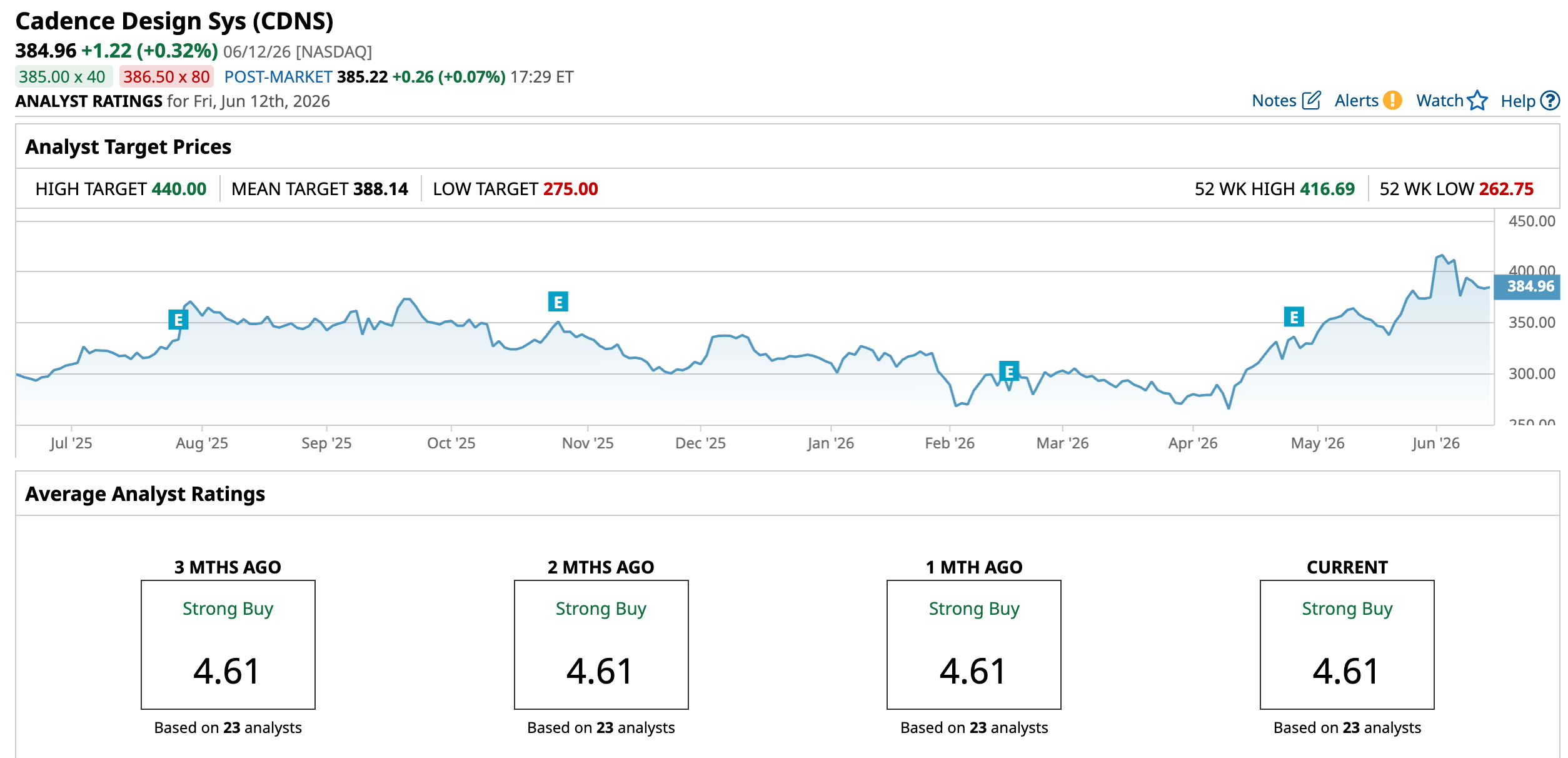
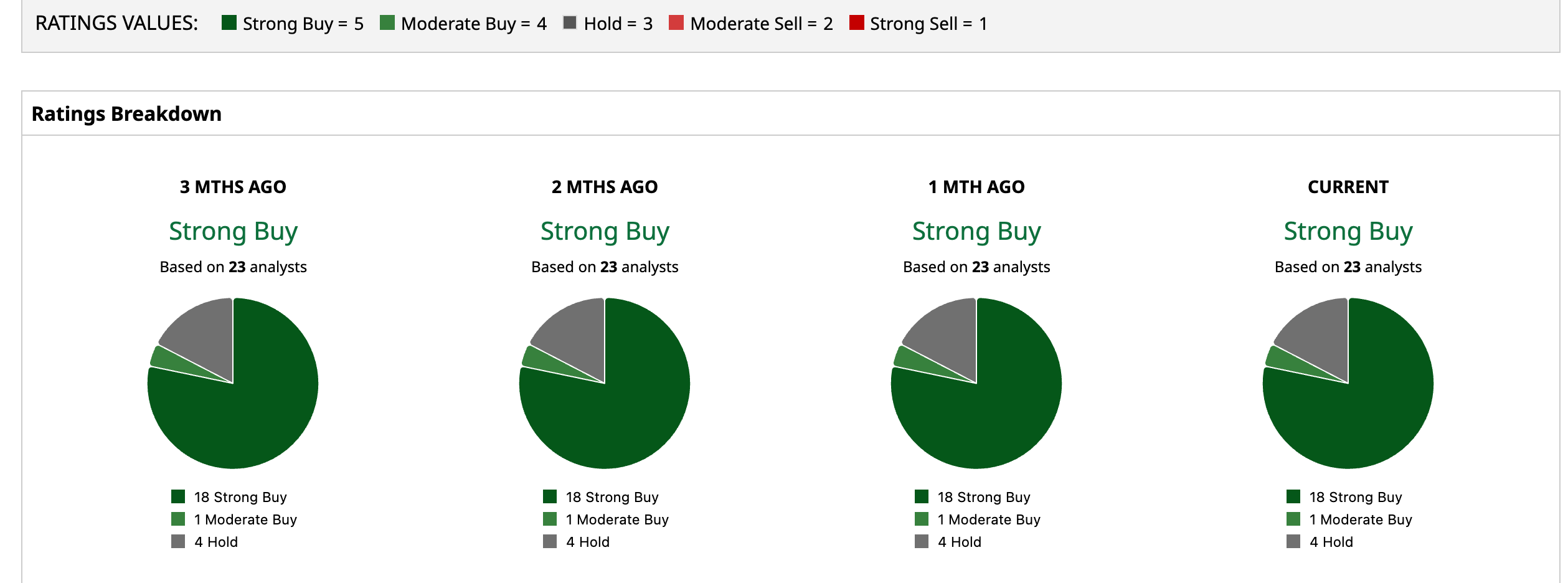
Overall, Wall Street’s confidence in Cadence remains firmly intact. The stock currently carries a consensus “Strong Buy” rating, with 18 of 23 analysts recommending a “Strong Buy,” one assigning a “Moderate Buy,” and only four opting to remain on the sidelines with a “Hold” rating. While the average price target of $388.14 points to limited near-term upside, the most bullish target on the Street stands at $440, implying that shares could still climb as much as 14.3% from current levels.
 www.barchart.com
  www.barchart.com
 On the date of publication, Anushka Mukherji did not have (either directly or indirectly) positions in any of the securities mentioned in this article. All information and data in this article is solely for informational purposes. For more information please view the Barchart Disclosure Policy here.
More news from Barchart
Why Wall Street Loves Cadence Design Systems Stock Here Corning’s Amazon Deal Validates the AI Optics Boom. What That Means for GLW Stock. A Major Short Squeeze Could Be Brewing in Cracker Barrel Stock Ignore the Financial Influencers Pushing a ‘Trifecta’ ETF Strategy. Manage Risk and Volatility with 1 of These Savvy Funds Instead.